Strong GDP Growth Failed to Cushion the Tech Stock Selloff



U.S. GDP grew faster than expected, but technology stocks fell sharply as investors weighed earnings and the risks of the AI transition. On Diet TBPN, hosts John Coogan and Jordi Hays treated those concerns as part of the day’s market uncertainty, while noting that Alphabet’s advertising, cloud, chips and AI businesses could still give it several ways to benefit from AI.
Strong GDP did not soften the market’s judgment on tech
U.S. GDP grew at a 3.4% annual rate over the summer, above analysts’ 3.1% expectation. Consumer spending and business investment drove the expansion, making the report the last major accounting of the economy before the midterm elections. But the number landed against a sharp selloff: the Nasdaq was down about 3.34%, and the Dow 1.13%.
The contrast sharpened a political question: would voters respond more to growth figures or to falling stock prices? One host suggested that voters care more about “vibes” than either measure in isolation, and that the market’s mood was plainly poor. John Coogan said that hearing most people sound fearful had started to make him feel “a little greedy.”
Earnings helped explain the pressure. Google had suffered what the hosts called its worst day on record after investors confronted the possibility that the company’s transition to AI could force painful tradeoffs in a business long known for growth and profits. One host described a familiar pattern in technology: the first few years of a major transition can look “peachy,” before its effects become visible in earnings. Even high-growth companies, he said, have inertia.
That concern did not erase the bull case for Alphabet. The hosts pointed to its advertising business, cloud computing, in-house chips and frontier-model work as sources of exposure across the AI stack. One described it as the closest thing in tech to a “one-stop AI shop,” while wondering how the company might be valued if its own models began producing a substantial revenue ramp. The argument was not that the transition would be painless, but that Alphabet had several ways to benefit even if expectations for AI cooled.
The day’s losses were broad. On the show’s ticker, Nvidia was down nearly 6%, Oracle 7%, and Amazon and Microsoft about 3% and 2%, respectively. Berkshire Hathaway, by contrast, was described as one of the few stocks in the green. The hosts returned to that contrast throughout the broadcast: in a day of anxiety about growth, earnings and technology, Berkshire appeared comparatively steady.
The Binance breach tested the limits of a reserve fund
Binance faced a reported $6.3 billion crypto heist after hackers accessed digital wallets through, among other breaches, a Binance engineer’s laptop. The scale raised an immediate operational question: how could one compromised engineer put such a large amount at risk? One host contrasted that with traditional bank wires, which often require multiple checks and approvals, and asked why moving crypto assets would not similarly require several people to sign off.
Binance had established a reserve called SAFU—the Secure Asset Fund for Users—for incidents of this kind. The fund was said to hold roughly $1 billion, but the reported loss far exceeded that reserve. Stablecoin issuers Tether and Circle, along with other crypto firms, had frozen about $3 billion, the hosts said, leaving roughly $3.3 billion under the hackers’ control. They also raised the possibility that some assets had been borrowed against and moved into more liquid forms before being frozen. The situation was still developing.
The reported attribution to North Korea’s TraderTraitor hacking group widened the stakes beyond Binance. One host noted that $3 billion would amount to a substantial share of North Korea’s economy if it reached the country. The hosts also questioned whether an emergency fund tied to crypto assets could lose value at the same time as the broader crypto market fell. Holding the reserve in U.S. dollars or a more diversified basket might reduce that exposure, they suggested, though they acknowledged the tradeoff: crypto assets could appreciate when the market rises.
The market reaction seemed comparatively muted. Tyler Cosgrove, appearing as Greg Abel, recalled that after the Mt. Gox hack in 2014, Bitcoin fell about 25% to 27% over the following two weeks. This time, the hosts put Bitcoin’s decline at roughly 4% over five days. They suggested that some holders might be more committed to self-custody and less concerned about centralized exchanges.
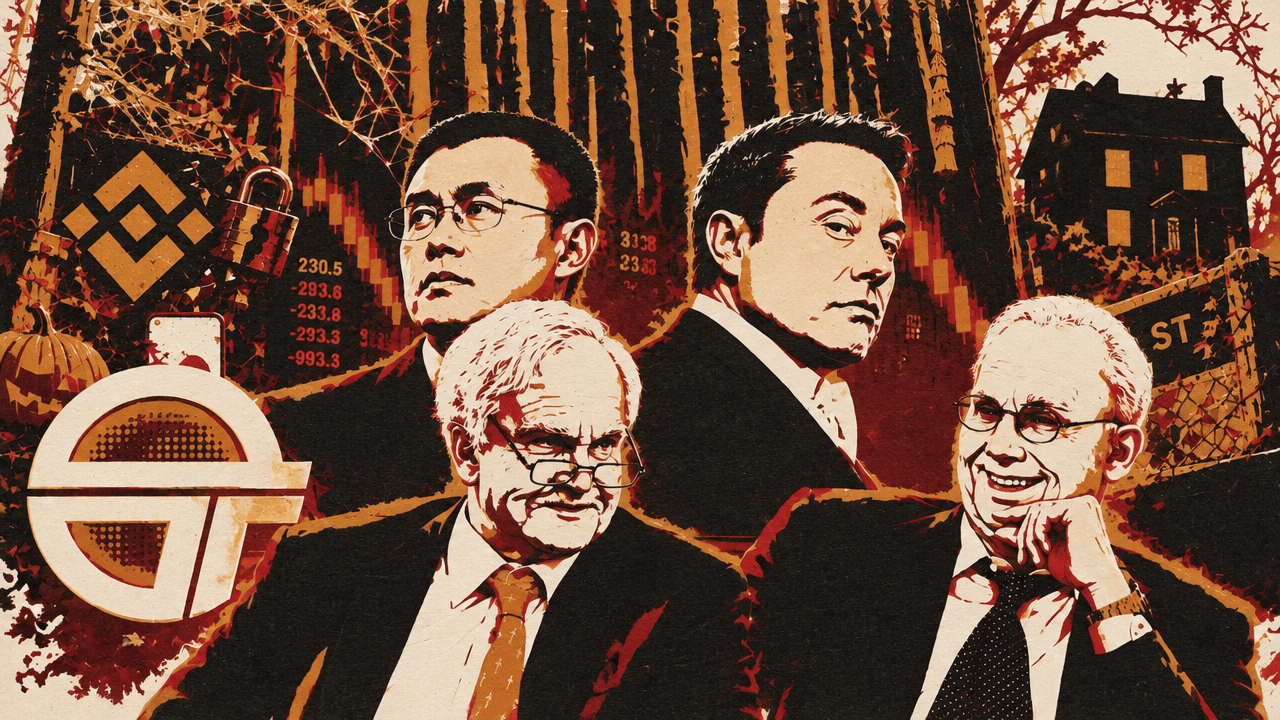
The exchange’s response also unfolded publicly. The hosts discussed an X exchange involving Binance founder CZ and Elon Musk, after Musk reacted to the hack and CZ asked him to show support, citing Binance’s SpaceX shares. The hosts read CZ’s reference to those shares partly as a warning that he could sell them, while noting Binance’s statement that its revenue could cover the losses without such a sale. A post shown on screen quoted CZ saying the loss, after frozen assets, was around $1 billion and represented 0.69% of Binance’s assets under custody.
Binance was not the only platform with a security incident. A breach of a UK-based third-party vendor exposed the wallets of about 700 Polymarket users, with approximately $2.7 million stolen, the hosts said. Polymarket paused trading while it investigated, then resumed on its flagship international platform. Even a short pause could frustrate users who expected to sell or act while a market was resolving. The hosts described the broader challenge as particularly acute for digital financial platforms, where users may have little recourse after a loss.
Intel’s fall carried more than an earnings disappointment
Intel’s stock fell sharply after weaker-than-expected earnings that the company blamed on softness in the PC market. The chart shown during the discussion recorded a close of $72, down 21.81% for the session; the hosts later cited a larger intraday decline.
The selloff reversed much of the optimism that had lifted the stock over the previous year. The hosts traced that optimism to the U.S. government’s investment and expectations that hyperscalers would begin using Intel’s fabs. Intel was still valued at about $336 billion, but its share price had fallen from a peak near $140 to around $63 in the discussion, while remaining above the roughly $43 level cited for March.
The reaction to the earnings call added to the unease. The hosts read a post from Nick Dorsey saying Intel CEO Lip-Bu Tan had sounded lost, and a post from Jim Cramer saying he was “actually furious” about the company. But the criticism was not simply schadenfreude: one host stressed that people wanted Intel to succeed. The company was losing money, he said, and Tan had substantial work ahead.
The mansion’s lasting feature was a room built for candy
Minecraft creator Markus Persson, known as Notch, bought a Beverly Hills house in 2014 for a reported $70 million. John Coogan said Persson had outbid Jay-Z and Beyoncé for the property, which set a record at the time. The house later lost that distinction as developers built larger and more expensive homes; the hosts said they had seen properties offered for $200 million and one seeking as much as half a billion.
Coogan had visited the house and described it as built for entertaining: it had a music studio, a bar, a large garage with glass that showed off the cars, a home gym and a wine cellar. Its most memorable feature was a candy room. Photos shown during the segment included a wall of clear dispensers filled with colorful sweets. The dispensers fed into tubes, Coogan explained, so guests could make their own bags without necessarily seeing the brands.
The house prompted a disagreement about what makes a property desirable. Jordi Hays called it S-tier, then said the land mattered more than the building and that he would tear the house down and build something more modest in its footprint. Coogan challenged the logic: if it needed to be torn down, how could the house itself rank so highly? The exchange separated the value of the site from the value of the home, without settling which mattered more.
AI agents can act, but everyday habits still set the bar
A post by Phillip Jackson offered an example of an AI agent taking legal action. Jackson said he had hired Muse to sue someone on his behalf; the other party offered a settlement within 20 minutes of being served, and paid within ten days, including additional compensation for recovery expenses. Jackson said Muse filed a motion to dismiss, which the court accepted. The example showed an agent being used in a dispute that reached a practical result, not just to generate text.
That account sat beside a less dramatic measure of adoption. Discussing DoorDash’s earnings call, Hays said the company had received only several hundred orders in total from personal agents such as Muse. DoorDash, he argued, was right to make its service accessible through an API and command-line interface rather than resist the technology. But a few hundred orders did not yet amount to widespread demand.
The limitation might be less about whether agents can place an order than whether people need them to. Ordering food is already easy, Coogan said, and customers are habitual. Someone could use an agent regularly for other tasks and still prefer to order DoorDash themselves. Hays suggested that agents might become more useful when they learn a person’s ordering patterns, rather than being asked to handle a single routine transaction.
Reddit cannot count on Google to send readers back
Reddit’s earnings discussion exposed a consequence of AI-mediated search. CEO Steve Huffman said Google was crawling Reddit as much as ever, but that Google’s AI mode did not drive traffic to Reddit—or, as he understood it, to other sites either. People still wanted Reddit, Huffman said, but Google was no longer sending them there as it once had.
Instead of clicking a search result and encountering a Reddit discussion and its ads, users could get an answer directly in Google’s AI mode. Reddit, Huffman said, was not counting on that traffic returning: “We don’t control Google. We only control Reddit.” The hosts described the company’s response as requiring users to log in, a registration wall. Coogan called Reddit a social network; Hays agreed that this might be its natural form.
Reddit may retain users who want its discussions while losing some visitors who used to arrive through Google. Huffman’s remarks framed the company’s response as a shift toward the audience it can reach directly, rather than reliance on search referrals.
Buffett’s habits and investing advice framed the day’s volatility
A story Bill Ackman told about Warren Buffett supplied a fitting detail for the hosts’ Buffett and Munger costumes. Ackman recalled asking Buffett at dinner whether he wanted still or sparkling water. Buffett declined and said, “Bill, I haven’t had water in 48 years.” Ackman had stocked Cherry Coke for his guest, and the hosts connected the anecdote to Buffett’s reported fondness for the drink. They also recalled a claim that Coca-Cola had accounted for a quarter of Buffett’s daily calories.
The Buffett theme also shaped the hosts’ closing response to the selloff. A post from OddStats listed earlier occasions when QQQ had opened down at least 2.5% on a Friday following a down day. The cited precedents included three times in 2001, June 2002, October 2008, twice at the start of COVID, and “Liberation Day.” The hosts noted that the pattern appeared to fit the current day as well.
Coogan’s advice was to maintain a margin of safety. He contrasted short-term market panic with the outlook of an investor who buys something for its cash flow and value and whose favorite holding period is “forever.” Hays answered with the Buffett and Munger line: “Price is what you pay, value is what you get.” It gave the hosts a way to distinguish a falling quote from a change in the underlying worth of a business.