Cerebras Raises IPO Range as AI Inference Demand Surges


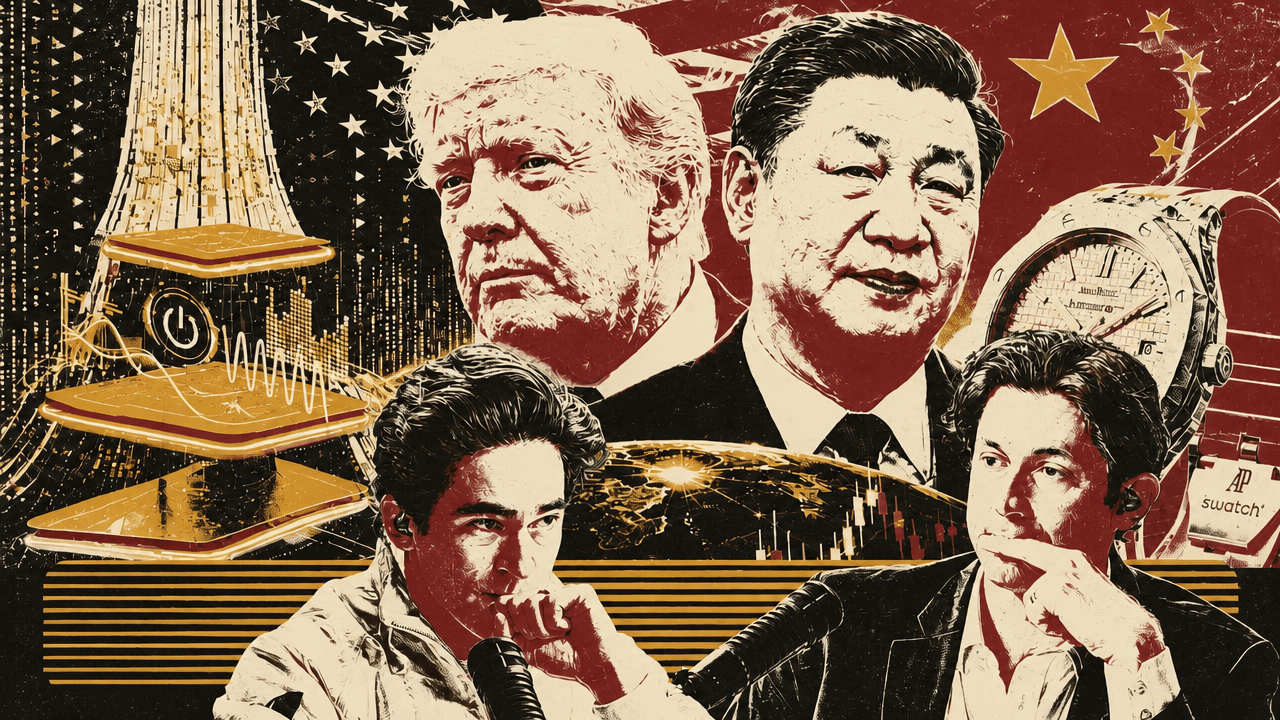
John Coogan and Jordi Hays read Audemars Piguet’s Swatch “Royal Pop” as a sanctioned cheap lookalike: not a real Royal Oak substitute, but a lower rung into a brand whose entry point has moved far out of reach. Coogan also framed Cerebras’s higher IPO range and reported oversubscription as evidence that AI chip demand is being repriced around inference speed. On Trump’s China trip, he argued that tech priorities such as export controls, compute and AI access may be crowded out by Iran, oil and diplomacy.
Audemars Piguet is turning the knockoff problem into an entry point
John Coogan framed the Swatch x Audemars Piguet “Royal Pop” as an official version of what would otherwise look like a Royal Oak knockoff. Jordi Hays put it more bluntly: “They knocked themselves off.”


The product itself had not been fully revealed in the source discussion. Swatch’s official teaser showed a glossy 3D animation of watch gears and mechanisms assembling under the text “Royal Pop,” but Hays said the actual watch had not been shown. In the absence of a real product image, social media had filled the gap with “somewhat realistic looking posters,” borrowing from the precedent of the MoonSwatch, Swatch’s previous collaboration with Omega around the Moonwatch.
That precedent matters because it gives the AP collaboration an obvious strategic read: a luxury watch brand with a high-status silhouette uses Swatch to create a much cheaper, more accessible version without lowering the price of the real thing. Hays described the MoonSwatch as “a more accessible entry point” to Omega’s Moonwatch. Coogan extended that logic to Audemars Piguet, arguing that AP lacks a clean “walk crawl run” path into the brand. The effective floor for entering the Royal Oak ecosystem, he said, had moved toward roughly $30,000 as aftermarket prices rose and AP increasingly priced closer to where its watches traded secondhand.
Hays added that the gap had been growing because aftermarket prices had been increasing faster than incomes. That gap is central to the business question. If a consumer can either spend six figures on a Royal Oak in certain configurations or a few hundred dollars on a Swatch collaboration that carries enough of the silhouette to be legible, some existing owners may see dilution. But Coogan’s read was that the real Royal Oak remains far away in materials, construction, price, and status. The Swatch version is not a substitute so much as a rung on a ladder.
A tweet shown on screen from Live Monitor captured the skeptical version of the argument: “Spend $500,000 or $500…. AP owners should be livid,” alongside images of a blue Royal Oak and a blue Swatch-style watch. Coogan acknowledged that the two looked “pretty similar,” while stressing that the materials and reality of the products would be very different.
The hosts also treated the collaboration as a response to a world where fake luxury watches are increasingly sophisticated and cheap. Coogan noted that Chinese copies of popular models — Nautilus, APs, and others — can be found on Alibaba in the low hundreds of dollars, with enough similar componentry to be visually persuasive. Hays pointed to watch reviewer Nico Leonard being tested on six watches, three authentic and three knockoffs, and correctly identifying all of them, despite some of the fakes being convincing, especially a Patek example.
That leaves AP with a choice: fight the existence of cheap lookalikes from the outside, or create the sanctioned cheap lookalike itself. Coogan said he was not a watch expert, but described the move as a possible way to “lean into” a market already flooded with fakes while keeping the real brand healthy.
The IP theory is plausible, but not the whole explanation
A separate theory presented in the source tied the Royal Pop collaboration to Audemars Piguet’s legal protection around the Royal Oak design. A tweet from Ariel Givner, shown on screen and read by Coogan, argued that AP’s trademark losses meant it had “lost the moat around their octagonal bezel and tapisserie dial,” and therefore licensed its “crown jewels” to Swatch for a flood of affordable, legitimate Royal Pop pieces. Givner called it “a masterclass in damage control.”
Coogan said the reference was to AP losing a trademark fight in Japan in 2024 and in the United States in 2025, with courts ruling that the bezel and dial were not distinctive enough to legally own. Hays pushed back on the broadest version of that claim, saying AP had managed to maintain some kind of trademark around the octagon. Coogan distinguished between trade dress and owning an abstract shape: a company may be able to prevent a full direct knockoff of a product, but “they couldn’t lock down the idea of an octagon.”
That left the IP explanation unresolved rather than definitive. Coogan said he did not know how much of the Swatch deal was truly “damage control around the intellectual property,” but considered it interesting as part of the strategic context.
The source also showed how quickly the collaboration had become a resale event. A tweet thread from gemchanger framed the launch as “the easiest 4-figure week you’ll have all year” for anyone willing to do “something that resembles work for 14 hours.” The thread claimed the Royal Pop would drop Saturday, May 16, with a one-week teaser-to-release cycle. It described the retail range as $300 to $500, based on the MoonSwatch and Blancpain Scuba precedents, and said sales would be in-store only, limited to one piece per person per store per day.
The resale argument rested on prior Swatch collaborations. The thread claimed MoonSwatch launched in March 2022 at $260, averaged $900 on StockX, saw the Tiffany blue Uranus version average $1,040, and had individual eBay listings reach $2,400, or 12 times retail. It also claimed Blancpain Scuba launched in September 2023 at $400, with Chrono24 asks two years later between $600 and $995 across colorways and launch-week premiums of two to three times retail.
| Collaboration | Launch price | Resale claims shown in source |
|---|---|---|
| MoonSwatch | $260 | StockX average trade of $900; some eBay listings reportedly hit $2,400 |
| Blancpain Scuba | $400 | Chrono24 asks shown at $600-$995 two years later; launch-week premiums described as 2-3x |
| Swatch x AP Royal Pop | $300-$500 claimed range | Thread speculated 5x to 12x retail depending on demand |
The tactical advice was equally specific: avoid flagship stores such as SoHo, Times Square, Carnaby Street in London, Ginza, and Orchard Singapore, where MoonSwatch lines had allegedly been extreme, and target secondary cities such as Oak Brook, Troy, King of Prussia, Garden City, Canoga Park, Honolulu, Charlotte, and Nashville. Coogan joked about going to Honolulu for the drop, but concluded the release would be a hit. Hays agreed: “The haters are wrong. People love G-Shocks. It’s sort of a combination.”
The collaboration’s appeal, in their reading, is not only scarcity or arbitrage. Coogan described it as “a fun watch” and a “point along a curve” for someone getting into watches: start with the Swatch AP, then later move up into something else. The source treated resale mania, brand strategy, counterfeit pressure, and entry-level customer acquisition as overlapping explanations rather than mutually exclusive ones.
Daniel Craig gives BYD a European luxury signal
BYD’s Denza luxury EV advertisement used Daniel Craig not as a generic celebrity but as a carrier of James Bond associations. The commercial shown in the source featured Craig driving a green Denza at night through a city and later in countryside scenery, with a black dog in the back seat. His narration leaned into reinvention: “Old selves, past identities, they shift. They have to,” and “Doesn’t life ask us to step out of the shadows and embrace the new?”
Coogan read the endorsement as an example of Craig continuing to monetize the “aura” of Bond even after leaving the franchise. Hays noted that Craig has shown more comedic timing post-Bond, including on SNL and in comedies, but said he will “still just never not be James Bond” because of the success of his run in the role.
The ad prompted a small product question: Hays thought he heard what sounded like an internal combustion engine. Coogan heard it too and wondered whether engine sound was being played through the speakers, or whether, with BYD, there could be some hybrid component despite the “luxury EVs” framing. The source did not resolve the technical question. It left the point as a tonal observation: the ad wanted the emotional language of a performance car, even while selling an EV.
The pricing discussion complicated the usual BYD narrative. Coogan said BYD numbers often feel like “the performance of a Ferrari for the price of a Camry,” but Hays said the European price tag being discussed was 134, and then clarified that the Denza Z estimated price range was 60 to 140, while many other Denza models are in the $40,000 to $60,000 range. Coogan’s conclusion was that the car was “actually getting pricey,” though not uniformly so across the Denza line.
The strategic point was that BYD was using Craig for a European luxury push. Coogan said that when a company is advertising a car with Aston Martin-like associations — or a luxury BYD — Craig is the obvious mental reference point. His Bond identity, his performance in Layer Cake, and even his Benoit Blanc role in Knives Out all contribute, in Coogan’s view, to the same authority-bearing screen presence.
Cerebras has moved from semiconductor curiosity to IPO demand story
Cerebras was presented as the strongest market story in the source. Coogan said the company had updated its IPO filing, with the date reported as Thursday, May 14, an offering increased to 30 million shares from 28 million, and a price range lifted from $115–$125 to $150–$160. That implied a raise of up to roughly $4.8 billion instead of $3.5 billion. He also said the deal was allegedly more than 20 times oversubscribed — about $100 billion of demand for a roughly $5 billion offering — while cautioning that this did not mean the stock would “10x on day one.”
Hays cited Dan Loeb’s comment that if one wanted an ideal time for a chip company IPO, May 2026 was “hard to beat.” Coogan connected that timing to a broader change in AI economics. For a long time, he said, Cerebras had faced skepticism: it took years to design and tape out the chips; early versions were less flexible and less collaboratively designed with customers; customer concentration was a concern; and some critics worried the company might be over-optimized for transformer architectures if AI research moved away from attention.
In Coogan’s framing, the feared architecture shift did not happen. “Attention and transformer-based architectures are still dominant,” and inference costs and speed have become more important in the age of agents. Demand, he said, is “10xing every few months,” creating a clearer business story than the company had when it was mostly known for an unusual chip design.
Tyler Cosgrove gave the most concrete product-level endorsement. He said users can try Cerebras-backed performance through Codex desktop by selecting GPT 5.3 Spark from a dropdown, then asking for something as simple as a history of the Roman Empire. The result, he said, is an instant full-page response with “5.3 level intelligence.” His point was not merely that the chip is fast, but that the user experience changes when meaningful AI work no longer means firing off a request and coming back five minutes or two hours later. If latency is cut by half or by 10 times, he argued, the effect should matter across LLM interfaces and AI experiences.


Tyler also questioned why customer concentration would remain a durable concern if labs and AI product companies face exploding demand. He named Cursor, Anthropic, Meta, and Google as examples of potential buyers unless they have direct answers of their own.
The source described Cerebras’s architecture in contrast to conventional semiconductor manufacturing. Traditional manufacturing fabricates a silicon wafer, cuts it into hundreds of smaller chips, packages them individually, and connects them into systems. Cerebras instead uses the whole 300-millimeter wafer. Hays described the system as having four trillion transistors, 900,000 AI-oriented compute cores, and petabits per second of internal bandwidth, which he tied to memory bandwidth for KV caches and related AI workloads.
| Metric | Cerebras description in source |
|---|---|
| Wafer approach | Uses the entire 300 mm wafer rather than cutting it into many chips |
| Transistors | 4 trillion |
| AI-oriented compute cores | 900,000 |
| Internal bandwidth | Petabits per second |
The market speculation around the IPO was aggressive. A tweet from Omer Cheema said Polymarket was projecting Cerebras to close above a $50 billion market cap by the end of day one, about 100% above a target valuation of $26 billion. Another tweet from JJ claimed Benchmark VII still owns more than 20% of Cerebras and that if Cerebras traded at even half the valuation level of Shanghai-listed Moore Threads and Cambricon, it could exceed $500 billion in under two years. Coogan treated that as a “big statement,” while noting that Benchmark would be “absolutely cleaning up” if the position holds.
The technical joke that stuck was from Quantian: Cerebras could be imagined as a manager asking, “Why can’t you just put 50 gigabytes of L3 cache on this chip?” and the engineer replying, “uh, I guess you could?” A follow-up analogy put it as “building the entire plane out of the black box,” except the plane works and “goes Mach 10.” Coogan endorsed the analogy as essentially what happened: an apparently blunt idea made real by engineering.
Trump’s China trip is framed by Iran before tech can get a turn
The China discussion began with a Wall Street Journal screenshot headlined: “Xi’s China: Dazzling Technology, Military Muscle—and an Economic Mess,” with the subhead saying the government is pouring money into AI, electric cars, and military power while consumer confidence sags and the job market grows bleak. But Coogan’s focus was not China’s domestic economy in isolation. He said Donald Trump was meeting Xi Jinping in Beijing that week, and that Iran would loom over the summit.
Hays said the delegation was being called a “field trip,” with major business figures reportedly going, including Tim Cook, Larry Fink, Stephen Schwarzman, Jane Fraser from Citi, Chuck Robbins from Cisco, David Solomon, and possibly Elon Musk. Coogan initially thought Hays meant journalists; the list made clear the trip was heavy with executives.
Coogan said the “vast majority” of discussions would center on the war in Iran. Reading from the Journal framing, he said the heads of the two superpowers would meet with Iran as the other nation looming over the summit. The meeting had already been delayed once because of the US and Israel’s war against Iran, which had led to closure of the Strait of Hormuz. Trump, in this account, wanted to move on from a Middle East war that was weakening him domestically and straining the global economy. China, which relies on Iran for low-cost oil, had incentives to help broker an end to the conflict because Middle East turmoil restricts oil supply and reduces other countries’ ability to buy Chinese goods.
Hays added that, as of that morning, Trump had said the peace deal was on “major life support.” Coogan took that as better than dead, but only barely, and said he was hoping for a comeback.
The economic pressure point was oil. Coogan said prices had climbed amid fears of prolonged disruption through a choke point carrying roughly one fifth of global oil flows. The summit would also cover trade deals, including Chinese purchases of American agriculture, energy, aerospace products, and related investment mechanisms.
For the tech industry, Coogan said the hope was to wind down the conflict quickly and then move to export restrictions, GPUs, the AI supply chain, rare earths, and other inputs needed for the sector to flourish. His expectation, however, was that Iran’s scale would limit both movement and useful sound bites from the trip. The presence of many tech CEOs made him think some tech conversations would still happen.
Tyler raised a different layer: AI regulation. He referred to recent news about CAISI and possible tests before model releases, saying it seemed the direction was becoming less safety-focused. Coogan and Hays then riffed darkly on what China might request: unfettered access to a model like Mythos 2, enough access to distill it quickly, or simply the model weights, under the stated purpose of inspecting it for release in China. Tyler noted that some people in China are genuinely worried about AI safety, but said the executives going over — Tim Cook, Jensen, Elon, and others — were unlikely to argue for a safety-first position.
The China section therefore held two tracks in tension. The immediate diplomatic agenda was Iran and energy security. The tech industry agenda was export controls, compute, model access, AI regulation, and supply-chain constraints — important, but possibly secondary until the war question moved.
The smaller stories were all about institutional friction
Several shorter items shared a theme: ordinary systems creating absurd overhead or accidental value.
The first was Palmer Luckey’s argument against junk mail. A tweet shown on screen said the United States Postal Service should ban junk mail, comparing physical spam with spam calls regulated by the FCC and email regulated by the CAN-SPAM Act of 2003. The tweet claimed junk mail is the majority of mail and consumes 100 million trees per year. Coogan agreed that there is “way too much” of it.
A follow-up Luckey tweet argued that America had given a monopoly on letter delivery to a quasi-governmental agency, which then uses it to flood homes with unwanted garbage. Another claimed that if the average American spends only 30 seconds a day sorting mostly spam mail to find real mail, that adds up to over a billion hours. Coogan misread the final unit aloud as dollars, but accepted the underlying productivity complaint. His proposed workaround was “earth class mail”: a PO box that scans physical mail into an email inbox, with OpenAI or Claude filtering what makes it through.
The second was a joke about San Francisco real estate. A tweet from Jake proposed a service for realtors and homebuyers: he would show up to open houses wearing OpenAI or Anthropic merch and charge a 5% commission. Coogan described the idea as a way to “pump up the price,” calling it “chandelier bidding.” Hays questioned whether it would actually help, since some buyers might simply decide not to bid if they thought an OpenAI or Anthropic employee was interested. Coogan thought others might instead strengthen their offers to compete with perceived AI-company wealth.
The third was the University of Michigan’s early OpenAI investment. A tweet from Stephen Council said that before ChatGPT, before Microsoft’s $1 billion bet, and long before IPO plans, the University of Michigan put $20 million into OpenAI, with a possible $2 billion payday equal to about a tenth of the university’s current endowment. The screenshot shown listed the Regents of the University of Michigan with a $20 million capital commitment and a $2 billion target distribution amount. Coogan speculated that Michigan may have initially considered donating and then realized it could participate in the for-profit side instead.
The final item was a comic example of how hard technology still is for ordinary users. A video showed a text overlay claiming someone’s mother tried to search for information about energy drinks and accidentally set up their house as a business on Google Maps. The resulting listing was named “What Is In Energy Drinks,” categorized as a beverage distributor, with a 4.8 rating from five reviews. Coogan used it as a caution against assuming new technology will diffuse smoothly: if a person can begin with a Google search and end with a business listing at their home address, rapid AI adoption is “debatable.”