Stripe’s $53 Billion PayPal Bid Hinges on Operational Turnaround

John Coogan argues that Stripe’s $53 billion offer for PayPal is a wager that its consumer accounts, bank-linked relationships, checkout presence and cash flow can be worth far more under stronger management. He and Jordi Hays say the transaction depends less on identifying those assets than on whether Stripe, alongside Advent International, can restructure and integrate a 25,000-person legacy fintech without eroding them. The show applies a similar test to OpenAI’s reported AI speaker and Chip Motors’ autonomous neighborhood EV: appealing concepts still have to clear the harder work of building, operating and delivering them.
Stripe’s PayPal bid is an operating bet on assets the market has discounted
John Coogan frames Stripe’s $53 billion offer for PayPal as a bet on a battered but still unusually consequential payments asset. PayPal’s share price has fallen more than 80% from its pandemic-era high, according to the five-year chart discussed. Coogan treats the 2020–21 surge as an e-commerce anomaly, but argues that the subsequent decline has left a company with substantial cash generation and consumer reach trading at a distressed valuation.


He cites fintech investor Sheel Mohnot’s February formulation: PayPal, then down roughly 85%, was generating $5.5 billion in free cash flow on a roughly $50 billion market capitalization—about a 10% free-cash-flow yield. The question is not whether PayPal has become a weaker business than it was at the pandemic peak. It is whether its remaining assets can become materially more valuable inside a buyer with better operating execution.
Those assets are not limited to the PayPal brand. Coogan points to roughly 400 million consumer accounts across PayPal and Venmo, along with attached bank information that makes those accounts harder to recreate than a conventional consumer audience. In his framing, this is the “white whale” for a consumer company: a relationship that has progressed through identity checks and into customers’ banking lives.
PayPal also retains checkout placement across millions of merchant sites. That placement is slowing, Coogan says, amid competition from Apple Pay, Shop Pay, and Klarna. But it remains valuable real estate. Stripe has expanded into adjacent products, including Atlas, while never really cracking consumer payments. Integrating PayPal’s stored consumer relationships and branded checkout into Stripe’s merchant network could change that.
Venmo supplies a further consumer-facing brand. Coogan recounts the ownership lineage—Venmo was bought by Braintree, which was then sold to PayPal—as part of the broader point that PayPal contains several hard-won assets whose value may not be reflected in its public-market price.
The terms Coogan describes are $60.50 per share, a 28% premium to the prior day’s close, with $50 billion of bank financing committed. The offer nonetheless sits well below PayPal’s valuation a year earlier. Michael Burry, identified as a shareholder, has objected publicly to selling at that price on the grounds that PayPal could regain its prior share price.
PayPal has been reluctant to engage, according to Financial Times reporting cited by Coogan. He sees that as consistent with the company’s position: its new chief executive, Alex, has only recently taken the role after coming from Intuit and may want the opportunity to execute a turnaround rather than immediately hand the business to an acquirer. Jordi Hays says making the proposal public could be intended to put pressure on that leadership team.
The deal only works if Stripe can run PayPal differently
The hardest part of the Stripe thesis is not identifying PayPal’s assets; it is absorbing a sprawling legacy company without losing the qualities that make Stripe attractive. Mohnot’s objection, as relayed by John Coogan, is cultural. PayPal has roughly 25,000 employees and decades of technical debt. Stripe and Apple may have product strength, but neither is known as a private-equity-style operator that acquires an aging asset and ruthlessly restructures it.
Coogan is less concerned by the software problem than by the organizational one. He suggests that technical debt is more tractable in an era of coding agents. But an acquisition would still require a different operating posture from Stripe: cost cutting, integration, and potentially substantial reductions in headcount.
Jordi Hays makes the lender’s version of the case. Financing a transaction of this size requires confidence that the buyer can make PayPal operate materially better. He assumes Stripe would conclude that it does not need 25,000 people to run the business.
If you could make PayPal even run half as well as Stripe, that's probably worth double what it's currently worth.
For lenders or partners, Hays argues, Stripe is difficult to beat as an operating counterparty. Stripe is partnering with Advent International, a private-equity firm with fintech deal experience, according to Coogan. He says the two would split the equity portion 50–50, supplemented by bank financing. That structure means the prospective buyers are not simply purchasing a strategic feature set; they are underwriting an operational transformation.
The sellers’ counterargument is straightforward. PayPal can acknowledge that branded checkout has slowed while arguing that it has a new chief executive, a restructuring plan, and a path back toward the share-price range it held only a year earlier. The $60.50 offer may be a premium to the current price without being sufficient compensation for a turnaround management believes it can deliver itself.
Coogan also runs through Mohnot’s alternative buyers. Apple could use PayPal to deepen its e-commerce presence and pair it with Apple Pay, while Venmo would fill a social-payments gap. But Apple would face both cultural integration concerns and major antitrust risk.
Visa and Mastercard have the financial capacity and an interest in moving beyond interchange toward direct merchant relationships. PayPal’s checkout presence could accelerate that effort by years. Yet either network buying the largest independent online checkout provider would invite what Mohnot called brutal regulatory scrutiny.
JPMorgan, in Mohnot’s view, may be the most logical buyer. The bank has invested in payments and acquisitions, and a PayPal deal could bring it closer to building a consumer super-app alongside Chase. Venmo would give it a younger-consumer peer-to-peer brand it has struggled to build; PayPal’s merchant placement would provide a broad e-commerce foothold. But even for JPMorgan, $50 billion would be a consequential acquisition requiring regulatory approval.
Elon Musk has a poetic connection to the asset: he co-founded PayPal and wanted it to be called X. Coogan notes that Musk is also, he believes, an early Stripe investor. But the case against a Musk-led return is bandwidth. Musk is already spread across Tesla, SpaceX, xAI, X, politics, and other commitments. Coogan does not dismiss him on technical debt—Musk knows PayPal’s history—but does not see a bid as likely.
Coogan expects further negotiation rather than a quick resolution. Stripe may be the most compelling strategic and operating buyer, but PayPal has a credible reason to argue that the opening bid is too low.
OpenAI’s reported speaker would turn AI into a more personal household presence
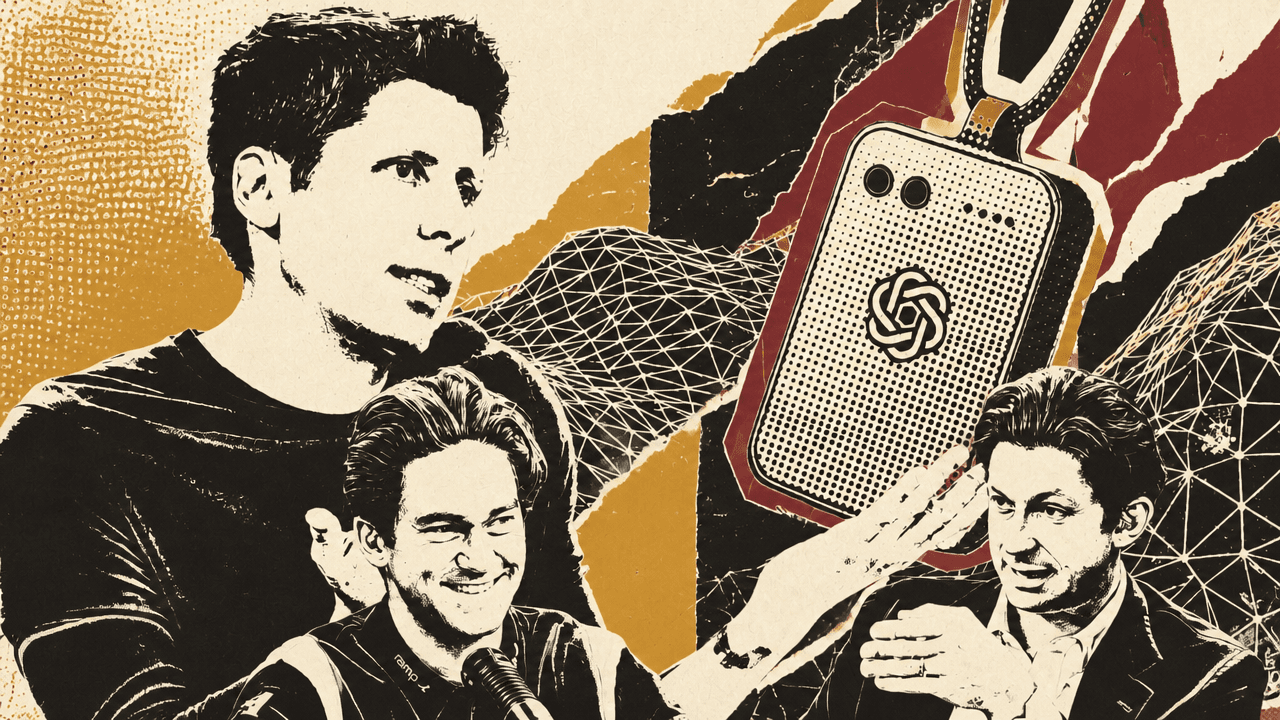
OpenAI’s first consumer hardware product will reportedly be a screenless, movable AI companion speaker. John Coogan cites Bloomberg reporting, amplified in a post from Mark Gurman, that the device would answer questions, control smart-home devices, play music, and use GPT capabilities. Its larger purpose would be personalization: learning an owner’s habits and drawing on personal information, potentially including email, to provide more useful help.
The reported design differs from a conventional smart speaker in both sensing and behavior. Coogan says Bloomberg described mechanical elements that move on their own, along with a camera and other sensors intended to understand the device’s surroundings. Powered by GPT-4o’s real-time voice mode, it is expected to hold more natural conversations and recognize when someone enters a room. A rechargeable battery would allow it to move around the house.
Jony Ive is said to be helping design the product. Coogan says OpenAI’s hardware team is developing roughly five AI devices, with the speaker expected to arrive first: an unveiling is targeted for this year, ahead of a planned 2027 release.
Coogan and Jordi Hays turn the word “movable” into a joke about a one-ton concert speaker stack on wheels, with an onboard battery and enough volume to follow its owner from room to room. They explicitly identify it as a bit. The serious implication of the reported design is more consequential: OpenAI is said to be considering a device that combines voice interaction with sensors, personal information, and an increasingly individualized model of its owner’s routines.
Coogan connects that ambition to what he sees in Codex and the increasingly integrated ChatGPT apps on phones and computers. He describes being able to use a phone to remote into a computer, open a logged-in browser, and retrieve information through an existing session. In his view, consumer AI is moving beyond chat toward a combination of computer use, agents, and desktop integration that no longer requires users to configure terminal-based tools such as Open Interpreter.
Generated product concepts make the interface problem visible—and absurd
The mock products push ambient-computing logic into physical absurdity: if AI systems must keep users informed away from screens, then perhaps they should communicate through taste, keyboards wrapped around water bottles, or other sensory objects.
MELT is a custom-fit oral wearable intended to turn ChatGPT Codex status into flavor. The proposed sensory language is literal: a completed run produces a sour pulse; an error becomes spicy; an empty API balance is bitter; passed checks and a deployment are sweet. John Coogan describes the appeal as being able to step away from a terminal without losing awareness of an agent’s state. A sour cue means it is time to review work; heat demands attention; bitterness signals that credits need to be refilled; sweetness marks a successful deployment.
The idea is openly comic, including the suggestion that the device could resemble an iced-out grill. But it follows the logic of an ambient interface: the signal should be private, immediate, and available when the user’s eyes and ears are elsewhere. Coogan also points to the behavioral logic embedded in it. A sweet reward for successful work, he says, creates a Pavlovian hunt for the next burst of flavor.
KEYDRA applies the same logic to a water bottle wrapped in a keyboard. Its mock specifications include a 32-ounce bottle, a 64-key tactile QWERTY layout, Bluetooth support for three devices, a six-month battery, and a sealed keyboard. The ostensible problem is that a person using voice input cannot speak while drinking water and might switch to typing without breaking their flow.
When Hays asks why the bottle would not simply have a microphone, Coogan answers that drinking is precisely why it needs a keyboard: speech is unavailable in that moment. Hays says he likes the object aesthetically even if the keyboard is not functional, comparing it to accessories that make visible computer hardware part of their design.
The same rapid site-building process gives more conventional ideas enough specificity to expose their weak points. Hays says Laptop Detailing Co. is a business that should be built: a service analogous to car detailing, but for laptops. Technicians would clean screens, keyboards, trackpads, ports, vents, and exterior casings at homes or offices, with after-hours service for companies. He imagines monthly plans for startups, enterprises, and other teams that want employee devices kept clean and polished.
The premise came from Coogan trying to clean his own laptop with a screen wipe that he says caused a chemical burn and peeling skin on his fingers. The mock company responds with screen-safe formulas, anti-static equipment, insured professionals, and a pitch aimed at people who do not want to decipher cleaning labels or use household chemicals around their devices. Hays considers the $9.99 advertised price too low for an on-site visit, putting a more plausible figure around $20 or $29.99.
The exaggerated feature is a “No Insider Trading Guarantee,” promising not to photograph, memorize, transcribe, trade upon, or tip anyone about information visible on a client’s screen. Coogan’s joke is that the low price might only be possible if cleaners were monetizing the trade secrets they saw; the guarantee therefore has to be unusually emphatic.
Paradox, a $48 luxury toothpaste in a refillable frosted-glass jar, fails faster. Its pitch is to turn toothpaste from a hidden tube into a bathroom ritual: scoop one precise pearl, brush, and refill the jar with a pouch. Hays asks what happens to the spoon after it has been dipped into the toothpaste. Coogan immediately concedes that the hygiene problem ends the idea. The polished presentation makes the practical objection more obvious, not less.
Chip’s appeal depends on whether it can reach production before competitors catch up
Chip Motors is selling a compact electric “robot car” that talks, parks itself, offers customization, and is designed for local trips. Its promotional vision includes leaving a garage, collecting a family, driving around a neighborhood, finding parking autonomously, and serving as a mobile screen. Reservations begin at $15,000.
Jordi Hays doubts that a finished vehicle will ship at that starting price, anticipating upgrades and manufacturing complexity. But he thinks it could sell even in a $20,000–$30,000 range because higher-end neighborhood golf carts already occupy that territory.
Chip is making a different bet from Amble, Hays says. Amble favors less technology and greater simplicity; Chip is leaning into autonomous driving, screens, AI, and custom styling. He sees distinct customer bases for the two approaches and thinks both can work.
John Coogan is more uneasy about the autonomy pitch. He singles out the prospect of sending a small robot car to park itself near a children’s soccer game as an especially sketchy scenario. Still, he wants the broader category of niche, compact EVs for towns and neighborhoods to reach market faster than previous startup vehicles have.
I'm interested to see, can this come to market in a two year timeframe or three years or something as opposed to...
Coogan’s concern is that a compelling vehicle can lose its window by taking too long to manufacture. Tesla demonstrated that a new car company could break through, he says, but follow-on companies such as Nikola struggled or failed after years of work and billions of dollars in capital. Long development cycles also gave established automakers time to match the premise. By the time Lucid moved beyond its premium sedan toward an SUV, he notes, Porsche had the Taycan and Mercedes had the EQS.
He points to Chinese manufacturers shipping vehicles that crab-walk, spin, jump, and offer other unusual features as evidence that development can move more quickly. Whether an American startup can do the same depends, in his view, on regulation, supply chains, and execution. For Chip, the question is not whether a $15,000 robot car is an appealing story. It is whether the company can build and deliver one before the story stops being distinctive.