SpaceX’s IPO Case Now Depends on AI Infrastructure Demand
TBPN’s John Coogan, Jordi Hays and guests read SpaceX’s filing as more than a rocket-company IPO: its valuation case increasingly rests on Starlink, defense and especially AI infrastructure, including a large Anthropic compute partnership. They argue that Anthropic’s reported revenue acceleration and OpenAI’s claimed breakthrough on an Erdős math problem strengthen the case that frontier AI is becoming both economically material and technically more capable. The discussion frames the day’s market news as a shift from AI adoption stories to capital-intensive infrastructure, public-market valuation and measurable frontier-model results.
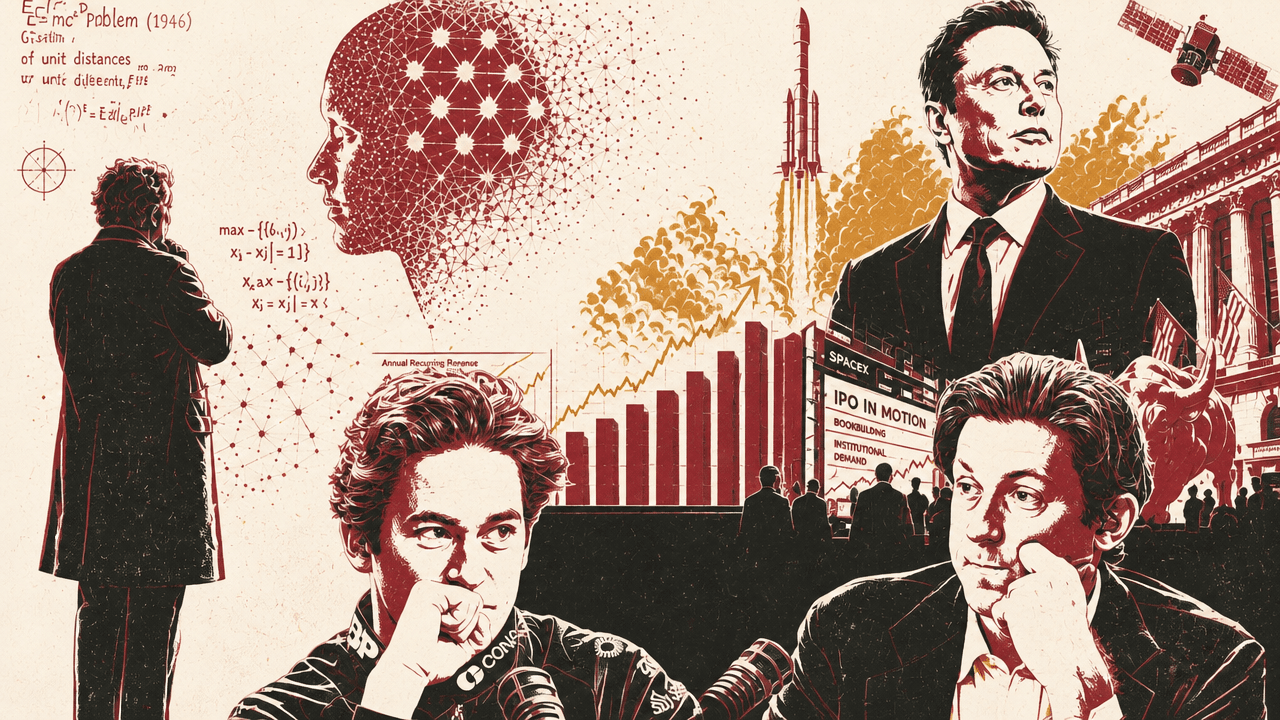
SpaceX is being valued on a story larger than rockets
John Coogan framed the SpaceX filing as the start of a clock: a potential stock sale “as soon as next month,” with a rumored June 12 date, and a raise that could reach $80 billion or more. The prospectus positions SpaceX not only as the company that reshaped commercial launch, but as a sprawling technology platform across rockets, Starlink, defense, AI infrastructure, and an emerging orbital-compute narrative.
The numbers explain why the filing immediately became a market event. SpaceX reported $18.67 billion in revenue last year and had more than 22,000 workers as of March 31. Coogan noted Dan Primack’s reaction that the business was smaller than he expected, while also emphasizing the broader reception: the S-1 was unusually readable for a securities filing. Kevin Kwok called it “the most enjoyable S1 read in a long time” and said it “reads so easy like sci-fi or fiction.” Coogan said that line worked in both directions: for believers, the sci-fi quality is part of the appeal; for skeptics, it can be read as a warning.
The most striking part of the filing was the total addressable market slide. Sawyer Merritt quoted SpaceX saying it had identified “the largest actionable total addressable market in human history,” with a quantifiable TAM of $28.5 trillion. The filing’s breakdown, as displayed, allocated $370 billion to space-enabled solutions, $1.6 trillion to connectivity, and $26.5 trillion to AI. Within AI, the prospectus attributed $2.4 trillion to infrastructure, $760 billion to consumer subscriptions, $600 billion to digital advertising, and $22.7 trillion to enterprise applications.
| Segment | Estimated TAM |
|---|---|
| Space-enabled solutions | $370B |
| Starlink broadband | $870B |
| Starlink mobile | $740B |
| AI infrastructure | $2.4T |
| Consumer subscriptions | $760B |
| Digital advertising | $600B |
| Enterprise applications | $22.7T |
| Total addressable market | $28.5T |
Some parts of the market map were more persuasive to Coogan than others. “Everything else is more believable to me than X getting meaningful digital advertising penetration,” he said after Jordi Hays asked whether the digital advertising line was for X. He also pointed out that the size of the markets depends heavily on time horizon: some of the markets are not that large today, he said, but could be over 25 or 100 years. The filing also excluded China and Russia from global estimates. Coogan joked that world peace would expand TAM, turning geopolitics into an economic upside case.
The filing also produced a secondary story around the banks and early investors. Dan Primack pointed out that Goldman Sachs beat Morgan Stanley for the lead-left position, despite Michael Grimes returning to Morgan Stanley in part for the SpaceX deal. Morgan Stanley is still on the deal, but Coogan called it a “big win for Goldman.” Will Bitsky joked about “the Goldman analyst that was ritually sacrificed to win this lead left IPO,” alongside a long list of joint book-running managers. Coogan’s read was that a filing this large and structurally complex — with multiple businesses and Elon Musk as the client — would have required an extraordinary amount of work.
The investor-winner story was clearest in the discussion of Luke Nosek and Gigafund. Coogan cited an old Axios item saying Nosek had left Founders Fund to lead a new investment firm initially focused on raising capital for SpaceX, where he was a director. Coogan stressed that “exclusive” did not mean 100% of capital went into SpaceX, and that Gigafund has other portfolio companies. But SpaceX was the company where Nosek was deeply involved and had participated across many rounds.
The valuation question remained unresolved. Frank used Codex to sketch a sum-of-the-parts valuation: $400 billion to $600 billion for Starlink and connectivity; $100 billion to $250 billion for launch, Starship, defense, and space optionality; and $300 billion to $650 billion for xAI/X/compute, including Anthropic optionality. That put a “reasonable base case” around $1.1 trillion to $1.5 trillion, with a bull case of $1.7 trillion to $1.9 trillion if investors assume Anthropic sticks, AI infrastructure margins are strong, Starship unlocks major new markets, and public-market scarcity drives demand. Above $2 trillion, Frank’s Codex-assisted analysis argued, the market would be assigning $800 billion to $1 trillion or more to the AI/orbital-compute story on top of an already rich Starlink valuation.
That was the central tension: SpaceX’s filing is not just being read as a space-company IPO. The upside case increasingly depends on whether investors believe the AI infrastructure business is real, durable, and large enough to justify the valuation premium.
The Anthropic deal changes the SpaceX story if the spend holds
The sharpest change in the SpaceX story was the Anthropic partnership. Coogan described Anthropic as spending “over a billion dollars a month,” and Hays put the figure at $15 billion a year. Against SpaceX’s reported $18.67 billion in annual revenue, Coogan said that would be “huge” and could make SpaceX “one of the biggest neo clouds overnight.”
Hays framed the arrangement as a strong fallback from the original xAI/Grok distribution story. xAI was growing, he said, but not at a rate that obviously required infrastructure of that scale. The distribution-side product-market fit existed, but, in Coogan’s phrasing, X was “not the biggest platform.” Hays summarized the strategic move as: shoot for the stars, and if you miss, you still have “a pretty great neo cloud business.” He also asserted that Anthropic has to pay well above traditional neo-cloud pricing for this compute, which would make the arrangement a strong outcome for SpaceX.
Peter Hague put the shift more bluntly after reading the SpaceX SEC document: “One thing that sticks out is the capital spend on AI is 3x that on space(!). Its an AI company with some rockets.” Coogan called that “a wild pivot” at the “11th hour.” For much of its life, SpaceX was a rocket company; Starlink made it an internet company, but the link to launch was obvious. SpaceX needed launch capacity to build the satellite network, and Starlink quickly became tangible: consumers using it while traveling, camping, living off-grid, and on planes. AI compute, by contrast, felt like it belonged to a different company — because, as Coogan put it, Colossus xAI was a different company — but it became very large very quickly.
Hays argued that the AI-infrastructure narrative did not appear by accident. The past year looked to him like a coordinated set of plays: people began talking about space data centers, investors such as Gavin Baker started discussing the theme, SpaceX floated valuation ideas late last year, built an AI narrative, made a play for Cursor, and partnered with Anthropic despite being more combative only months earlier. Coogan agreed there had been “name calling basically.” Hays’s conclusion was that Musk has accumulated so much capital because he is “pretty much the best in the world” at making plays.
That same Anthropic relationship also fed into the separate story of Anthropic’s own revenue acceleration. Coogan cited a Wall Street Journal report saying Anthropic’s revenue was set to reach $10.9 billion in the second quarter, with the headline he read saying sales were up 130% over the previous quarter and on pace for the company’s first profit. A Ray Wang post shown on screen quoted the Journal differently: it said Anthropic’s second-quarter revenue was set to increase by more than 200% to $10.9 billion and that the company would post a $559 million operating profit for the first time.
Coogan described the report as a direct challenge to the “AI will never be profitable” camp. He pointed to an argument Dylan Patel made on the Dwarkesh Patel show: leading models may eventually be able to raise prices because they generate so much economic value. He also cited a SemiAnalysis table showing workflows where AI produced equivalent results at a tenth or a hundredth of the cost of human labor in some cases, and sometimes with roughly 30% savings.
Tom Brown, a co-founder of Anthropic, wrote that Anthropic was expanding its SpaceX partnership and would be scaling up GB200 capacity in Colossus 2 throughout June. Brown said SpaceX was helping Anthropic “find good homes for the Claudes,” and in an earlier post said the company would need to “move a lot of atoms” to keep up with AI demand. Coogan paused on the phrasing — “Is Claude plural?” — but the business point was straightforward in his reading: Anthropic’s demand for inference capacity is large enough that SpaceX is becoming part of its operating infrastructure.
The skepticism thread centered on Gary Marcus. Lisan al Gaib juxtaposed Marcus’s February 2026 Substack headline, “Turns out Generative AI was a scam,” with reports of Anthropic profits, OpenAI’s model solving a long-standing Erdős problem, and valuation gains at OpenAI and Anthropic. Coogan said he had checked the date because the headline felt more plausible as a 2024 claim, when usage limits, a possible data wall, or the need for a new paradigm were easier to argue. In 2026, he said, it was remarkable to write that during what he described as the fastest period of acceleration in actual value from the models.
Hays offered a broader explanation for why some people remain skeptical: the crypto boom, NFTs, VR, and the metaverse “broke a lot of people’s brains.” Coogan agreed that the metaverse was overpromised and underdelivered, though he argued that there was at least a short Apple Vision Pro moment when people treated it as the current thing. Hays rejected the comparison: with the metaverse, he said, there was never a moment where one could use a product and have a mind-blowing experience. Coogan’s distinction was that anyone can now have a “pretty wild experience” with AI across many services; the metaverse never had that kind of accessible, general product moment.
OpenAI’s Erdős result was presented as a general-reasoning step change
The OpenAI math result was treated as evidence that the frontier-model story is no longer only about product adoption and revenue. Hays introduced Tyler Cosgrove to explain what had happened after Noam Brown said an internal general-purpose OpenAI model achieved a breakthrough on a well-known combinatorial geometry problem. Brown’s claim, as read by Hays, was that less than one year after frontier AI models reached IMO gold-level performance, he expected the pace of progress to continue.

Cosgrove began with Paul Erdős, whom he described as a legendary twentieth-century mathematician who proposed a little over 1,200 problems. These problems have long been discussed as targets for AI. In earlier cases, he said, AI-related “solutions” have sometimes been more ambiguous: a system might find an existing paper that had not been added to the main website tracking solutions, making the result useful but not a genuinely new mathematical breakthrough. This case, he said, looked different.
This is kind of the first time we've really seen kind of a big step change. Like this is actually a new solution. This is using like you know kind of novel ideas here.
The problem was Erdős problem number 90. Cosgrove read the formal version as asking whether every set of distinct points in the real plane contains at most pairs that are one unit apart. He then translated it into geometry: place a set of points on a two-dimensional plane and ask how many pairs of points can be exactly one unit apart. The question is about the maximum number of such unit-distance pairs as the number of points grows.
He walked through increasingly complex constructions. If the points are placed in a straight line one unit apart, four points produce three unit-distance pairs. In general, that scales as . If the points are arranged in a square grid, the number of qualifying pairs still grows linearly; for a large grid, Cosgrove said, it scales as roughly . Hays asked whether the answer was “just a grid,” and Cosgrove said no: the diagonal lines in a square grid do not count because they are not one unit long, and more sophisticated arrangements can do better.
The next construction was a lattice. The image Cosgrove referred to was a dense black-background lattice from the OpenAI blog, filled with white points and many connecting lines. He described it as a “crazy looking grid” with far more unit-distance pairs than the simple line or square grid examples. This construction, he said, scales at , and is the best known example that works. But it is a lower-bound construction: mathematicians know configurations of that size exist, but that does not by itself prove no configuration can do better.
Cosgrove separated that from the upper-bound side of the problem. He said the theorized high bound had been . He also described Erdős’s original conjecture as a claim about the upper bound being closer to the lattice-style behavior, with the small-order term going to zero as goes to infinity. According to Cosgrove, OpenAI figured out that this conjecture is not true: for infinitely many values of , there are cases where the maximum number of unit-distance pairs is greater than the original Erdős conjecture allowed. He stressed the limitation: this is not a claim about every possible number of points, but about infinitely many sizes.
Cosgrove said mathematicians were taking it seriously, including Terence Tao, whom he characterized as reacting that the result was incredible. The proof was about 18 pages long, and Cosgrove said he did not fully understand it, but he said mathematicians were suggesting the ideas could be useful for other problems.
The important AI point, for Cosgrove, was that this was not a specialized math model. It was an internal, general reasoning model. Hays suggested one could call that “generally intelligent,” and Cosgrove agreed. He also said public perception indicated the result did not require vast inference spending: perhaps hundreds to thousands of dollars of compute, not millions. Coogan connected that to Gwern’s conjecture about novel ideas emerging from brute-forcing connections between concepts, but Cosgrove pushed the point that this did not look like simple brute force. It was not, in his telling, a model spamming solutions from one Erdős problem across all 1,200 and finding an accidental match. It looked more like a new mathematical method.
Cosgrove’s analogy was AlphaFold: a moment when a model’s capability becomes legible not as a demo, but as a step change in a serious technical domain.
AI infrastructure is moving from balance sheets into politics
Nvidia’s earnings would normally have occupied more attention, Coogan said, but OpenAI IPO-filing rumors and the broader AI news cycle pushed them down the stack. He still highlighted Nvidia’s results as “skyrocketing” on the rise of AI agents and noted an $80 billion share-buyback authorization. Tae Kim, he added, had made a bullish case on Nvidia in a prior TBPN interview.
The more consequential spillover was not another model result but the physical infrastructure behind the models. A comedy clip of someone playing Catan with a billionaire showed a player placing a “data center” on the board, then joking about using seven water to power it. Hays said the water focus is notable because critics have not moved as much toward energy. Natural-gas turbines would presumably also draw opposition, he said, yet the public conversation is focused on water.
His theory was that water is concrete and emotionally legible — “water’s delicious” and one can visualize a glass of water — while electricity is vague and abstract. Coogan told him to stop giving opponents ideas. Hays also suggested that the water-intensity framing can be misleading at the level of an individual user’s AI consumption, saying that dozens of LLM queries every day for a full year are equivalent to eating a single almond, “something like that.” He presented the comparison as a rough intuition, not as a formal estimate.
The policy signal was quantum. Andrew Curran reported that the White House was awarding $2 billion in grants to nine quantum-computing companies, with $1 billion going directly to IBM, while taking equity stakes in all of them. Coogan reframed the word “grants” after Hays asked about the equity stake: “It’s an investment.” His summary was that the American taxpayer would now own a basket of quantum-computing companies.
That government-equity point sat beside the AI infrastructure story rather than inside it: the state is becoming more willing to put capital behind strategic compute and advanced-technology sectors. Coogan did not extend the argument beyond the reported quantum program, but the framing was clear enough. The same day’s market narrative had SpaceX selling investors on AI infrastructure, Anthropic proving demand with a massive compute ramp, Nvidia buying back stock on the back of AI-agent growth, and the White House taking equity stakes in quantum companies.
The remaining items were treated as shorter market and technology notes. Hays cited Mitchell Baldridge’s advice to newly exited founders: open a Vanguard account, not Fidelity or Schwab, because Vanguard’s interface is so bad “you will never trade.” Cosgrove noted that Lionel Messi’s hydration drink Mas+, described by Darren Rovell as a Prime copycat, was shutting down after 23 months; Coogan wondered whether the failure had more to do with international retail distribution than celebrity appeal. Hays also highlighted Matthew Ball’s move to Xbox, saying Ball was one of his favorite technology thinkers and that he was highly optimistic about Xbox with Ball on the team. Tae Kim called the hire “a literal game changer” and said it made him the most bullish he had been on Xbox in seven years.