SpaceX Opens Near $2.3 Trillion After Orderly IPO Pop

Jordi Hays and John Coogan read SpaceX’s public-market debut as a well-managed success, not because it produced a spectacular first-day surge, but because a roughly mid-20s pop at a multi-trillion-dollar valuation showed strong demand without disorder. On TBPN’s Diet episode, they argued that scarce allocations, Gwynne Shotwell’s operating role, and SpaceX’s two-decade execution record made the listing look credible even as they stopped short of settling the company’s valuation case.
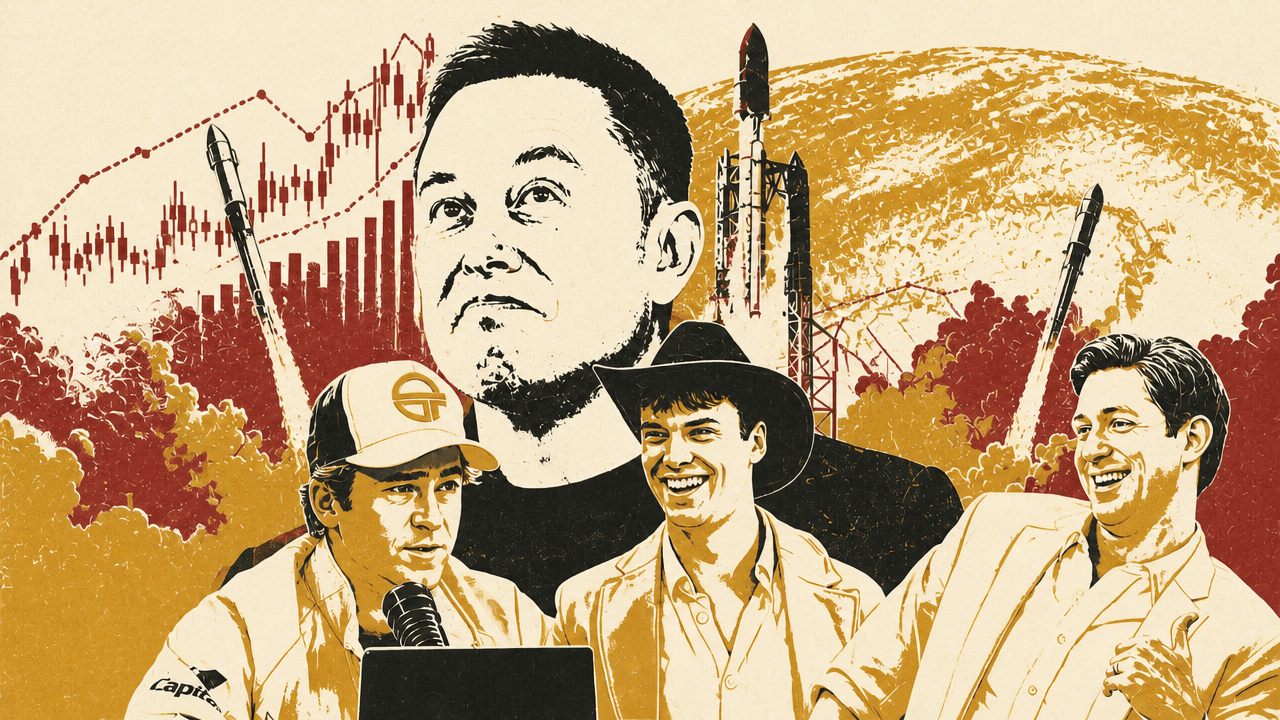
A mid-20s pop looked orderly at a multi-trillion-dollar scale
Jordi Hays framed SpaceX’s public-market debut as a success not simply because the stock rose, but because the move looked large without looking disorderly. He said the IPO had priced at $135 a share and opened at $150. Early in the trading day, with the live price moving on the broadcast chart, he put the stock around $172 and said SpaceX was “a $2.28 trillion company now.” The chart carried the same broad picture: SpaceX, under the ticker SPCX, at $2.28 trillion, up about $506 billion intraday, or 28.59%.
Hays’s test was the size and character of the first-day move. He said there had been “a bunch of chatter back and forth” — bull cases and bear cases — but that it was hard not to see the IPO as successful. Citing the familiar Bill Gurley-style concern that a company should not want a “crazy pop” on day one, Hays argued that a 10%, 20%, or 30% move in a company this large felt like “everything came together properly.” A 100% first-day pop would have told a different story. A gain in the range SpaceX was showing, in his view, suggested strong demand without the sense that the offering had lost control.
John Coogan reached a similar judgment when the stock later settled closer to a $2.24 trillion market cap and a roughly 26.5% gain. The chart was not producing the intraday drama some viewers wanted. Coogan called it “very stable” and described the listing as “very well managed” from start to finish. Hays added that at this scale, even if the share count available for trading was small, SpaceX was now so large that it was harder for the stock to move casually like a smaller issue.


The noon prediction game made the range more legible. Coogan had picked no pop at all: $135, exactly the IPO price, on the theory that the funniest outcome would be perfect banker pricing and a perfectly efficient market. Hays was much more bullish. He said he had expected something around $183 by noon, thought the stock would open above $170, and expected it to keep running. Tyler predicted a 31% move, about $176.
| Person | Prediction | Result against noon price |
|---|---|---|
| John Coogan | 0% pop, or $135 | Too low |
| Jordi Hays | About 33%, around $183 | Too high |
| Tyler | 31%, about $176 | Closest, but still high |
At the reveal, the stock was around $167, which Hays described as a roughly 24% pop. Hays conceded he had been too bullish. Tyler was closest, though still high. The prize was not financial exposure; Coogan handed him an extra Ramp ad read.
Shotwell cast the IPO as another operating day
The Nasdaq ceremony centered on Gwynne Shotwell, SpaceX’s president, who stood at a podium beneath SpaceX and Nasdaq branding and opened by telling employees and shareholders, “Today we make history... again.” Her speech did not present the public listing as a pause in operations. She said SpaceX had opened the morning “in a rather exciting way” by launching Falcon 9 with Starlink satellites to orbit.

What company would do such a thing on the day that they open in the public market? SpaceX would.
Shotwell compressed the company’s history into a sequence of objections and answers. She said everyone had said SpaceX could never get to orbit; in 2008, six weeks after the failure of Falcon 1 Flight 3, SpaceX got “the first liquid fueled rocket to orbit from a private company.” Then skeptics said that was only a small rocket; two years later, Falcon 9 reached orbit. Then came the doubts that SpaceX could reach the Space Station or carry astronauts there; she answered those with another “check.” Then came the claim that Falcon 9 would never fly enough to reach production scale; she pointed to 96 launches the previous year.
The next objection was scale. Doubters said SpaceX would never build a rocket large enough to take humans to the Moon and Mars. Shotwell’s answer was Starship: SpaceX had built it, flown it, recovered and reflown the first stage, and she said she believed that this year SpaceX would get the vehicle to orbit and recover the second stage.
Shotwell also linked the listing to what she described as the company’s merger or acquisition of xAI. She said the combined group now owned “the largest coherent gigawatt class compute on the planet,” which would help it “truth seek and understand the universe.” The line sat inside a broader message: SpaceX was entering public markets without becoming conventional in ambition or cadence.
She said SpaceX was about 22,000 employees strong, and that more than half of them had bought additional stock in the opening, totaling almost $1 billion. Her thanks went to employees for “keeping a straight spine as the doubters doubt” and for achieving historic things “sometimes every day, multiple times a week.” She told most employees to take a moment to celebrate, while noting that the Falcon recovery team could not take one immediately.
Hays described SpaceX as one of the most remarkable stories “in the history of capitalism” and “in the history of America,” and called Shotwell one of the most impressive executives of the modern era. Coogan then supplied the biographical frame. Before SpaceX, he said, Shotwell had worked at Chrysler and at the Aerospace Corporation, including technical work on military space research and development contracts.
That background mattered in Coogan’s account because SpaceX in 2002 did not look inevitable. It was a small startup founded by “a guy who made money on the internet” and now wanted to build rockets. Coogan said Shotwell had described the decision to join as personally risky: she was accustomed to larger, established companies, was starting a family, and was a part-time single mother. She had drawn out the decision for weeks.
The phrase Coogan highlighted from Shotwell’s own account was that she eventually realized she was “being a total idiot” by focusing too much on whether she or the company might fail. The trying mattered: “Try that risky thing, be a part of something exciting.”
Hays noted that Shotwell was SpaceX’s seventh employee. Coogan added that she joined as vice president of business development, not as a founder or chief executive, which he said probably helps explain how her equity position developed. She was promoted to president and chief operating officer in 2008, the same year SpaceX won what Coogan called a critical $1.6 billion NASA cargo transport deal.
Coogan also described the operating texture around Shotwell. He said she was paid $86 million the prior year, mostly in stock options, and was one of eight SpaceX board members. She was 62 and had worked with Musk for two decades. He described her launch-day ritual: because she was in Scotland when SpaceX first successfully reached orbit, she writes “Scotland” on two sticky notes and places them inside her shoes for each launch, so that she is “in Scotland” every time.
Her role was presented not only as operational but stabilizing. Coogan said Shotwell had been a staunch defender of Elon Musk and had worked to prevent business fallout during political turmoil, including reassuring NASA officials that tensions would pass. He also quoted her view that she liked Musk’s in-person self better than his Twitter self, saying they often felt like two different people. Shotwell’s own social media presence, he noted, is sparse and almost entirely about SpaceX.
Residual capability explains how surplus becomes a new market
John Coogan connected Shotwell to the phrase “residual capability,” which he described as an important way to understand SpaceX’s strategy. He was not sure whether Shotwell coined the term, but said she began using it around the time Starlink started working.
The idea, as Coogan described it, is that SpaceX built ahead of demand. It created more launch capacity than the market initially required. Because the company could build and launch rockets efficiently and affordably, and because there was room on its rockets, it could deploy a massive constellation of internet-connected Starlink satellites. What might have looked like excess launch capacity became the basis for another major business.
This was not only an explanation of Starlink. It was a model for how SpaceX can create new markets from capabilities that initially look like surplus. Coogan pointed to point-to-point transportation as another possible residual-capability business: a passenger could board a Starship in New York and arrive in Tokyo in roughly 30 minutes by going to space and returning to Earth.
Coogan said that idea had been more prominent for a time, but had taken a back seat in SpaceX’s S-1 and marketing materials. He did not treat it as abandoned. If SpaceX can deliver “incredible safety and performance and cost reductions” in rocket launches, he argued, then using rockets for long-distance travel remains plausible. He suggested it might even be easier to approve than hypersonic planes, which he said had been stuck in regulatory approvals for years or decades and had not really worked out.
The open-competition argument was presented as vindicated by execution
A Jimmy Soni Wall Street Journal opinion piece cited by John Coogan revisited Musk’s early case for open competition in space. The article was headlined “Vindication For Young Elon Musk,” with the subheadline: “In 2004, he told the Senate that open competition would transform the industry.”
The hearing, as Coogan summarized it, asked whether America could still reach space without the Space Shuttle. The shuttle had been grounded, 14 astronauts had died across two disasters, and there was fear that the United States might rely on Russian rockets for years. The first panel was NASA, including William Readdy, then associate administrator for space flight, accompanied by a retired admiral. The second panel was industry: executives from ATK, Lockheed Martin, the Aerospace Corporation, and then a 32-year-old Musk, who had founded SpaceX two years earlier and had not yet launched anything.
Musk’s immediate complaint, in Coogan’s telling, was not simply about heavy-lift capacity. NASA had awarded a rival a quarter-billion-dollar contract without open competition, and SpaceX had protested. Senators tried to steer him away from the contract dispute because it was already under government review and the hearing was supposed to focus on heavy lift. Musk still got his correction on the record, saying NASA’s process had not in fact been competitive.
The larger claim, as Coogan paraphrased it, was that human spaceflight had entered a “dark age.” Costly government programs had failed to reach the pad. Public drift from space was not indifference but disappointment. Musk borrowed Joseph Schumpeter’s concept of creative destruction: the space industry had lacked successful new entrants for four decades, while computing, the internet, and intercontinental flight had been transformed by newcomers and competition. The government, in Musk’s proposed model, should be a customer rather than a competitor.
Coogan lingered on one Musk flourish from the hearing. Launches from Vandenberg Air Force Base were required to be studied for their effect on local seals, at $10,000 per flight, even though the seal population had grown nearly 13% in a year. Musk joked that the launch activity appeared to serve as an aphrodisiac. Coogan described the laughter as the kind given to a clever outsider.
Two decades later, Coogan argued, that outsider’s argument could be graded by the record. The fear of dependence on Moscow was not ended by the shuttle, in his telling. It was ended by SpaceX. Coogan initially said “In 2002,” and Hays corrected him to 2020: a SpaceX capsule carried two astronauts to the International Space Station from American soil, closing a nine-year gap in which the United States paid Russia as much as $90 million per seat. The semi-reusable rocket Musk described to skeptical senators became a fleet of boosters that land and fly again. Coogan said SpaceX now launches more than half the world’s payloads.
The venture return depended on holding until the company became obvious
The IPO reopened the question of whether Founders Fund’s reported SpaceX investment ranks among the best venture investments ever. Jordi Hays pointed to a $20 million investment at a $200 million valuation, saying it may be the best venture investment “of all time,” even after dilution. John Coogan threw out “$50 billion” as a possible outcome; Hays thought it might be closer to $80 billion. They converted the scale into jokes about “8 trillion cents” and “8 trillion pennies,” but the underlying point was endurance.
Coogan argued that the unusual part was not only the entry price. It was holding long enough. Early investors in Google, Microsoft, and Amazon, he said, often distributed at IPO at valuations around $5 billion. Even founders sold too early, he added, joking that Bill Gates had “paper hands.”
Hays offered a counterexample: Masayoshi Son’s Alibaba investment, which he described as roughly $20 million becoming $70 billion on a shorter time horizon. Coogan conceded the comparison with a joke that Masa had “mogged” the SpaceX return debate.
A Nico Wittenborn post put the Founders Fund claim more directly: at a $2.2 trillion market cap, the $200 million valuation investment might be the best venture investment in history. The attached brokerage screenshot showed SpaceX trading at $169.84, up $34.84, or 25.81%, under the ticker SPCX.
The Peter Thiel detour that followed was less about SpaceX than about founder mythology. An Instagram video from @le_gagnant claimed Thiel had a chess.com account under his real name with more than 50,000 games over ten years, and that the account could be identified by its Silicon Valley and ex-Stanford friends and by matching its openings to Thiel’s public tournament games.
The narrator described beating the account after what he called basic mistakes, while emphasizing that “Peter Thiel never gives up.” Hays took that as the lesson: “Never quit.” Coogan called it respectable, then joked that it was proof that “they’re all ordinary guys.” Hays tied the point back to Musk: powerful people can refuse to quit and still make elementary mistakes.
Allocation scarcity became the clearest demand signal
Demand for IPO allocations supplied the market psychology around the listing. John Coogan read a post from Ben Pouladian saying someone placed a $1 million SpaceX order through a private bank and received only $50,000, or one-twentieth of the requested amount. The post said most people he spoke with got even less, and that unless someone had more than $25 million in credit products or investments, allocations were tiny.
Coogan said the pattern matched what people around TBPN had seen. Team members requested 20, 50, or 100 shares and received only a small fraction. Tyler said he got 22 shares after requesting more. Coogan said many people claimed they received only one share, which he described as almost worse than zero because it sits visibly in the portfolio. Jordi Hays called it “the one share wonder.”
Hays said he had initially been surprised by the scarcity. He had seen offers “flying around” and had been offered something like a $50 million allocation, though he was not going to take it down himself. The apparent availability made him think it was not worth texting people about. In hindsight, he said, demand was far greater than supply.
That scarcity had already become meme material. Coogan read a post from RJC showing an alleged text exchange: “SpaceX IPO this week,” “thoughts on SpaceX?,” “SpaceX IPO what we thinking boss?,” “who is this?,” and the answer: “it’s kyle. i was your uber driver 3 months ago.” Coogan doubted the screenshot was real, noting that Uber drivers do not get riders’ phone numbers anymore and that the rendering did not look enough like iMessage. But he accepted the joke because it captured the moment.
Hays said someone who was “certainly not” a professional investor had texted Nick with the advice: “you want to get in, but then you want to get out.” Get in, get out by the end of the day. That became the crude version of the day-one trading mentality, especially absurd if the recipient had only one share.
The bear case was reputational, while the first-day tape showed demand
The bear case surfaced less as formal valuation work than as reputational skepticism around Musk. A post from Andy, framed as “SpaceX IPO: A Visual Guide,” used a hand-drawn line chart to depict a steep fall from “now” through the next few years followed by a steep rise into 2029. John Coogan interpreted it as a forecast in meme form: SpaceX pops on IPO day, sells off for three years, and then “goes to the moon.” The implied joke was that skeptics would take victory laps if the stock traded down in 2026, 2027, and 2028, only to be upset if the long-term bull case eventually won.
Coogan connected that to articles from the prior year suggesting Musk could not recover from reputational damage tied to politics. Jordi Hays summarized the analogous Tesla bear case as: “No one’s buying the cars.” Coogan’s reply was blunt: “They’re buying the stocks.”
The valuation debate remained impressionistic rather than model-driven. There was no discounted cash flow, peer set, or detailed comparison between launch, satellite internet, transportation, and compute businesses. The argument Hays and Coogan advanced was narrower: on the first day, they saw a successful and well-managed debut, a large but not wild pop, scarce allocations, Shotwell’s operating credibility, and a company whose long-running case for open competition had become much easier to defend after two decades of execution.