Ferrari’s $640,000 EV Tests the Limits of Brand Scarcity

John Coogan and Jordi Hays argue on Diet TBPN that Ferrari’s first EV, the roughly $640,000 Luce, exposes a strategic problem rather than simply a design controversy: it is expensive, not clearly scarce, not obviously superior on range or performance, and positioned against EV makers with stronger software and scale. They make a similar case about the Enhanced Games, which Hays says had an appealing premise but failed to create the records, stakes or emotional context that make Olympic-style competition compelling. In both cases, the hosts contend that a strong concept is not enough to establish a market.
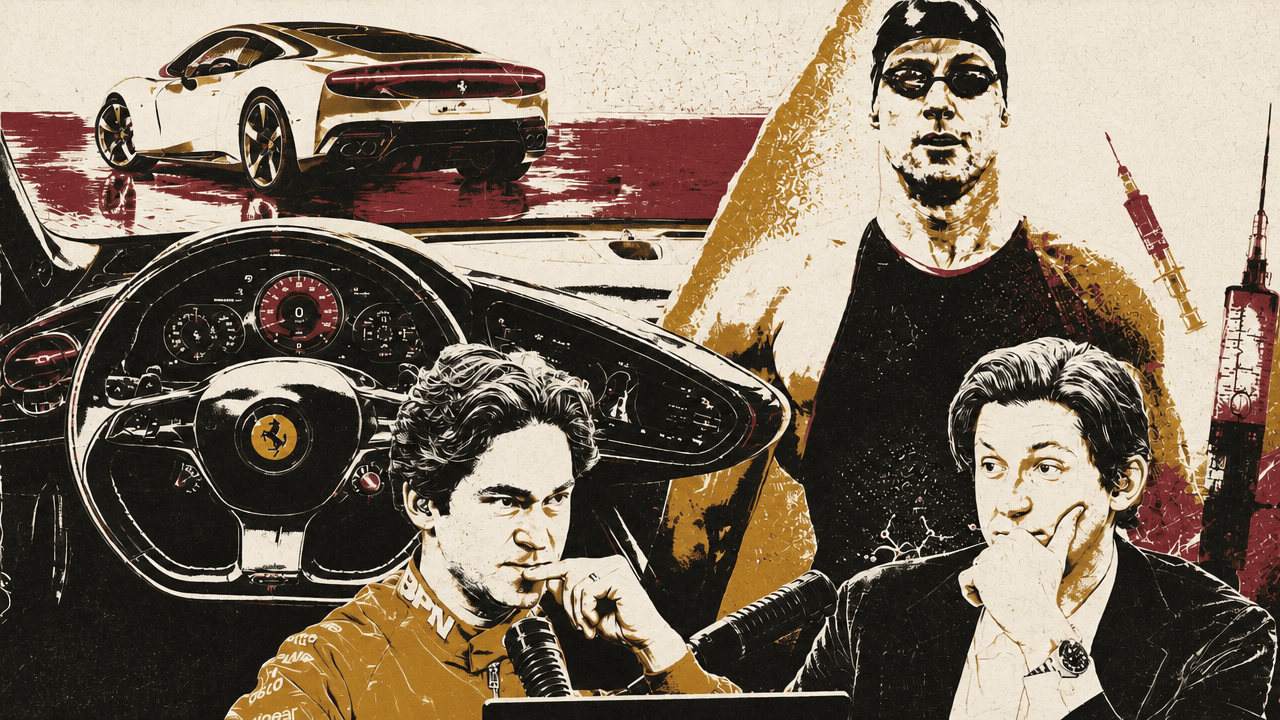
Ferrari’s first EV lands in the wrong part of the market
John Coogan and Jordi Hays treated Ferrari’s Luce less as a simple product launch than as a test of whether Ferrari can make an electric car that preserves the usual Ferrari logic around price, scarcity, performance, and desirability. The car, shown through Wall Street Journal coverage and on-screen imagery, is a roughly $640,000, glass-heavy electric Ferrari named after the Italian word for “light.” The on-screen Journal post described it as Jony Ive-designed, and a later social post shown on screen framed it as the first electric Ferrari designed by LoveFrom. It is also a four-door, five-seat vehicle — a description that immediately put pressure on the “speedster” label used in the Journal’s framing.


Coogan’s first objection was semantic but revealing: when he hears “speedster,” he thinks of a smaller, two-seat car, not a four-door car with room for five. Hays pushed back that it is at least “quick,” and the source gave a claimed zero-to-60 time of less than 2.5 seconds. Coogan did not treat that as enough to settle the case. The car has a reported 1,000 horsepower, but he noted the absence, at least in what they had seen, of the kinds of performance markers enthusiasts would normally use to understand the car: Nürburgring time, track video, and a more complete performance picture.
The comparison quickly became uncomfortable for Ferrari. Hays said he had confirmed the Luce is about half a second slower from zero to 60 than a Tesla Model S Plaid. Coogan added that the Luce’s claimed top speed of 190 mph is below the Plaid’s 200 mph. At that point, both hosts treated raw acceleration as a weak basis for a $640,000 argument. Coogan framed straight-line speed as almost muscle-car logic; Hays asked what “performance” even means for this buyer — acceleration, top speed, cornering, track handling — and doubted this car was intended to be a “track weapon.”
The range was a larger problem. Coogan cited 330 miles despite what he described as an unusually large battery, while noting that recent BMW and Volvo releases run more than 500 miles, the Lucid Air Sapphire is over 500, and many Teslas can reach into the 400-mile range. He granted that 330 miles is “totally usable for most people,” especially with home charging and daily use. But that concession sharpened the strategic question rather than resolving it: if the Luce is not the best track car, not the fastest straight-line EV, and not a range leader, “how does it fit into someone’s life?”
Hays’ answer was that the car is “the most confusing release from a major automotive manufacturer” he could remember. He did not reject the design outright. He said it looks unique, that the interior is “obviously cool,” and that certain angles look great. He could imagine an all-black version working well. But he could not make the price make sense, especially because the Luce costs more than Ferrari models he sees as more obviously desirable: the Purosangue, 12Cilindri, Testarossa, 296, and SF90.
The hosts treated the Luce’s price as the core contradiction. Hays said he expected something in the $300,000 range. His reconstruction of the product path was speculative but central to his critique: Ferrari may have started with the idea of its closest thing to a mass-market daily EV — practical, distinctive, built around the combination of EV architecture and a Jony Ive-style interior — only to see the cost rise until it landed at roughly $650,000. At that level, he argued, the concept stops working.
Unlimited production makes depreciation part of the product story
John Coogan placed the Luce inside Ferrari’s existing pricing and production structure. Ferrari has historically had a tier of limited-production halo cars — he cited the F40, F50, F80, LaFerrari, and Enzo — and another tier of more accessible, though still expensive, production sports cars in the lineage of the 360, 430, 458, 488, and 296. The SF90 complicated that structure: it sat above the traditional mid-engine sports car, cost far more than a 296, but was not a tightly limited allocation car.
That mattered because, in Coogan’s account, the SF90’s unlimited-production character contributed to “serious depreciation” and became a warning sign for Ferrari. The Luce does not look like a response to that problem, he said. It looks like a continuation of it. The Luce is described as one of the most expensive Ferraris not tied to a limited production run. Coogan translated that directly: Ferrari will make as many as there is demand for. Hays added that production may end up limited only because demand disappoints.
Hays tied the EV question to the depreciation question more bluntly. Modern Ferraris outside the halo category have already seen meaningful depreciation, Coogan said. Hays then asked what EVs have become synonymous with. Coogan answered: depreciation. Hays could imagine the Luce being “cut in half” quickly. He contrasted it with the Purosangue, whose naturally aspirated V12 gives it a better chance, in his view, of holding up, even if buyers may still be able to find one for around $350,000 in a few years because it is unlimited.
Ferrari’s stock reaction was also part of the discussion, though not treated as a complete verdict. Hays said Ferrari was down 5% that day and had a $62 billion market capitalization; Coogan noted that, compared with many beaten-up automakers, that still looked strong relative to volume. Hays added that it was down 30% over the last year. Later, while reading from coverage, Coogan cited shares slumping around 6% after the unveiling and said the launch had sparked online debate, with many car fans criticizing the design as too far outside Ferrari tradition.
The depreciation issue turned the car from a design debate into a question of what a Ferrari buyer is being asked to believe. Ferrari can charge enormous prices when scarcity, mechanical experience, and brand mythology reinforce each other. Coogan and Hays questioned whether a roomy electric daily driver, sold without a tight production cap, can support that same logic — especially when it sits in a category where Tesla, BYD, Lucid, BMW, Volvo, and others have trained buyers to compare range, software, acceleration, and cost.
The design criticism may be less important than the strategic mismatch
Jordi Hays rejected the simplest anti-Luce take: that Ferrari’s main problem is the styling. He said Ferrari launches are routinely met by a “peanut gallery” that demands the return of Pininfarina. In his view, that reflex is not very useful. Pininfarina is not coming back to define Ferrari in the old way, he said, and he has disagreed with negative reactions to many recent Ferraris that he thinks are excellent in person.
John Coogan used the Pininfarina Battista as a contrast. The Battista, an electric hypercar, looks like what many people expect from an exotic EV: poster-car proportions, McLaren/Ferrari-like styling, a two-second zero-to-60 time, and a price north of $1 million. Coogan said it looks like the result of asking ChatGPT to “make me a hypercar.” That can satisfy expectations, but he suggested it also reveals the limits of the category. The buyer who wants that shape may really want a naturally aspirated V12, a manual shifter, and a focused experience rather than practicality.
By that standard, the Luce is at least genuinely different. Coogan said that if someone asked an image model for a hypercar, they could “sit there for days” and not get something like the Luce. That difference can be good or bad. It makes the car more original than a generic electric hypercar, but it also means it does not meet the fantasy many Ferrari buyers bring to the brand.
The on-screen social reaction captured both poles. A tweet attributed to Haris quoted former Ferrari chairman Luca Cordero di Montezemolo saying, in translation, that if he said what he really thought he would be doing Ferrari harm; “You risk destroying a legend”; and, most sharply, that he hoped Ferrari would “take the prancing horse off that car.” The quote ended with the line: “This, for sure, is one car the Chinese at least won’t copy off us.”
Another tweet, from TJ Parker, defended the car. Parker, identified in the tweet as a former F40 and 360 owner who had driven most modern Ferraris, wrote that he thought the Luce was “great,” with an interior “fully Jony” and an exterior “totally Marc,” referring to Marc Newson. He imagined that “for the ocd types the daily interactions are going to be quite satisfying.” Hays said he was excited to drive one but would not buy one.
Hays read a second Parker post arguing that, in 10 years, “Jony Ive Ferrari design” could be the main business at a $150,000 to $250,000 equivalent price point, gradually washing out Ferrari as it exists today. Launching at today’s price, in that view, preserves the “dying” core business while Ferrari transitions to something more like an Apple-style business.
Coogan and Hays both took the opposite side. Coogan said that transition sounds “so hard to do” and argued Ferrari is more likely to become an ultra-luxury brand: fewer cars, very high prices, and a tighter focus on hardcore enthusiasts. He pointed to what he described as manual and naturally aspirated interest returning, and said Ferrari is already making, in his account, a version of the 296 without the EV componentry. Hays agreed with the direction but floated one extreme alternative: Ferrari could effectively license the badge, let a company like BYD build a $50,000 car, and charge another $50,000 for the prancing horse. He called that “full capitulation,” though he said it could make sense.
Ferrari’s EV problem is not only the drivetrain
John Coogan framed Ferrari’s EV challenge as broader than whether it can build a fast electric car. If the Luce is meant as a daily driver, it competes against companies whose advantages are not just batteries and motors, but software, vertical integration, and accumulated EV product habits. Tesla, in Coogan’s account, brings self-driving capabilities, parking and summon features, games, a soundboard, and a long list of functional or quirky features that make the car useful in ordinary life.
Jordi Hays agreed that the Luce has tactile and distinctive design elements, but he did not think those overcome the broader competitive gap. Tesla has made cars that are simply very drivable, he said, and in the $50,000 to $60,000 range, buyers can get range and performance from Tesla or BYD that make the Luce’s 10-times-higher price difficult to justify. His conclusion was severe: Ferrari cannot be competitive in this EV segment. “This segment,” Coogan clarified, and Hays said yes — for this kind of EV, he thinks it is “completely over.”
Coogan then used Waymo as an analogy for how a company might decide which parts of an EV-adjacent product to source and which parts to control. In his description, Waymo is sourcing the powertrain and battery from Chinese EV manufacturers while keeping telemetry, telecommunications, and IT systems as Waymo-controlled systems. He presented this as his read of a strategy: capture the benefits of the Chinese industrial supply chain in batteries, frames, powertrains, drivetrains, and related components without inviting the headline that the whole product is simply a Chinese car. He also acknowledged that people would still be suspicious.
The analogy brought the Ferrari question back to a practical constraint: if Ferrari cannot match dedicated EV companies on cost, range, software, or industrial scale, then it has to decide which parts of an electric car it truly needs to make itself. Hays’ hypothetical badge-licensing deal with BYD was intentionally extreme, but it pointed to the same pressure. An ultra-luxury carmaker may have to rely on others for parts of EV manufacturing that no longer carry much brand differentiation.
The Enhanced Games had a stronger concept than event
The second major subject was the Enhanced Games, which Jordi Hays watched at David Senra’s house. His reaction was immediate and negative enough that, 15 minutes into the event, he texted John Coogan that he thought the stock would “nuke” on Tuesday. Hays later said it was down 41%.
The concept itself still appealed to him. Hays described the Olympics as an exciting cultural moment even for people who do not closely follow swimming, weightlifting, running, or other Olympic sports. He has fond memories of watching them. Taking that structure and adding steroids, he said, is “a very fun idea.” Coogan summarized the promise as “jet fuel”: performance enhancement should, in theory, enhance the viewing experience too.
But Hays said the event did not deliver on that promise. He was willing to forgive some production shortcomings because it was the company’s first event. The commentary team had not done this before, the production did not feel like the Olympics, and the whole thing was being “birthed” in public under an unusual amount of attention. Coogan asked whether it lacked the kinds of advanced cameras and ultra-slow-motion tools that make elite sports broadcasts legible. Hays said they were trying, but the deeper issue was not just polish.
The core problem, in Hays’ view, is that viewers cannot visually perceive most marginal records without the surrounding machinery that gives those records meaning. You can watch someone run and tell they are fast, but not necessarily whether they are breaking a record. You cannot see the difference between lifting 220 kilograms and 220.1 kilograms. Without strong graphics, overlays, comparison lines, and a rich context, the enhanced premise does not automatically translate into an enhanced spectacle.
The event also lacked what Hays sees as the Olympics’ real emotional engine. Olympic sports work because extremely niche pursuits suddenly receive global attention, often for a few minutes every four years. The athletes represent countries. The stakes are framed as national pride, glory, and the culmination of a life’s dedication. In the Enhanced Games, Hays felt none of that. The organizers were trying to build athlete brands ahead of time, but he did not feel bought into the storylines. He saw former Olympic athletes, some highly accomplished, opting into a for-profit event that felt partly like a payday.
The human spirit is way more powerful than any PED.
The most damaging detail was that no records were broken until the final event, according to Hays’ account. He and the group turned the event on, drifted outside to make a fire, and came back near the end without realizing that the night had not produced the expected record-breaking spectacle. For Hays, that made the event feel less like a rival to the Olympics than a clever marketing vehicle for generic supplements. He noted that on enhanced.com, consumers could buy testosterone and other products, while making clear the show had no affiliation.
His final read was unexpectedly optimistic about ordinary human achievement. Watching the Enhanced Games made him feel that decades of obsession, national representation, and the emotional structure of the Olympics may be more powerful than performance-enhancing drugs. He called that a “major white pill for humanity.”