Enterprise AI Enters Its ROI Era as Token Costs Surge


John Coogan and Jordi Hays use the latest Diet TBPN to separate spectacle from operating reality: Blue Origin’s New Glenn explosion is a serious but recoverable setback in a capital-heavy launch race, while enterprise AI has moved from adoption theater into a phase where executives are asking what token spend actually produces. Their larger argument is that capital, cadence, and measurable output now matter more than headline momentum, whether in rockets, AI budgets, trophy fossil auctions, or frothy AI-adjacent markets.
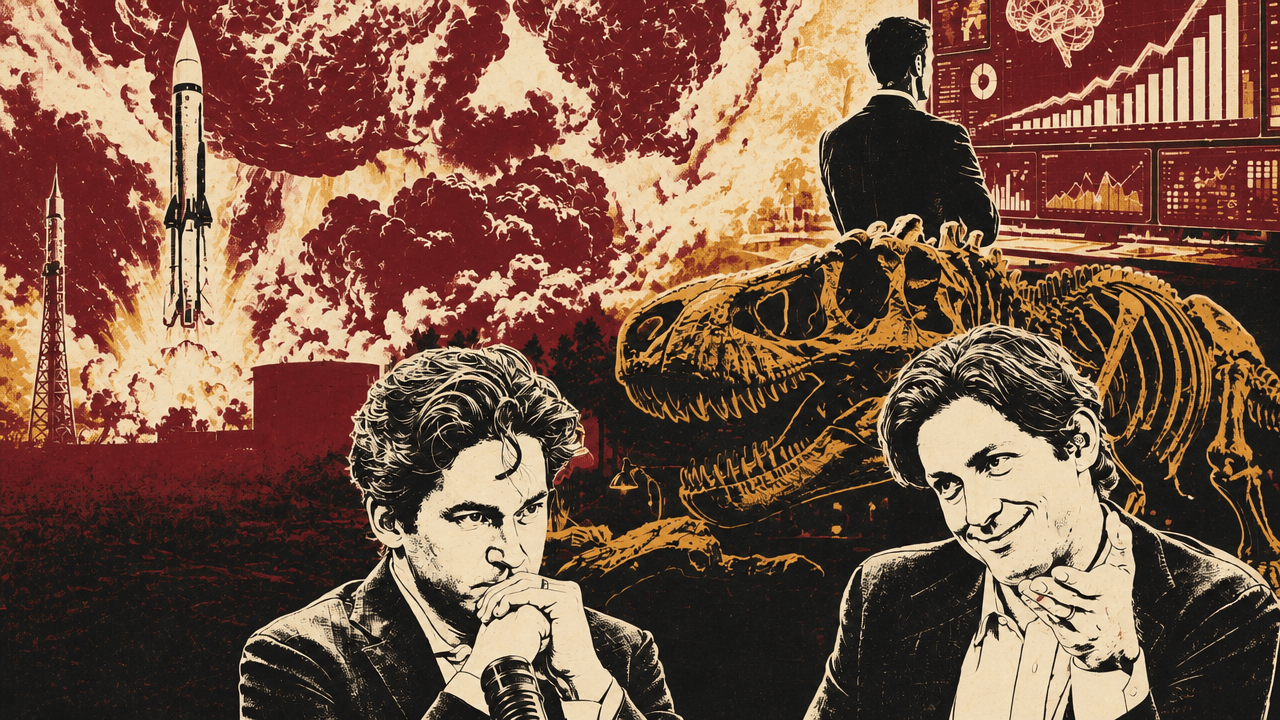
Blue Origin’s setback is a launch failure, a pad problem, and a capital problem
John Coogan framed the New Glenn static-fire explosion at Launch Complex 36 as both a dramatic technical failure and a competitive problem for Blue Origin. The footage showed a nighttime ignition followed by a massive fireball; Jordi Hays said it looked “like a nuclear bomb went off,” while Coogan compared the image to Oppenheimer.




The failure mattered beyond the spectacle because Coogan placed New Glenn in the market Blue Origin is trying to enter: reusable heavy-lift orbital launch, competing with SpaceX’s Falcon Heavy. In Coogan’s framing, a company built around launch faces a harder strategic position when its leading competitor has launch revenue, Starlink, and what he described as an AI-related business layered on top. A setback on the pad is therefore not just an engineering delay. It arrives in a market where SpaceX is expected, in his view, to have enormous capital to deploy toward higher launch cadence and broader ambition.
Hays added the historical sting: Blue Origin started before SpaceX. Neither host claimed to know how far the explosion would set Blue Origin back, but both treated it as significant.
The most important immediate fact was that no one was hurt. Coogan stressed that the pad appeared, in the footage, to be surrounded by substantial infrastructure, which made the absence of injuries remarkable. He cited Jeff Bezos’s response — “Very rough day, will rebuild whatever needs rebuilding and get back to flying, it’s worth it” — and Elon Musk’s supportive line that “Space is hard,” later paraphrased by Coogan as “rockets are hard.”
That solidarity mattered to Coogan because he argued that multiple American heavy-launch providers are valuable even for people who favor SpaceX. New Glenn reaching orbit had been exciting, he said, because it showed another American provider demonstrating the relevant rocket technology. His broader point was industrial depth: even America’s second-best rocket provider, in his phrasing, was “better than everyone else” around the globe.
Tyler added that the static-fire failure was preparation for the fourth New Glenn test. On the third test, he said, the rocket “kind of correctly went up” but deployed an AST Space satellite into the wrong orbit. Coogan took that to mean Blue Origin had been on a relatively good cadence before the explosion, while still calling this failure a “huge setback.” Tyler also observed that AST Space was down 16% that day. Asked whether that was because of the Blue Origin event, Coogan answered: “most likely.”
The damage assessment became more measured once daylight images appeared. Coogan said early descriptions pointed to “extreme structural damage” to Blue Origin’s only functional launch pad and noted that New Glenn had only one successful flight out of three attempted tries. He also compared the failure pattern to SpaceX’s early Falcon 1 period, when Elon Musk had three consecutive failures before a successful launch, arguing that failure is a natural state of rocket development even when it is painful to watch.
Daylight aerial views of Launch Complex 36 looked less catastrophic than the explosion footage suggested. Coogan said he had expected a crater. Hays said he had expected “total destruction,” but the images showed much of the surrounding infrastructure still standing. That did not imply an easy return to operations. Hays argued that every nut and bolt on the standing tower would still need to be inspected, re-examined, and checked for damage or corrosion.
Internet reaction supplied the memes, not the core assessment. A post shown from the account Truthful declared that New Glenn had “entirely exploded on the pad” and that “the whole vehicle is gone.” Another post compared the failure to Roman Roy’s fictional rocket launch in Succession. Coogan and Hays leaned into the comparison briefly, but the durable assessment was straightforward: Blue Origin will rebuild, and the setback lands in a launch market where cadence, capital, and competitive breadth matter.
Enterprise AI has moved from adoption theater to ROI accounting
Jordi Hays said enterprise AI adoption has moved quickly from early experimentation into Fortune 500-scale rollout. In his telling, Anthropic had recently passed “47 billion in ARR” and raised a large Series H at a $965 billion post-money valuation, while Claude Code had gone viral among early adopters months earlier as small “vibe coding” apps launched daily. The figures were delivered as part of Hays’s setup for the spending debate, not as an audited financial presentation.
The problem now is that adoption has become double-edged. Companies are spending more on tokens, and executives are asking what those tokens are producing. The issue was not an anti-AI turn. It was the next phase of enterprise deployment: after experimentation comes accounting.
Several examples carried the point. Hays cited reports of “token maxxing” dashboards at name-brand companies such as Meta, where employees allegedly left systems running overnight or generated unnecessary work to climb usage leaderboards. He described Uber as having blown through its AI budget, while cautioning against an overly simple interpretation. If Uber set a 2026 token budget in 2025, he said, model capabilities and costs may have changed enough that the original budget was too small. The more reasonable version of Uber’s concern, in Hays’s account, was not that AI had no ROI, but that the next iteration of adoption would require understanding its bottom-line impact.
John Coogan put the executive question plainly. Big numbers invite scrutiny. If a company spends hundreds of millions on AI in a month, leaders will ask what was made, what was done, and what actually got finished.
What did we make? Yeah. What did we do? How did we spend it? What did we get done? It's tough. What did we get done this month?
Hays cited Axios reporting from Madison Mills about a CFO worrying over a half-billion-dollar accidental AI bill. Mills’s post, shown on screen, summarized the theme as: “Corporate America enters its AI reckoning phase as IT bills keep rising and consumer sentiment nosedives,” including “an account from a CFO fretting over a half a billion dollar accidental AI bill.” Hays imagined the internal escalation: someone finds the number, raises it to the CTO, then eventually the CFO hears that the company “accidentally spent half a billion dollars in the last 30 days.”
He rejected a conspiratorial reading that Amazon-related AI spending was merely designed to help Anthropic’s valuation because Amazon has exposure to the lab. In Hays’s view, the pattern was broader than one investor-company relationship: multiple hyperscalers without the same active positions were seeing similar dynamics. The point was not a single accounting trick but a category-wide surge in cost.
Coogan’s bull case was cost deflation. The cost per completed AI task, he argued, should fall quickly. Even if a company is spending half a billion dollars a month today, the same output might cost one-tenth as much next year, or half as much. Hardware depreciation, additional power coming online, open-source model progress, distillation, and cheaper capability replication all push in the same direction. Hays called the trend “naturally deflationary.”
Coogan pointed to the familiar pattern of capabilities becoming open source, cheaper, and distilled into systems that deliver “90% of the value,” even if not the exact same flavor. That does not solve today’s misuse. He gave the example of people using LLMs to get weather reports — something he admitted he had done — while noting that it is one thing to ask a free chat app and another to use an expensive coding model for the task.
Hays supplied a more concrete consumer analogy. He described meeting someone who had built an agent that checked an iOS contact book for newly added entries, solving the problem that Apple does not offer a simple “sort by recently added” feature. A cheap app could perform the basic function. An agent could also do it, then email a summary or go further. The question is whether the added capability is worth the additional cost and complexity.
In the enterprise, Hays said, the same trade-off gets multiplied by “five extra zeros” or even “nine extra zeros.” The problem is not whether AI can perform tasks, but whether companies are pointing it at their highest-leverage problems. If teams use AI to attack old backlog items that were deprioritized for good reason, that may not be ROI-positive at current token prices. Some cutting-room-floor work, he suggested, should remain on the floor.
Token maxxing turns measurement into waste
The critique centered less on AI tools than on incentives. A literal token leaderboard can create obvious bad behavior: if employees are rewarded socially or organizationally for using more tokens, they will use more tokens. Jordi Hays argued that the same dynamic appears even without a leaderboard. A budget can become a target.
If an employee receives a token budget and does not spend it, they may appear not to be deploying the capital they were given. Hays compared it to a marketer with a million-dollar brand budget who returns having spent only $100,000; the manager may ask why the marketer did not find productive uses of the money. At the same time, spending just because a budget exists is wasteful. Hays described this as a familiar enterprise problem, now showing up in AI.
John Coogan summarized the governing forces as Jevons paradox and Goodhart’s law. When something becomes more efficient, people often use more of it rather than less. And when a measure becomes a target, it stops being a good measure. Hays jokingly called the combination “Coogan’s law,” while Coogan settled on “Coogan’s paradox”: both Jevons paradox and Goodhart’s law are true.
The Wall Street Journal headline shown on screen marked the mainstreaming of the concern: “Corporate America Is Starting to Ration AI as Cost Skyrockets,” with the subhead that executives are scrambling to track returns on AI investments as computing bills come due.
Corporate America Is Starting to Ration AI as Cost Skyrockets.
Coogan read the article’s basic claim: large companies urged employees to integrate AI, spent freely to encourage experimentation, and signaled to Wall Street that they would not be left behind. The result was skyrocketing token costs. Now corporate leaders are trying to ration AI and ensure it contributes to productivity.
The companies named in that coverage included Uber, Meta, Microsoft, Salesforce, DoorDash, and others. Coogan said some technical executives are reducing tool availability for certain employees or otherwise requiring evidence that AI usage moves productivity. He described the new environment as one where users get “nerfed” if they are not producing results.
Rationing was not treated as a rejection of AI. Coogan argued that it is healthy for companies to correct quickly after a few months of excessive experimentation: stack-rank token usage, cut unnecessary spend, and preserve productive spend. He contrasted two kinds of AI builders. One vibe-coded project may have extremely high token costs and little value. Another person may build something useful inside a normal $200 monthly subscription because they know what they are making and use the tool “like a scalpel not a hammer.”
A post from deepfates supplied the sharper version of that distinction: “I fear not the man who vibe coded 50 new apps, but the man who vibe coded one new app 50 times.” Coogan called it a “banger post” and suggested the intended phrasing may have been “the same app 50 times.” The line fit the ROI argument: iteration toward a real product is different from spraying tokens across disposable experiments.
Tool discipline, rather than blanket spending, was the practical heart of the AI segment. Experimentation helped companies enter the adoption phase. ROI discipline will determine what survives it.
Dinosaur fossils are becoming trophy assets
The Financial Times front page supplied a different kind of asset story: Sotheby’s planned auction of “Gus,” a 67-million-year-old Tyrannosaurus Rex fossil named after Gary “Gus” Licking, the South Dakota rancher whose land it was found on. John Coogan said the auction was estimated at $20 million to $30 million and scheduled for July 14 in New York.
The sale followed Sotheby’s prior auction of “Apex,” a Stegosaurus fossil sold to Citadel founder Ken Griffin for $44.6 million. Coogan noted that the pre-auction estimate for Apex had been only $4 million to $6 million, making the final price a dramatic outlier. Jordi Hays joked that he had not known Stegosauruses were “getting up there like that.”
| Fossil | Dinosaur | Figure cited |
|---|---|---|
| Gus | Tyrannosaurus Rex | $20M–$30M estimate |
| Apex | Stegosaurus | $44.6M sale after a $4M–$6M estimate |
The hierarchy of desirability was treated like a collector market. Coogan placed T. Rex at the top. Hays called it “the Ferrari of dinosaurs.” The Stegosaurus, by contrast, became the subject of mock asset-class debate: Hays first compared it to a minivan, then suggested maybe a Lamborghini, before saying serious dinosaur collectors may see momentum there even if it lacks the T. Rex’s heritage.
Coogan read the auction-house strategy as a bet that fossils are a market where the wealthy will spend heavily. He also noted a mitigating feature of that market: the overwhelming majority of fossil buyers still want to lend their purchases to museums. Apex, he said, is now on display at the American Museum of Natural History.
The point beneath the jokes was simple: rare dinosaur skeletons are being priced and traded like ultra-high-end collectibles, with auction houses betting that trophy value, scientific cachet, and museum visibility can support major private bids. Coogan called a T. Rex “the ultimate collector’s item,” joking that it is “the Pokemon card for boomers.”
A short coda on frothy AI-adjacent signals
A post from Prepared Remarks compressed several signs of speculative market behavior into one loose list: “Kyle Kuzma the AI maxi,” stocks rising 10% to 50% on a 13F filing, Dell moving sharply after earnings despite already being up heavily year to date, trillion-dollar companies moving 20% on sell-side notes, a “$1.5T space holdco,” 10% to 20% intraday moves “for no reason,” and software with AI exposure up 100% in a month.
John Coogan read the post as a set of “signals,” while Jordi Hays called it “blackpilling.” They did not develop it into a sustained market argument. It functioned more as a quick read on how extreme some AI-adjacent market moves and narratives have begun to feel.
Dell was the one example they lingered on. Coogan said Dell was up 222% year to date, called it “a great American technology company,” and stopped himself from calling it a dinosaur. Hays noted that Dell has been taken private and public and called the history of the company fascinating.