AI Data Centers Face a Local Legitimacy Fight Over Power and Water

John Coogan and Jordi Hays use the day’s OpenAI verdict, Leopold Aschenbrenner’s 13F filing and fights over new data centers to argue that AI’s next constraint is political as much as technical. On Diet TBPN, they treat Musk’s loss to OpenAI as a procedural win, read Aschenbrenner’s filing as an ambiguous signal about the AI-infrastructure trade, and frame the data-center backlash as a widening legitimacy problem over power, water, land and local benefit. The clearest proposed answer they surface, via Ben Thompson, is direct payment to communities asked to host the buildout.
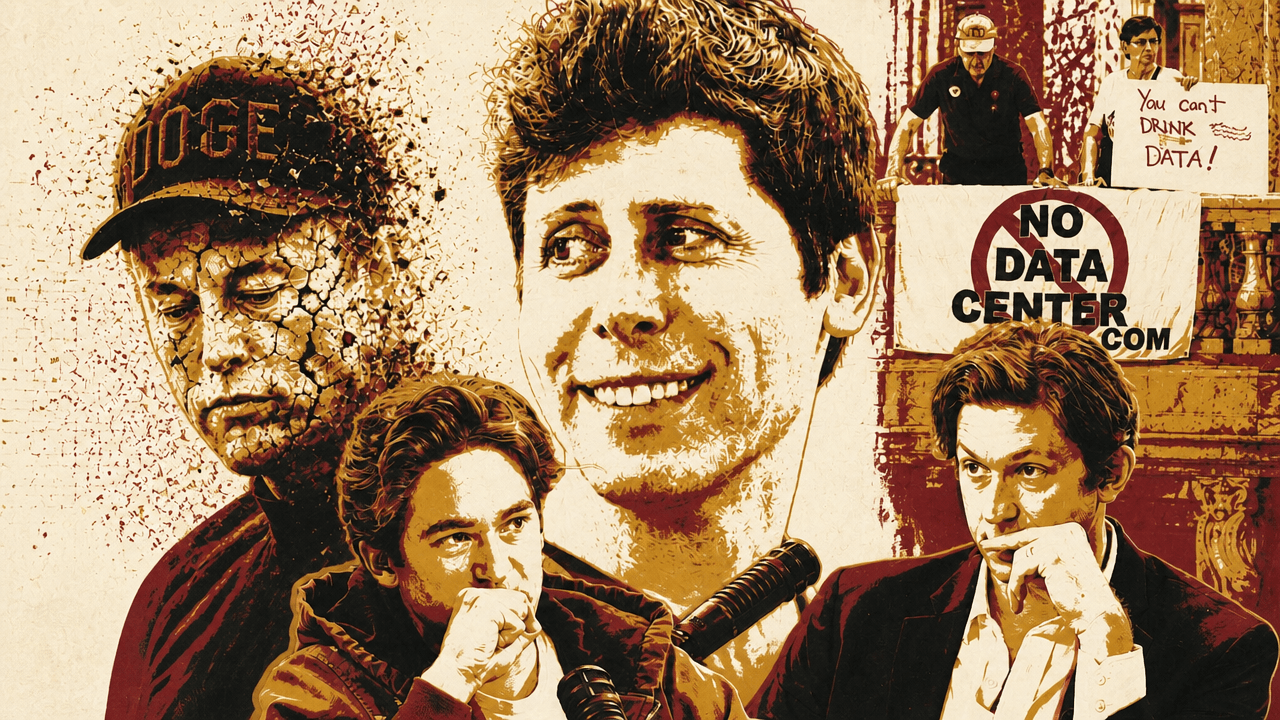
Musk lost on timing, not on a jury’s view of OpenAI’s mission
John Coogan opened with the legal result that mattered for OpenAI: a U.S. jury found OpenAI and CEO Sam Altman not liable to Elon Musk on Musk’s claim that OpenAI had strayed from its charitable mission, because Musk “waited too long to sue.” Coogan treated the outcome as a procedural win rather than a substantive vindication of OpenAI’s structure, calling it a “weird technicality” but “good news for OpenAI.”
The ruling, as presented through posts from Wall St Engine, Wired’s Max Zeff, and Mike Isaac, turned on timeliness. Zeff’s post said the jury unanimously ruled Musk’s claims were dismissed on the timeliness issue, that he filed too late, and that the court would uphold the decision. Isaac’s post emphasized the speed and unanimity of the verdict: 90 minutes of deliberation.
Jordi Hays said the jury “didn’t really make any type of statement other than the statute of limitation.” That distinction framed the hosts’ treatment of the case: Musk lost, OpenAI escaped liability, and the lawsuit was dismissed, but the verdict as discussed did not resolve the broader political and philosophical fight over whether OpenAI has departed from its original mission.
Coogan and Hays lingered briefly on the timing. If the jury arrived in the morning, deliberated for roughly 90 minutes, and returned a verdict, Coogan wondered whether jurors had effectively had the weekend to think about the matter before formal deliberations. Hays’s read was simpler: they showed up, talked for 90 minutes, and reached the result.
A visual shown from Tyler Cosgrove’s X account contained a Drake clip with the line “W’s in the chat.” Coogan read it as a possible representation of the mood inside OpenAI Slack. Hays identified the clip as Drake gambling “in front of God” and joked about his pronunciation of “chat.” The joking aside, the underlying point was direct: for OpenAI, the case was over.


Leopold Aschenbrenner’s 13F became a public AI-infrastructure signal, but an ambiguous one
The weekend’s more revealing market story, in Coogan’s telling, was not simply that Leopold Aschenbrenner’s hedge fund filed a 13F. It was that a hedge-fund disclosure had become a tech-culture event.
Coogan said there had been “a lot of anticipation” for Aschenbrenner’s Situational Awareness hedge fund to release its filing, with people expecting it Friday at 5 p.m. Hays said people were watching for it throughout the day and speculating about why it had not appeared. One theory was that Aschenbrenner had petitioned not to release it. Another was that the fund might be entirely in cash and therefore have little to report. Coogan joked that Aschenbrenner had “counted the ooms and there’s none left to count.”
The filing, as displayed in a post from Shay Boloor, showed new positions including Nvidia, AMD, Intel, TSMC, ASML, Micron, SMH, Corning, Hive, T1 Energy, and SHAZ. The same post said the fund added to AI power and compute names including IREN, Applied Digital, CleanSpark, Riot, Bitdeer, and CoreWeave; trimmed SEI, Core Scientific, and Bloom Energy; and exited Coherent, Liberty Energy, Tower Semiconductor, Hut 8, Lumentum, Kilroy Realty, and EQT.
Coogan described Aschenbrenner’s reputation as built around “extremely successful investments” tied to a core assumption: frontier AI will continue improving at roughly half an order of magnitude per year, or 0.5 “ooms” annually. In Coogan’s summary, that implies unprecedented demand for compute and for the bottlenecks around compute.
What made the filing interesting was the possibility that the thesis had become more discriminating. Coogan said the discussion around the 13F centered partly on “massive puts across the semiconductor sector,” including “two billion on SMH,” the VanEck Semiconductor ETF. He read that, cautiously, as potentially less of a broad “semiconductors will do well” trade and more of a view that Aschenbrenner believes he can identify which companies inside the semiconductor ecosystem are undervalued, overheated, or actually important to the next phase of the buildout.
The Nvidia position complicated the simple version of the story. Coogan noted that the Nvidia trade had at one point become “crushingly obvious” and then so large that it had not been among Aschenbrenner’s early positions. Now, according to the filing, the fund appeared to be long Nvidia. That mattered against a live debate over whether Nvidia still has a moat. Coogan’s answer was not definitive, but he suggested the filing required closer interpretation: “There might still be something else going on there.”
The caution was central. Coogan stressed that a 13F is a snapshot of holdings as of March 31, 2026. By the time viewers saw the filing, the positions were stale. The fund could have rotated out. And although 13Fs disclose put and call options, they do not disclose strike prices, expirations, premiums paid, hedge ratios, short positions, swaps, or whether options are part of broader structures.
Coogan cited a post from “Fey Jow” arguing that the morning had produced “unfathomably bad takes” and that 13F digging is often a waste of time. The post’s argument, as Coogan read it, was that March 31 fell during the “heat of the Iran war,” when it could have made sense to put on hedges. Options exposure on a 13F is quoted notionally as if it were 100 delta, meaning all 100 shares per contract. A headline number such as “he owns a billion dollars of Intel” may mean the fund owns the right to buy a billion dollars of Intel, not that it deployed a billion dollars of capital.
That ambiguity cuts both ways. Coogan acknowledged that option positions can be an important sign of things to come. But he emphasized the limits: viewers could not know whether reported positions were low-delta convexity hedges representing only a fraction of the widely circulated “billions” in puts, or whether they were in-the-money puts. Outright shorts do not get reported. Turnover and trading frequency are unknown. A lot happened in April and May. The fund’s current positioning could be completely different.
The practical advice he took from the exchange was blunt: do not idolize investors and do not make investment decisions in volatile assets using stale, partial filings. Develop a thesis for why you own or sell something.
AI infrastructure is turning into a left-right backlash, and power sourcing is part of the politics
Coogan linked the Aschenbrenner filing to the broader AI buildout through energy. If the fund had taken a position in T1 Energy, he said, that suggested at least some belief that solar could contribute on a shorter timeline than many AI bulls had assumed. He said many AI “maxis” and bulls had worried the buildout would be largely fossil-fuel based because nuclear and solar timelines looked too slow. Nuclear names had moved on the back of the AI buildout, but Coogan said that when they talk to people in the sector, even optimistic timelines point to around 2032.
The politics, in his view, are no longer confined to one ideological side. Coogan said AI data-center pushback had become both a left- and right-wing issue. He attributed that forecast to Saagar Enjeti, who he said predicted it on the show the previous year. On the left, Coogan said, the concerns are job displacement, theft of art, and destruction of creativity. On the right, the newest term is “surveillance centers”: data centers are framed as infrastructure used to spy on people, making opposition an anti-libertarian or right-wing position. He added a local-economic version: a hollowed-out coal town may vote right-wing, then see a data center arrive and conclude it is making the town worse while benefiting coastal elites.
Hays pointed out one irony: both sides are using AI to create anti-data-center graphics. Coogan added that there had been a piece about a data-center protester using AI heavily to research how to oppose data centers. Hays relayed a viewer’s joke that “data centers” should be rebranded as “data ranches,” a term Coogan liked.
The broader pattern was not just ideological. Hays argued later that people generally do not want new things built. In the abstract, people may support more housing, but once they own a home they often oppose new housing in their own community. Data centers, he said, may be “at the bottom” in popularity, but opposition to construction is a broader feature of American society, visible in fights over homes, permitting, and home expansion.
Coogan connected that to nuclear power. Hays said the failure to build out nuclear power 50 years ago was “one of the greatest mistakes humanity has made,” and that it contributes directly to today’s data-center opposition because of anxiety over energy bills. He wondered, without settling the question, whether the country had run out of nuclear scientists or whether something else stopped the buildout.
The Utah data-center fight shows the difference between technical mitigation and political legitimacy
The most concrete example was the proposed Stratos Project in Box Elder County, Utah, associated with Kevin O’Leary. Coogan said the “latest debate” he had seen involved a huge data center championed by O’Leary, whom he described as both a real businessman and someone who “plays a businessman on TV.” That made him, in Coogan’s view, an easy political target.
The optics mattered. Coogan pointed to O’Leary’s public persona, including an appearance at the Oscars wearing a Cartier Crash Skeleton and a ruby Rolex Daytona, and said that if someone wants to paint data-center construction as not in the interest of average Americans, O’Leary “is going to do a lot of the heavy lifting for you.” Hays added that “Mr. Wonderful” as the face of large-scale infrastructure that people fear “sounds like a supervillain.”
Coogan contrasted that with Tim Cook and Eric Schmidt as representatives of an earlier generation of hyperscalers and big tech executives. Companies such as Google and Amazon Web Services, he said, built major infrastructure over a decade or more while making bold climate pledges and avoiding the same kind of backlash. Hays’s simpler version of the contrast: neither Cook nor Schmidt was “rocking dual iced out watches.” Coogan called that a case for “quiet luxury.”
Yet Hays said someone had dug into the Utah plan and it “actually seems pretty reasonable.” Coogan agreed that the current plans looked “by the book”: remote area, its own power and water, and no obvious disruption of local communities.
The hosts then played a TikTok-style breakdown arguing that an uninhabited desert valley in Utah might be the ideal place for a giant data center. The video described the Stratos Project as a $100 billion project, potentially the largest data center in the world, on more than 40,000 acres. It said the site was a single 40,000-acre property, with much of the land remaining undeveloped. A document shown on screen stated: “How big is the proposed data center? The proposed data center project size is 40,000 acres...”
The video’s argument was that the large project area reflected, in part, the purchase of water rights from current property owners. Those owners were described as using water for agricultural irrigation. The project would buy the land and water rights and use the water to cool the data center. The speaker argued that the project was not taking water from local ratepayers or a local community; it was keeping existing water rights in the same valley. Power, the video said, would be produced on site rather than drawn from the grid.
Coogan immediately saw the rhetorical problem. Saying water is being reallocated from agriculture to cool a data center “makes that sound good,” he said, until the listener asks whether there will be less food. Later, when the video said this addressed water concerns, Coogan again said the line was not helping: “But I like vegetables.”
The power argument drew a similar distinction between technical and political claims. The video compared Utah’s electricity consumption with other states and argued that if the project doubled or tripled Utah’s electricity usage over time, that was not inherently bad if it did not raise costs for Utah residents because the project built its own power plant. It also pushed back against a claim from Utah State University physics professor Robert Davies that the project would require an additional 7 to 8 gigawatts of waste heat energy and amount to 23 gigawatts of total thermal load, characterized in an on-screen headline as “equivalent to setting off 23 nuclear bombs per day.”
Coogan called that “a bad framing.” The video argued that all electricity generation produces waste heat because generators are not perfectly efficient; by that metric, the speaker said, Texas would already have “230 atom bombs a day” going off, plus hundreds more across other states. Coogan joked that anything can sound more alarming if converted into atom bombs.
The more serious environmental claim concerned local temperature effects. A screenshot shown on screen said Utah’s average temperature is about 2.5 degrees Fahrenheit higher than in the early 20th century and that Davies predicted dumping the heat into Hansel Valley would increase local daily temperature by 2 to 5 degrees and nighttime temperature by 28 degrees. The video presenter acknowledged that 28 degrees “feels like a lot,” but emphasized that the prediction applied to Hansel Valley, not the state of Utah, and that Hansel Valley is an uninhabited desert valley.
The final defense was that the project addresses many stated concerns: water usage through reallocated agricultural water, power cost through on-site generation, and heat, size, and noise by locating in an uninhabited desert valley. The speaker called the original criticism fearmongering.
Coogan did not fully endorse the defense. He returned to the water-rights ambiguity. If the valley is uninhabited and appears to be desert, where is the agricultural water currently going? Is it piped elsewhere? Were people planning to farm it? Were there active agricultural uses, cattle operations, failed farms, former livestock operations, or unused rights? He explained the underlying issue through groundwater: historically, landowners could drill wells and pump water, but neighboring parcels may draw from the same aquifer. If one property pumps heavily, it can effectively drain the shared resource. Hays supplied the “There Will Be Blood” line: “I drink your milkshake.”
The result was unresolved. The hosts accepted that the plan may be technically more reasonable than critics suggest, but they did not treat that as enough. The politics of water, heat, and local benefit remained fragile.
Eric Schmidt’s commencement backlash captured a broader grievance than one speech
The hosts used Eric Schmidt’s appearance at the University of Arizona as evidence that data-center opposition sits inside a larger anti-AI mood. Hays described the clip as “incredible”: artificial intelligence getting booed during a commencement speech. He suggested that “telling college students AI was taking their jobs” may not have been the best strategy.
The video shown had text overlays framing Schmidt as the former CEO of Google, listing a net worth of $43.3 billion, and at one point accusing the speech of “comparing AI to immigrants.” Another overlay referenced Epstein files, and another displayed allegations against Schmidt. While Schmidt spoke about whether graduates would help shape artificial intelligence and warned that “you will surrender your agency,” the crowd could be heard booing.
Hays noted that the booing did not quickly subside. It sounded to him like “a low level boo the whole time,” escalating toward rowdiness. He said that at some point Schmidt should have gone off script. Coogan said the clip could be cut to make Schmidt sound cartoonishly ominous: “You will surrender your agency.”
Hays’s interpretation was that the audience was not necessarily booing for one reason. It was an ensemble of grievances with AI generally. He said one frustration is that “everyone is vibe coding, like 24/7,” leaving MacBooks open and talking about productivity, while magical consumer technology moments have been left behind. He contrasted the current AI wave with the earlier cloud and mobile era, when data centers accompanied consumer products that felt immediately useful: Yelp for finding restaurants, Groupon for discounted local experiences, Uber for avoiding unreliable taxis or standing outside trying to hail a car.
Coogan joked that perhaps the audience was angry about “nano banana usage limits.” Hays accepted the joke but then made the substantive point: people may think AI progress has plateaued outside coding. Writing from the models, he said, is “still not that good.” Coogan said he could “clock it,” and Hays agreed it remains “clockable.”
There was another possible grievance, offered jokingly by an unidentified speaker and extended by Hays: perhaps people were angry that Google under Schmidt held too much cash, did too many buybacks, and failed to invest enough in technology and innovation. Hays framed that as a “Thielian boo”: the argument that having $100 billion in cash on the balance sheet shows a company does not know what to do with the money, even if it eventually produces Waymo and DeepMind.
Coogan thought Schmidt’s message might have fit better at Stanford, where a student audience might plausibly hear “don’t be afraid of AI; jump in and help shape it” as an invitation. At the University of Arizona, he suggested, graduates may instead hear that multiple career paths they are considering are being disrupted. Hays said he would prefer a commencement speaker like Sam Sulek.
The key reading was not that Schmidt alone misjudged a room. It was that AI’s public legitimacy problem now includes jobs, culture, institutional distrust, consumer disappointment, and resentment of the people delivering the message.
Ben Thompson’s proposed fix was not better messaging alone, but direct payments
Hays brought in Ben Thompson’s proposed solutions for how tech might build data centers without losing the public. The first was messaging, but Thompson’s diagnosis, as Hays read it, was more complicated than “explain better.”
There are three problems, in Thompson’s framing. First, some people in tech, particularly at one leading lab, genuinely believe most jobs are going away. They could lie more effectively, but that would be dishonest and would also conflict with the intensity with which they are pursuing AI despite spending billions on models that become obsolete in months or even weeks.
Second, the benefits are hard to describe because they do not yet exist: inventions not yet made, cures not yet discovered, economic activity not yet engaged in. Hays compared this to nuclear power. Fifty years ago, people could ask why they should build scary nuclear plants when electricity was not that expensive. Now electricity is expensive, and the regret is that the plants were not built.
Third, Thompson argued that tech is bad at understanding and relating to the rest of society. Hays relayed Thompson’s example that Silicon Valley was skeptical of Facebook because the Valley is full of people “running away from their friends and family,” while Facebook was built around connecting with friends and family. Tech people may live in the future, Thompson suggested, or they may live in opposition to and denial of humanity.
Thompson’s second broad solution involved misinformation. Hays summarized his argument that TikTok is a major point in the data-center fight because the algorithm is still controlled by China and may amplify misinformation. Meta, in an ironic turn, learned from past criticism not to overtly censor, but now receives no credit for allowing misinformation about data centers to circulate.
The third point was more speculative. Hays called it “total tin foil hat” but interesting: X may be structurally incentivized to be anti-data-center because X is owned by SpaceX, and part of SpaceX’s future public-offering story may involve building data centers in space. Hays emphasized that Thompson said he had seen no evidence of a thumb on the scale, and Hays had not either. The problem, in that framing, is that people would not necessarily know if there were.
The boldest proposal was direct compensation. Thompson’s “most crass” solution, as Hays read it, was to “simply start giving people money.” Not universal basic income, but payment for the local resource that a data center consumes: community tolerance, land, power, water, and siting.
The numbers made the proposal concrete. Thompson described a data center “up the road” expected to be 1.6 gigawatts and to generate around $3 billion in annual operator revenue. DeForest, the village where it was to be built, has around 11,500 people. Paying every resident $10,000 a year would amount to 3.8% of the data center’s annual revenue. Hays said Thompson believed that proposal would likely have passed and that operators could pass those costs on to data-center users. It also made the original commitment — Hays said he believed it was around $50 million — look “relatively pathetic” by comparison.
| Item | Figure discussed |
|---|---|
| Expected data-center scale | 1.6 gigawatts |
| Estimated annual operator revenue | $3 billion |
| Village population | About 11,500 people |
| Annual payment per resident in Thompson’s example | $10,000 |
| Share of annual revenue required | 3.8% |
Coogan agreed with the underlying logic. Months earlier, he said, they had argued that AI is not like a natural resource where residents automatically benefit from having it in their backyard. Ordinary AI users do not care where the data center is located. If a company wants to put one in a community, it is fair for that community to demand a benefit.
The important shift is from indirect public benefits to direct local compensation. Tax revenue, infrastructure promises, and abstract participation in an AI future may not be persuasive when residents face the costs locally and the benefits globally. A recurring check in the mailbox might be.