Meta’s $18 Billion Settlement Is Small Beside the Tobacco Precedent


John Coogan and Jordi Hays argue that Meta’s $12.7 billion settlement over alleged youth social-media harms is substantial in headline terms but a far smaller and less durable burden than the tobacco settlement it has been compared with. Across the AI stories they examine, the hosts locate the more consequential competition in control of hardware, inference costs, distribution and users’ private data—not simply in increasingly large valuations or striking product demonstrations.
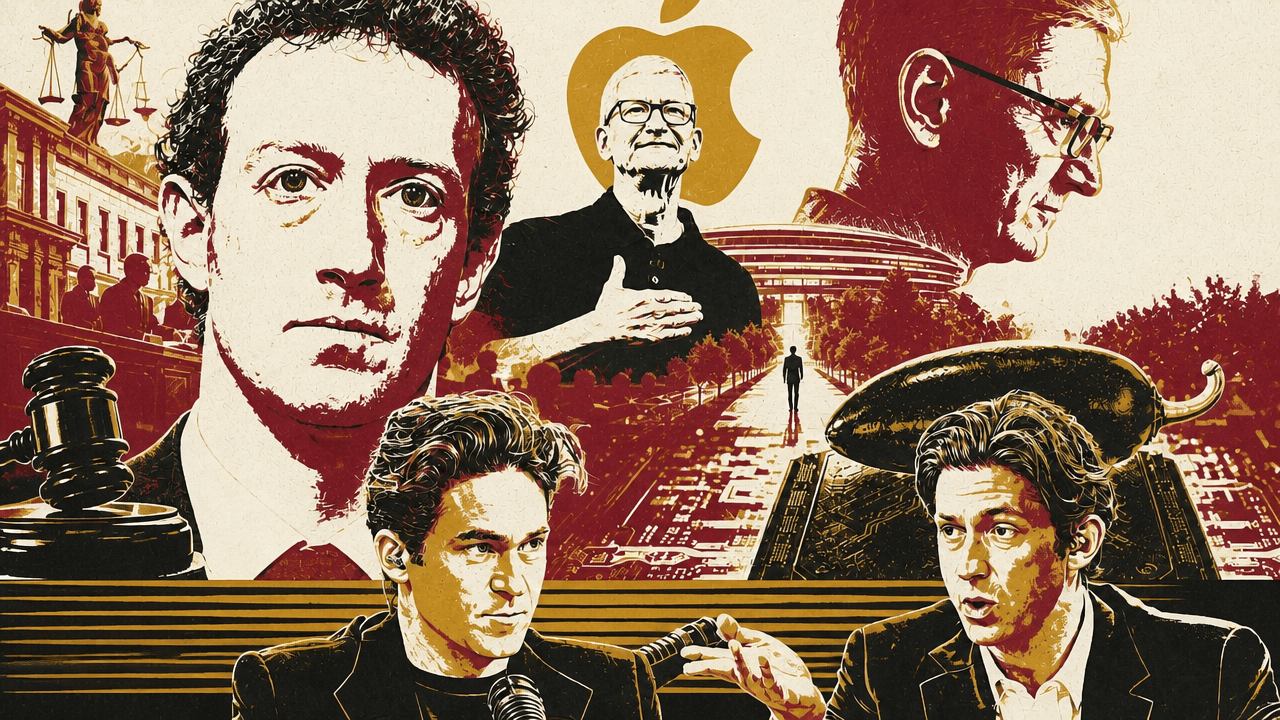
Meta’s settlement is large in dollars but small beside the tobacco precedent
John Coogan characterized Meta’s agreement with attorneys general representing 48 states, the District of Columbia, and three U.S. territories as “the big one” in litigation alleging that Facebook and Instagram harmed children and teenagers. Meta will pay $12.7 billion over 10 years, he said, with the total potentially reaching $18 billion if other platforms join the settlement.


For states, Coogan’s first reading was uncomplicated: the payments create a substantial pool of money that can be distributed across public purposes, from education to health care. The harder question is whether the agreement deserves the “Big Tobacco” comparison that has followed it.
The analogy has an obvious basis. A major industry accused of creating an addictive product has agreed to make multibillion-dollar payments to states. But Coogan, drawing on Eric Seufert’s analysis at Mobile Dev Memo, argued that the comparison changes when payments are measured against the affected industry’s revenue and when the structure of each agreement is considered.
Coogan cited a USDA white paper using Bureau of Labor Statistics data that put U.S. consumer expenditure on tobacco at roughly $57 billion in 1998, when the Master Settlement Agreement was signed. The agreement’s approximately $250 billion in combined payments over 25 years works out to roughly $10 billion annually—about 17.5% of domestic tobacco expenditure at the time.
Meta’s upper-end $18 billion figure would average $1.8 billion a year over a decade. Against the company’s roughly $75 billion in 2025 U.S. revenue, Coogan calculated, that amounts to about 2.4%.
| Settlement | Annualized payment | Domestic revenue or spending base | Implied share | Payment mechanics |
|---|---|---|---|---|
| Tobacco Master Settlement Agreement | About $10B | About $57B in 1998 U.S. tobacco expenditure | 17.5% | Per-pack structure, inflation-adjusted, tracks unit sales |
| Meta settlement at $18B total | $1.8B over 10 years | About $75B in 2025 U.S. revenue | 2.4% | Fixed stated payment over 10 years |
As Coogan put it, tobacco paid 17.5% of domestic revenue while social media would pay about 2.5%. The tobacco agreement’s mechanics matter to that gap. Its per-pack payments are inflation-adjusted and tied to sales volumes; Meta’s settlement, as he described it, has no comparable mechanism. If Meta’s revenue rises, the fixed payment becomes a smaller portion of the business. Inflation would also reduce the payment’s real value over the decade.
Jordi Hays saw the figure as meaningful partly because Meta is spending heavily on AI. A multibillion-dollar commitment may sting more when a company is already deploying extraordinary amounts of capital. Coogan had the opposite initial reaction: $18 billion looked consequential until he divided it across 10 years, arriving at roughly $100 million a month.


They did not treat social-media addiction as simply interchangeable with nicotine addiction. Coogan described nicotine as a chemically addictive product that can be tested in animals, whereas social media is psychological, has perceived benefits, and implicates free-speech considerations. A chimpanzee scrolling upward through a smartphone video feed supplied a comic visual counterpoint. Coogan joked that a product crossing species barriers made the possibility of addiction feel more plausible, while also crediting the interface design: it was easy enough that “even a monkey could use it.”
The restrictions are about retaining a generation, not today’s ad revenue
John Coogan read Meta’s proposed teen protections as including a two-hour daily time limit, overnight access turned off by default, no notifications during school hours, prompts after every 15 minutes of continuous screen time, and additional parental-supervision controls. A post shown from New York Times reporter Mike Isaac said Meta planned full-page advertisements in the Washington Post, Los Angeles Times, and New York Times urging TikTok and YouTube to adopt the same commitments.
Jordi Hays called that a particularly effective piece of spin: a company paying a large settlement over alleged harms to young users can frame its required changes as an invitation for rivals to “join us in supporting teens.” Coogan’s view was that the measures broadly make sense. Defaults are powerful, he argued, while parents can still override them when they have a reason to do so.
The commercial risk, in Coogan’s account, is not that teens are unusually valuable customers today. Younger users do not generate the immediate advertising value of older users buying cars or expensive products through the platforms. The risk is that the restrictions are not applied evenly.
If Instagram limits someone to two hours while TikTok or YouTube remains less constrained, Hays said, the remaining attention has somewhere to go. Someone who would historically have spent three or four hours on Instagram may simply use another platform for the difference.
That matters because youth usage is a pipeline rather than merely a current revenue line. Coogan pointed to Meta’s earlier strategic problem: Facebook risked becoming a network identified with older users, but Meta acquired Instagram. Snapchat then attracted younger users; Meta could not buy it, so it cloned core features and succeeded. What Meta cannot permit, Coogan argued, is a new social app becoming the defining network for the next cohort. The concern is not short-term teen monetization. It is losing a lifetime user relationship before that user becomes commercially valuable.
Apple’s AI posture is to sell the machines, not build the lab
Tim Cook’s farewell memo to Apple employees, displayed in a post by Mark Gurman, said Cook would miss the work “in ways I can only begin to imagine” while remaining “completely at peace” with his decision to step down as chief executive. The memo said he had “enormous comfort” handing the helm to John Ternus.
Jordi Hays argued that Cook’s record can be underrated because Apple’s defining mass-market hardware categories originated under Steve Jobs. Vision Pro was not a breakout success, and Cook did not introduce an equivalently transformative form factor. But Hays emphasized the services business developed under Cook: advertising, the App Store, and what he called a highly effective money-printing machine.
He also credited Cook with navigating a difficult political and trade environment without having Apple’s supply chain “nuked.” His joking test was that Donald Trump never used the ready-made insult “Tim Crook.” The underlying claim was more serious: Cook managed Washington, tariffs, and supply-chain exposure well enough to keep products moving and the company operating strongly.
Gurman’s reporting, shown on screen, said Vision Pro layoffs went beyond video and gaming, reaching teams working on device security, audio engineering, Siri integration, testing, and the product’s operating system. The hosts treated that retrenchment as consistent with a hardware-first AI strategy: Apple can focus on devices and on computers that become more useful as AI use grows, rather than acquiring a frontier-model lab or building data centers on the scale of OpenAI and Anthropic.
The hosts were optimistic about Apple’s next M-series chips as AI hardware. One argued that Apple does not need an AI lab because it is, fundamentally, a hardware company: “AI lab is software.” Another said that an acquisition in the $500 million to $1 billion range might have seemed plausible a year earlier as a talent-oriented move, but that the current strategy now appears to be working.
A report attributed on screen to The Information supplied a more concrete illustration of where Apple hardware fits in the AI stack. OpenAI had reportedly bought tens of thousands of Mac minis and Mac Studios for reinforcement learning and training computer-use agents, while Anthropic reportedly rents Mac minis through AWS.
John Coogan described his own attempt to use Codex to play the poker-style game Balatro as entertaining but still slow; it did not complete a full victory. What he wants is lower latency: agents quick enough to use ordinary software fluidly, or even to compete in fast games such as Modern Warfare.
Cheaper inference makes the agent race more practical—and private access more contentious
The discussion of OpenAI’s reported Jalapeño chip concerned inference rather than training. A displayed Dylan Patel post pointed to SemiAnalysis reporting that OpenAI’s first-generation custom chip beat Nvidia Blackwell and Rubin—an unusually strong result, Patel said, for an initial chip design.
SemiAnalysis, as relayed in Patel’s post and discussed by the hosts, reported roughly 1.5 to 1.9 times more useful inference throughput per watt than Nvidia GB200 and GB300 systems, alongside end-to-end latency reductions of 1.7 to 3.6 times. Jalapeño was described as a rack-scale data-center system, not a consumer component. The hosts expected better throughput per watt to allow more inference from a given energy and data-center footprint, and lower latency to make computer-use products more responsive.
They also discussed a 10-gigawatt OpenAI–Broadcom arrangement running from the second half of 2026 through 2029. They cautioned that the capacity could include Jalapeño successors rather than this design alone. One host put the prospective buildout at roughly five times OpenAI’s currently operational compute. What struck them was the speed: custom accelerators were conventionally expected to take years, while this effort was described as already heading into production.
At the product layer, the more difficult control point is not compute but access to a person’s private information. Jordi Hays discussed Instinct’s reported $350 million raise at a $2.5 billion valuation after only four or five months of building. He had not tried it, partly because the company’s circulating terms and conditions seemed to grant broad access to user data. The data might be secured, he said, but the company would still have access.
Hays understood the appeal. An assistant that can get a dinner reservation or buy movie tickets can create a quick, concrete “magical moment,” and that short path to usefulness matters in consumer software. Yet the same email, messages, and personal context that make an assistant capable also make it harder to trust.
He thought the valuation was already pricing in much of the upside. An always-on digital assistant could be an enormous opportunity, but he wanted to see whether Instinct could move beyond the VC hype cycle into durable mass-market use. He invoked Clubhouse and Superhuman as examples of products that attracted intense venture enthusiasm without thereby proving broad consumer-scale viability.
John Coogan proposed a less immersive model of agency. Rather than becoming its user, an agent could have its own phone number and email address, receive information selectively, and have read-only access where appropriate. If it books a reservation, it could identify itself as an agent rather than impersonating the person it serves. The user could expand access gradually while retaining a meaningful boundary.
The unresolved design question, as Coogan framed it, is whether an agent should be “Jordi” or “John Doe”: a direct digital extension of a person, or a separate actor that understands preferences without absorbing a complete private identity.
Robot demonstrations leave industrial leadership unresolved
A four-legged robotic machine carried a rider around an indoor track using high-torque electric joint motors and a high-voltage battery. Jordi Hays called the form factor promising enough to imagine an autonomous commute, or at least a “land jetski.” John Coogan paired that enthusiasm with a separate clip of a bipedal humanoid robot falling and sparking on a running track—an equally vivid reminder of the gap between a record-setting demonstration and reliable operation.
An unnamed participant relayed a distinction attributed to Roon: Chinese robotics demonstrations tend toward kinetic displays—dancing, fighting, and running quickly—while U.S. systems are more often shown manipulating small objects of the sort used in factories. Coogan thought that pattern seemed counterintuitive given American enthusiasm for feats such as the 100-meter dash.
The point was not that either side had clearly won. Dramatic Chinese demonstrations may create an impression of leadership, the participant suggested, without settling which systems are better at manufacturing tasks or other economically useful work. Hays treated that interpretation skeptically, calling it “good cope,” but the exchange left the comparison open rather than resolved.
AI exits are reshaping the math behind venture prices
A displayed Samir Kaji post listed valuations including Cursor at $60 billion, OpenRouter at roughly $8 billion, Hugging Face at $12.9 billion, and Decart at $6 billion to $7 billion. Kaji’s premise was that AI mergers and acquisitions were fully underway and far from finished, while prospective IPOs from companies including SpaceX, Anduril, Anthropic, Ramp, OpenAI, and Databricks could generate historic liquidity.
John Coogan agreed that the appetite for acquisitions among unicorns and decacorns has remained remarkably strong. That changes venture underwriting. If trillion-dollar companies are willing to pay roughly 1% of their market capitalization for a business that could become a new product line, a startup’s high initial valuation can look less irrational. In his example, 10 comparable exits at $10 billion preserve the possibility of a 10x return even from a $1 billion seed valuation.
Coogan also noted that not all reported deal values translate into immediate liquidity. An acquisition by a public company differs from a cash exit, and he questioned how much short-term liquidity a prospective OpenRouter deal would create. Still, he regarded the quantity of large transactions as consequential after a long period with little M&A.
Kevin Durant’s reported Hugging Face investment supplied the celebratory version of that logic. A displayed post said Durant invested in its 2018 seed round and earned an estimated 467x return when Nvidia acquired the company. Coogan calculated that a $100,000 check would imply $46.7 million. Another displayed Durant post, from 2010, put the lesson more simply: “Investing is better than goin to da club.”