Situational Awareness Cuts Leverage After 67% July Loss


Leopold Aschenbrenner says Situational Awareness remains an AI-focused hybrid fund after a July loss estimated at 67%, but has eliminated leverage, closed its shorts and sold part of its public portfolio to Citadel to avert a more damaging liquidity event. John Coogan and Tyler Cosgrove argue that the episode does not by itself disprove the AI trade, which Big Tech earnings continue to support, but exposes how concentrated, levered positions can become untenable amid sharp swings in AI-linked stocks.
Situational Awareness sold risk, not its future
John Coogan reads Leopold Aschenbrenner’s letter to investors as an unusually direct account of a fund under severe pressure: Situational Awareness LP lost an estimated 67% in July, suffered extreme moves in its core positions, and faced deteriorating liquidity as trading turned adverse in names publicly associated with the fund.


Aschenbrenner’s central distinction was between a painful loss and permanent impairment of capital. The fund, he wrote, had come closer to the latter than it considers acceptable. Its solution was to sell a portion of the public-equity portfolio to Citadel in a block transaction, eliminate leverage, close every short, and remove reliance on portfolio financing. The remaining public book consists of long stocks and fully paid-for long options, according to the letter.
That does not make the month a non-event. Aschenbrenner said the fund’s positive long-short spread “reversed violently” while many AI names fell by half or more. The fund had tried to stay inside its risk parameters, but positions moved rapidly against it and liquidity dried up. He described the feedback loop as similar to a bank run: vulnerability begets more vulnerability, particularly when other market participants recognize that a levered investor is under stress.
Coogan’s interpretation is that the distinction matters. A liquidation would have meant returning capital and ending the enterprise; a conversion into a private-only fund would have meant abandoning the public-market strategy. The letter rejects both descriptions. Situational Awareness says it will continue as a hybrid public-private fund, albeit with a fully paid-for public book while it changes its portfolio-management and risk practices.
Aschenbrenner put the point plainly: “The fund was not shut down, it was not liquidated or transformed into a private-only fund.”
The fund’s reported year-to-date figure provides the other side of the picture: even after July’s loss, Aschenbrenner estimated it was still up 80% for the year. Coogan notes that the fund had previously grown from an initial $250 million raise to roughly $45 billion in assets under management in less than two years. That scale made the risk-management failure more consequential than the familiar story of a young manager suffering a bad month.
Aschenbrenner accepts responsibility without blaming market conditions. AI-stock volatility, he wrote, may remain intense for years, and his organization needs greater resilience across portfolio management, the risk team, and general vigilance. But the letter also argues that the investment opportunity has improved: underlying AI fundamentals are accelerating even as prices have fallen substantially. Aschenbrenner says he remains almost entirely invested alongside limited partners.
Getting the trade right did not make the structure survivable
Tyler Cosgrove and Coogan separate two questions that market commentary had often collapsed into one: whether Aschenbrenner’s AI thesis was wrong, and whether the fund was structured to survive a violent move against it.


A post shown from Rory O’Driscoll makes the distinction sharply. In O’Driscoll’s view, there is little to learn from the incident about the AI trade itself: Aschenbrenner was right in 2024, and continuing hyperscaler capital expenditure, including Amazon’s reported results, supports the underlying view. The lesson, he argues, is risk management. “4x leverage with high beta stocks is a mistake,” O’Driscoll wrote; getting the trend right is only half the work, while portfolio construction is the other half.
Coogan agrees that leverage is the obvious issue, but adds concentration. Situational Awareness’s public disclosures had appeared to show roughly a dozen names, he says—limited diversification for a portfolio built around volatile AI-linked equities. The meaningful evidence of what the fund learned will not be its rhetoric but its later positioning: potentially lower leverage, less portfolio-wide borrowing, a larger number of names, or a different balance of options and equities.
The Citadel transaction became contentious because some observers called it a bailout. Coogan rejects that description. His account is that Situational Awareness had to meet a margin call and sold shares to a willing counterparty; he says an auction involved three bidders and that bids came in above a liquidation level. In that framing, the sale was an emergency transaction that allowed the fund to remove leverage and preserve its private positions, not protection from the losses already incurred.
The private portfolio appears to have been a crucial source of optionality. A Wall Street Journal report cited in the discussion said Situational Awareness reached an agreement late Wednesday to sell $3.5 billion of its Anthropic stake to a group led by Greenoaks and Sequoia Capital, then backed out on Thursday morning. Coogan and Cosgrove read that decision as evidence that the fund preferred to sell the public book to Citadel, clear immediate risk, and retain an asset it remained strongly bullish about.
The relevant question is therefore not whether a sharp drawdown should be treated as a credential. It is whether a manager can prevent a drawdown from becoming a terminal liquidity event. A post from John Arnold offered a concise version of that view: the optimal number of past blowups for a trader is one. Aschenbrenner’s own formulation is narrower and more immediate: the fund must be able to “take a loss and fight another day.”
Earnings rewarded AI revenue and punished uncertain spending
John Coogan describes the latest Big Tech earnings cycle as a demonstration of how sensitive markets have become to AI’s economics. Most of the major companies beat conventional top-line and bottom-line expectations. Their stocks nevertheless moved sharply based on what investors inferred about capital expenditure, AI adoption, and the eventual return on new infrastructure.
Microsoft delivered the clearest positive case. It reported fiscal fourth-quarter revenue of $90 billion, up 18% year over year, versus an $87.4 billion consensus estimate. Earnings per share were $4.74 against an expected $4.21, while Azure revenue grew 43% year over year. A Wall Street Journal screenshot displayed during the discussion characterized the market reaction as the largest one-day market-cap gain for any U.S. company: Microsoft added $450 billion in value while Meta shares fell.
Apple also beat expectations, reporting $109.4 billion in quarterly revenue and earnings per share of $2.02. Its market capitalization briefly moved above $5 trillion, according to Coogan, before the stock fell roughly 9.5% during the day being discussed. Amazon’s revenue rose 20% to $200.6 billion, with AWS up 37% to $42.4 billion; its shares were sharply higher in after-hours trading and, on the show’s figures, up about 15% that day.
Meta illustrates why a revenue beat has not settled the question. The company reported $60.8 billion in revenue, up 28% year over year, but earnings per share of $6.18 missed the $7.22 analyst expectation. Investors focused on $31.1 billion in quarterly capital expenditure and $3.6 billion in one-time legal and severance costs. Alphabet, meanwhile, reported $119.8 billion in revenue and earnings per share of $9.11, with Google Cloud revenue rising 82% to nearly $24.8 billion.
The throughline is not that spending has stopped. It is the opposite: hyperscalers continue to direct hundreds of billions toward compute capacity. But investors are differentiating among companies based on whether AI infrastructure is visibly translating into revenue, whether cloud growth is accelerating, and how credible the path is from capital expenditure to durable returns.
Coogan connects this directly to volatility in AI-linked stocks. At trillion-dollar scale, companies were moving 9%, 10%, or 15% on earnings and capital-expenditure framing. That makes an AI-focused long-short portfolio inherently harder to manage, even if the broad technological trend remains intact.
The model is only part of the cost and performance equation
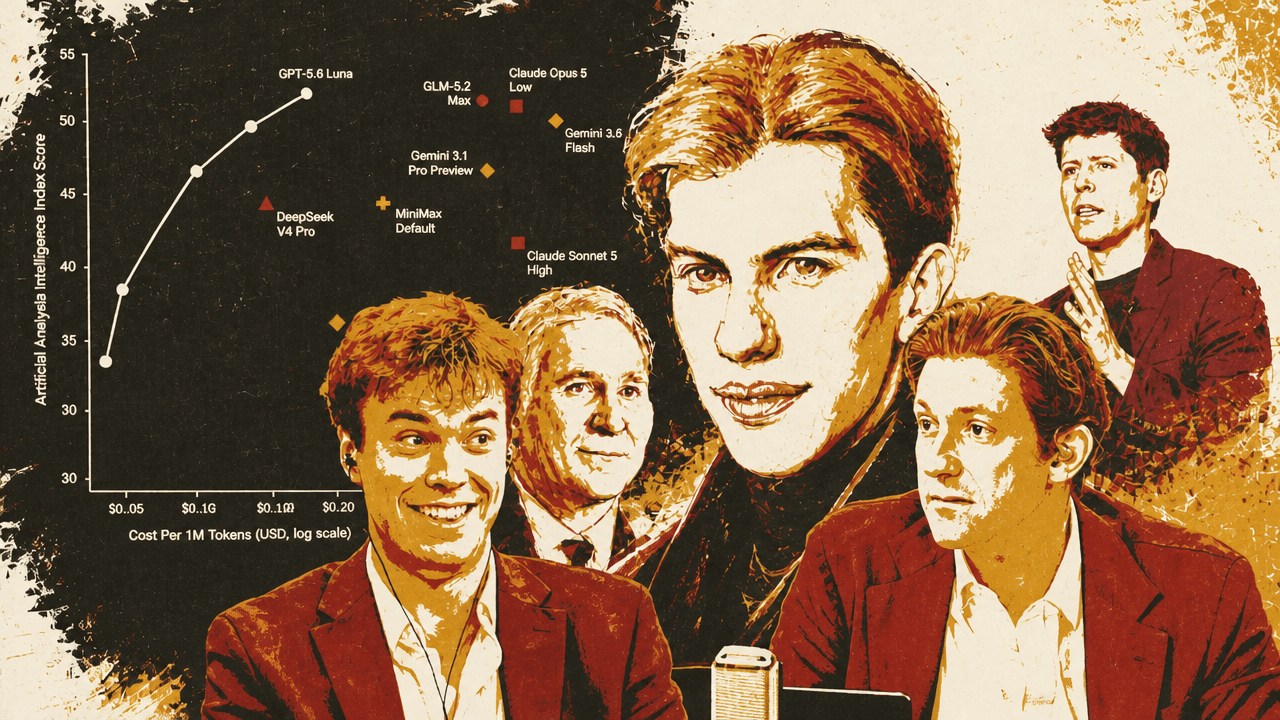
Tyler Cosgrove turns from the market’s valuation of AI infrastructure to the operating economics of using models. OpenAI’s GPT-5.6 Luna, presented as the low-cost member of a Luna, Terra, and Sol model lineup, sits prominently on an Artificial Analysis chart comparing intelligence scores with cost per million tokens. The chart’s stated conclusion is that Luna achieves the highest intelligence score at a fraction of the cost of similarly capable models.
Cosgrove’s caveat is central: cost per token is not the same as cost per completed task. A model that costs half as much per token but needs ten times as many tokens can be materially more expensive in actual use. The more useful efficiency measure combines token pricing with token efficiency—how much reasoning, tool use, or output a model requires to finish the job.
The same distinction appears in benchmarking. An OpenAI screenshot shown during the discussion says GPT-5.6 Sol had been used to solve open problems in mathematics but struggled on ARC-AGI-3, a benchmark of two-dimensional puzzle games. OpenAI’s stated explanation was not a shortfall in the base model alone: the official evaluation harness was not allowing it to remember what it had learned. Enabling two API settings, the post says, tripled its score with six times fewer output tokens.
Cosgrove says this is consistent with a recurring pattern over the past year and a half. The harness can have major downstream effects. An evaluation or integration layer that restricts memory, configuration, or interaction can make a capable model appear substantially weaker than it is.
Coogan contrasts that reality with the simpler expectation that one sufficiently powerful model would simply predict the next token perfectly. Practical performance depends on more than raw model capability; it depends on memory, API configuration, tool access, and the system built around the model.
ARC-AGI remains useful to Coogan because it makes progress visible to people who do not experience model improvement through software development. Task-duration metrics can be abstract: a claim that models can perform work taking a human twelve hours does not necessarily convey what that work is or how it maps to a job. Puzzle environments offer a more immediate way to see a progression from easy cases to tasks requiring adaptation.
The implication across both model pricing and ARC-AGI evaluation is that frontier comparisons are increasingly systems comparisons. The model, the harness, and the number of tokens required to accomplish the work all affect the answer users and investors ultimately care about: what does a capable result actually cost?