AI Is Recasting Platform Power From OpenAI Stakes to SpaceX Phones
The strongest thread in this Diet TBPN segment is the fight over who controls AI-era infrastructure and who benefits from it. John Coogan and Jordi Hays treat the reported OpenAI stake talks as an unsettled but revealing case: a government stake could invite political capture, while direct equity for individuals might offer a cleaner version of public participation. The same question recurs in their discussion of a possible SpaceX AI phone, OPM’s paper pension bottleneck and Nvidia’s place in the AI buildout, where infrastructure can mean public benefit, private lock-in or concentrated financial power.
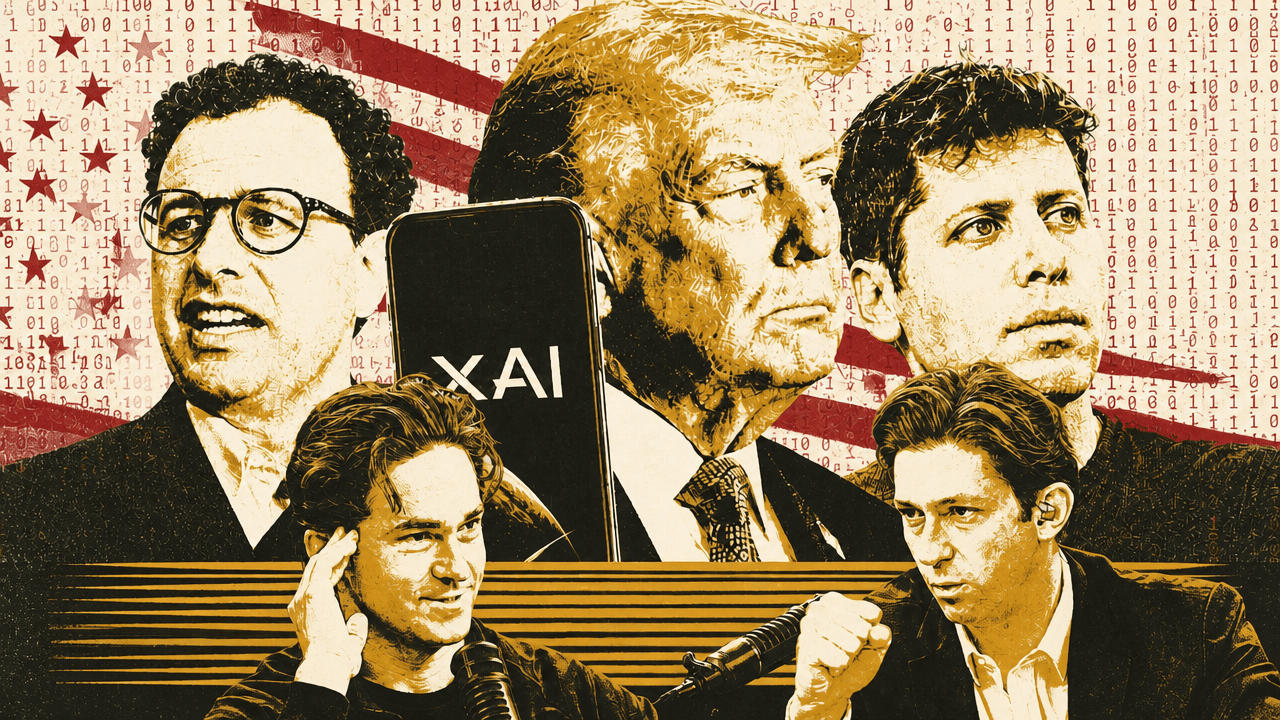
The OpenAI stake proposal was still only early talk, but it exposed the real fight
John Coogan framed the reported OpenAI talks with the Trump administration as one concrete version of a larger AI-governance problem: who gets access to powerful models, how constrained those systems should be, and whether the constraints are disclosed clearly. The release of “Fable 5,” he said, appeared to have been “nerfed in some ways,” which raised familiar questions about where restrictions are justified. Blocking a model from helping build a bioweapon or hack a system is one category. The harder category is recursive: if a user asks the model to build another AI system capable of doing the prohibited thing, the restriction has to reach that level too.
Jordi Hays compressed the problem into a phrase: “build me unfettered intelligence.” After a brief dispute over whether he had invoked Cambridge Dictionary or “Cambridge Analytica,” the definition on the table was “not limited by rules or any controlling influence.” Coogan’s reaction was that “unfettered intelligence” would probably invite regulation immediately. Hays suggested, half-seriously, that while most AI labs want to present themselves as friendly and respectable, there is room in the market narrative for a more “sketchy villain-like” lab.
Coogan then turned to a Financial Times report that, in his characterization, described early conversations between OpenAI and the Trump administration about a 5% equity stake. He stressed that the details were light. He said the discussed plans seemed to involve other frontier AI players apportioning stakes as well, but he did not treat the structure as settled. A visible Dean Ball thread also contained a caveat that mattered: “this rumor may even be importantly untrue or misleading in some way.”
The report still triggered two distinct objections. Joe Weisenthal, in a tweet displayed during the discussion, mocked the novelty of equity stakes by describing taxation and regulation as the established alternative: “Rather than equity stakes, why not make companies pay ~20% of all pre-tax income to the federal government? And then instead of exercising shareholder influence, politicians and regulators could set rules on corporate conduct across industries.” Hays responded dryly that someone should “try this.”
Ball’s objection was not that public participation was inherently wrong. It was that the structure mattered. In the tweet Coogan read, Ball said there were “two broad ways this can work”: divide the 5% stake across all U.S. households, giving each household a direct stake, or give the stake directly to the government. The first version, Ball wrote, was “fine.” The second was “probably ruinous,” comparable to “inviting rats to live and reproduce in the walls of your house.” In a later thread, Ball warned that the arrangement “will never stop at 5%,” that governance would become a nightmare, that political capture would be real, and that the public-relations benefit would be illusory. If the AI industry’s answer to “What has the AI industry even done for America?” became that it handed “a collective $200b of itself to Donald Trump,” Ball wrote, half the country would instantly hate the industry and some Republicans would assume corruption by default.
Coogan accepted that as a serious point. Hays added that the Financial Times framing itself was risky: the proposal sounded less like contributing to a sovereign AI fund and more like giving shares to the White House. Coogan then cited another Financial Times item saying Trump denied conflicts of interest as filings showed he made more than $1 billion last year, including $1.4 billion of stocks bought, $432 million sold, and deals for watches and perfume.
An on-screen chart attributed to “Corporate filings and financial disclosures” compared Trump’s 2025 earnings with a selection of listed U.S. crypto firms. Its headline was “Trump Outearned Biggest Listed US Crypto Firms in 2025.” The note said Trump’s disclosure covered calendar year 2025 while some company net-income figures covered slightly different periods, and that the company set was a selection rather than a comprehensive list.
| Entity | Earnings shown |
|---|---|
| Trump | $1.4B |
| Coinbase | $1.26B |
| CleanSpark | $365M |
| IREN | $87M |
| Bitdeer | $66M |
| Hive | -$3M |
| Bit Digital | -$80M |
| Bitfarms | -$209M |
| Galaxy | -$241M |
| Hut 8 | -$248M |
| Core Scientific | -$289M |
Hays said Trump also out-earned Hyperliquid “by a meaningful margin,” citing $908 million in total fees in 2025. Tyler, speaking from off camera, ran quick numbers on the OpenAI scenario: if 5% of the company were worth about $50 billion, and if that stake were distributed across roughly 130 million households, each household would receive about $371 in equity. His point was practical rather than ideological: that amount might not materially change public perceptions of AI labs if goodwill were the goal.
Coogan’s more optimistic version depended on narrowing the recipient pool. He pointed to “Trump accounts” as a possible vehicle for directing equity to individuals through a Social Security number or identity-based account, rather than placing it in a government fund. If shares went only to children born in a given year, or to children under five or under 18, the denominator would shrink and the amount per recipient would rise. The broad idea was not simply state ownership of AI labs; it was direct individual participation.
That distinction echoed the source’s discussion of data centers. Taxes paid to local governments can fund roads, schools, services, and budgets, but Hays argued that those benefits are abstract. Residents do not know whether their taxes will fall, whether a road will actually be built, or whether the benefit will help pay bills. Coogan invoked Ben Thompson’s proposal for small towns hosting data centers: in a town of 5,000 or 10,000 residents, a sufficiently profitable data-center project could fund meaningful direct checks, in some cases around $1,000 a month by Thompson’s math as described by Coogan.
Coogan’s reading of the broader context was that AI companies are trying to respond to growing negative sentiment around AI and data centers. He also said, as part of that interpretation, that doing business with the Trump administration had worked well for some companies, naming Intel and Dell. Intel was his central example: Coogan said the stock was up sharply after a government stake, and Hays supplied “400” as the percentage.
Jersey Mike’s IPO puts a $12 billion price on a 1975 sandwich-shop bet
Jersey Mike’s filed for an initial public offering seeking a $12 billion valuation, after Blackstone acquired the sandwich chain the prior year for $8 billion. Coogan called it a “nice 50% markup in just a year.” A tweet from Dan Primack added one filing detail: “Danny DeVito is mentioned four times in the S-1.”
The company, Coogan said, has 3,300 locations across the United States and Canada and plans to open 300 shops in the U.K. and Ireland. Its founder, Peter Cancro, is not named Mike. Cancro started in 1975, at age 17, by buying a Point Pleasant, New Jersey sandwich shop called Mike’s Subs with a $125,000 loan from his football coach, who was also a banker.
The origin story was striking because of the size and timing of the loan. Coogan initially joked about the inflation-adjusted figure, then corrected himself with a CPI-based estimate of about $775,000 in current dollars. Hays noted that, at 17, even a few thousand dollars would have felt enormous; a $125,000 purchase was remarkable even if the existing shop’s economics made the deal easier to underwrite.
A vintage photo shown on screen showed two men standing in the doorway of “Mike’s Giant Size Submarines,” overlaid with the text: “JERSEY MIKE’S FILES FOR IPO” and “SANDWICH CHAIN SEEKS $12 BILLION VALUATION.” Coogan said Cancro grew the company for almost 50 years before moving to chairman in April. Former Wingstop CEO Charlie Morrison now leads the company. The proposed ticker, Coogan said, is JMKE.
OPM’s retirement bottleneck was a paper workflow in a mine
The Office of Personnel Management’s retirement system had been slow because the process was paper-based and manual, according to the account Coogan read from Spike Brem’s post on X. Federal employees and U.S. veterans could wait up to six months to receive their full pension. The story, as Brem described it and Coogan relayed it, was not merely about old software. It was about physical files, underground storage, manual review, and legacy systems.
Brem’s post said Joe Gebbia, Airbnb founder and current U.S. Chief Design Officer, recruited a small group of trusted early Airbnb engineers to embed at OPM and solve “the retirement paper problem.” Brem described visiting the Pennsylvania mine Elon Musk had referenced. In underground limestone caverns, he wrote, there were “literally acres of file cabinets as far as the eye could see,” storing federal employees’ employment and pay-stub histories. A simple case could be a quarter-inch or half-inch thick. A complex case could fill an entire filing cabinet. One famous case, as Coogan read it, took up a whole pallet.
Hays joked that the mine may have been “a feature, not a bug,” because people “yearn for the mines.” Coogan called the setup “the ultimate lock-in factory”: caseworkers in cubicles underground, processing pensions by hand.
The workflow Brem described was slow at every step. Caseworkers checked calculations, confirmed that forms were properly filled out, handled exceptions, and keyed information into a black-and-white terminal connected to a decades-old COBOL mainframe. Physical case files moved from one worker’s outbox to another worker’s inbox. Sometimes they sat for days waiting to be picked up. A Fox News Digital clip shown on screen depicted a large underground storage facility filled with filing boxes, with text saying the previous day had marked “the end of paper retirement processing at OPM.”
Brem’s post also described years of partial modernization. OPM had attempted digital transformation multiple times, leaving some newer systems alongside older ones. A mid-1990s effort created systems that were difficult to make interoperable. Another web app allowed employees applying for retirement to fill out forms digitally, but those forms were still mailed into the mine and placed into paper files.
The most severe criticism in Brem’s account concerned government software contractors. When the embedded team arrived, OPM was already in the middle of a digital-transformation attempt delivered by a contractor. Brem called the “black pill” the quality of the software and the contractor relationship. Coming from Silicon Valley, he wrote, he could not believe “how low the talent and quality bar was for selling software to the government.” The key skill of such vendors, in his telling, was securing government contracts; product quality was secondary. The team fired the vendor, took over the project, tried to connect data sources and improve the caseworker experience, and then concluded it had to rebuild the stack from scratch.
Coogan treated the digitization as significant because the prior bottleneck had been concrete and physical. The system was not merely old; it was organized around underground paper files, hand calculations, physical routing, and mainframe entry.
A SpaceX phone would test whether AI has weakened Apple’s app lock-in
The SpaceX phone discussion depended on reporting Coogan and Hays treated as early, contested, and far from a shipping product. Coogan said the Wall Street Journal was reporting that SpaceX had shown potential investors a prototype of an AI-focused handset during a recent IPO roadshow. He emphasized that Elon Musk had denied phone reports multiple times and that the product might never ship. Still, in Coogan’s account of the reporting, investors had seen at least a demo.
The prototype, as Coogan described the report, was said to be slimmer than an iPhone, to run a proprietary operating system, to use xAI technology, and to be built around Qualcomm Snapdragon chipsets. Coogan noted that this would not be Apple-style vertical integration around in-house silicon, at least not yet, though he said Musk’s companies have experience with chips. A TBPN graphic labeled the story “SPACEX AIPHONE?” and added: “SpaceX Showed Investors an AI Phone Prototype. Generated by GPT.”
Hays argued that the strategic rationale was obvious enough for Musk to “at least take a shot.” SpaceX has a global satellite network through Starlink, and Hays said one could imagine, over time, any person on the planet using an internet-connected SpaceX device. The idea also fits Musk’s broader “everything app” ambitions, even if the handset remains only a reported prototype.
The larger claim was that AI may be reducing the App Store’s value as a moat. Hays said there are many apps he used five years ago that he no longer needs in the same way. He can ask a chat interface for the weather. He can pull a surf report into chat. He joked that he could “vibe code” his own beer app, while acknowledging that opening a dedicated app is often more efficient. His underlying point was not that apps vanish entirely; it was that the long tail of utility apps no longer locks him into the iPhone as strongly.
Coogan and Hays then separated the observation from the cause. Hays cited Mark Pincus’s argument from the prior day that Apple is not pushing small apps and that the App Store is not a reliable distribution channel for vibe-coded apps, games, or other small software. As Hays summarized it, Zynga had grown on Facebook when Facebook was open enough for separate software to go viral inside the platform and keep the customer relationship off platform. The current App Store does not produce that behavior at the same intensity. Users do not commonly open it and ask for “one new app.”
Hays asked whether the decline came from Apple’s distribution choices or from consolidation by super apps. Instagram can absorb stories, vertical video, and other formats. ChatGPT and other AI chat apps can absorb utilities that once required separate apps. Coogan added a third explanation: after roughly a decade of real mobile-app innovation, the category may have reached saturation.
Coogan still found the absence of new AI-native consumer hits surprising. If he had fallen asleep at the ChatGPT moment and woken up now, he said, he would have expected the App Store charts to be full of new AI consumer apps. Instead, he said, the charts were dominated by World Cup-related apps, sports betting, streaming apps, and other familiar categories. AI, in his words, has been more of an “extending innovation” for existing apps than a source of new consumer winners.
That matters for a potential SpaceX phone because weaker app lock-in lowers the barrier for a new device ecosystem. Coogan said AI chat interfaces and vibe coding could help a new device maker, especially if the device were Android-based, but perhaps even if it used a new operating system. Hays agreed with the incentive but rejected the idea that Musk’s version would be open. When Musk bought Twitter, Hays said, the API became smaller and more expensive. Tesla, in his view, is not an open ecosystem where a user can deploy a competing self-driving system.
Tesla's not an open ecosystem, you can't deploy a different self-driving system onto your Tesla. It's a closed system. It's a competitor to the Apple ecosystem. It's an equally walled garden. But it would be his.
Coogan agreed. The argument was not that a Musk phone would liberate users from platform control. It was that AI may make it more plausible to compete with Apple’s walled garden by building another one.
The closing items turned cultural symbols into price signals
The Empire State Building stunt produced a quick lesson in how brands turn a public moment into a template. A couple climbed to the top of the building, raised a flag, and apparently got engaged or proposed. Brands quickly began editing their own logos or messages onto the flag. Jack Appleby called the response “so, so embarrassing,” singling out Loverboy and saying, “congrats, you put your logo on a flag, really innovative stuff.” Matthew Kobach posted a collage of brand versions and wrote, “Brands move fast these days. And there’s hundreds more.”
Hays noted that many examples in the collage were beverage brands, including Drink Culture Pop, Drink Hiyo, Drink Loverboy, Drink Spritz, and Bulletproof Coffee, alongside Fashion Nova, a New York City account, and Petco with “stop breaking treats in two.” The format was fun, he said, but brands have a hard time breaking through when they all pile onto the same meme.
The stunt itself was visually striking but imperfectly executed. Aerial footage showed two people on the spire holding a large black flag with white text: “WHEN THE POWER OF LOVE BEATS THE LOVE OF POWER THE WORLD KNOWS PEACE.” Coogan said the wind made the writing hard to read and that a more legible execution would have worked better. Hays said the wording had “a little bit of the AI cadence.” Even so, Hays said the climb was impressive, and Coogan congratulated the couple while doubting whether the stunt achieved whatever political or symbolic impact they intended.
Jensen Huang’s signature black Tom Ford leather jacket turned a different kind of symbolism into a market object. A post by Will Stern showed a Sotheby’s listing with an estimate of $40,000 to $60,000. Hays said the estimate seemed too low, because the jacket was a unique item tied to a figure likely to be remembered as part of AI history. He wondered whether Huang had provided it directly or whether someone else had obtained it and taken it to Sotheby’s.
The jacket led into a Jensen Huang meme with the text “I wake up (not a loser) infinite money.” Hays tied it to a Valuetainment post claiming Meta employees consumed 73.7 trillion AI tokens in a single month, at an estimated cost of $221 million per month and about $2.65 billion per year. Hays said the figure sounded low relative to what he expected Meta’s token spending to be, but the direction supported the broader point: Nvidia benefits from the scale of AI compute consumption.
Hays also said Nvidia has partnered with AI cloud firms through revenue-sharing arrangements, taking circularity to a level that feels new in tech. Sale-and-leaseback structures and similar financing arrangements exist in other industries, he said, but the novelty is seeing them in technology as AI pushes the sector into a more industrial era. In that framing, the AI buildout is not only about models or apps. It is about hardware, capital, financing structures, and the companies positioned to capture the spending loop.