Huang’s Reported Affair Puts Nvidia’s China Strategy Under Scrutiny


Bloomberg’s report that Nvidia CEO Jensen Huang admitted to an affair with Alice Wong, identified in reports as a suspected Chinese spy, has put his advocacy for selling chips to China under new scrutiny. On Diet TBPN, hosts Jordi Hays and John Coogan said the affair does not establish that espionage occurred, but could make Huang’s long-standing argument for access to the Chinese market harder to defend. They also questioned whether information was compromised and what Nvidia might lose if the controversy weakened Huang’s influence in Washington or at the company.
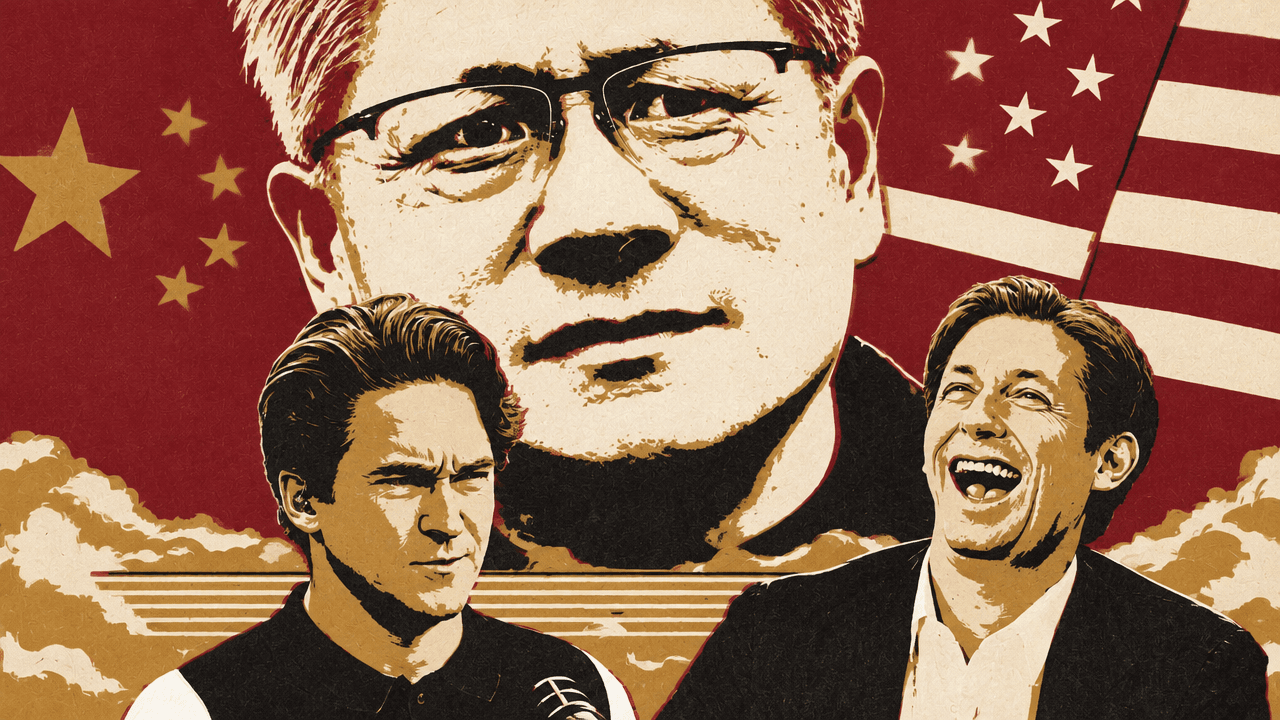
The reported affair has put Huang’s China advocacy under new scrutiny
Bloomberg reported that Nvidia CEO Jensen Huang admitted to an affair with Alice Wong, a woman identified in reports as a suspected Chinese spy. The hosts described the disclosure as an unusually serious disruption for a company they said had avoided personal and governance scandals through decades of growth. Nvidia had faced cyclical business problems, including periods when chips sold off, but John Coogan and Jordi Hays could not recall a comparable episode centered on its CEO.


Hays stressed that suspicion is not proof of espionage. Officials were still probing the matter, he said, without publicly specifying what information might have been transferred or what the alleged activity involved. He cited commentary by Bill Bishop raising the possibility that private meetings, if Huang had devices with him, could have created access to information about Nvidia. Coogan questioned whether material taken from an executive’s phone or computer—such as sales reports, schematics, PDFs or design files—would be enough to accelerate China’s semiconductor production, which could also depend on machinery and physical hardware. He also raised the possibility that access could expose information about the American semiconductor supply chain.
Nvidia’s board said it had found “no reason to believe that either national security or Nvidia secrets were compromised” as a result of Huang’s actions. It announced an independent investigation, overseen by a committee of independent directors and outside counsel, to examine the available information. Huang said he would cooperate. Investor Gavin Baker, whose post was shown on screen, said he had known Huang for nearly 30 years and did not believe Huang would knowingly disadvantage Nvidia or the United States. Baker also quoted Huang saying he was committed to protecting Nvidia and supporting American national security.
Hays said Huang had recently described his relationship with Wong to Bloomberg as an ordinary business relationship. In light of the reported admission, Hays questioned that characterization. The hosts also debated what investigators might find: Hays asked whether the matter involved espionage, sabotage or access to Huang’s devices, while Coogan questioned how useful any information obtained from a phone or computer would be to China’s chipmaking efforts.
The immediate market reaction was part of the hosts’ discussion of the business stakes. Hays said Nvidia was down about 5% while the Nasdaq was up roughly 2.5%, and noted that AMD was up nearly 13%. Coogan wondered whether investors were rotating out of Nvidia and into other companies.
Mega Speed’s ownership trail is still difficult to explain
The scrutiny extends beyond Huang’s relationship to Mega Speed, the Singapore-based Nvidia reseller and AI-compute provider linked to Wong. Coogan summarized reporting on Wong’s career: she began as a state-media journalist, moved into finance, including roles at major Chinese financial firms and HSBC, and took control of Mega Speed in early 2023. The hosts questioned how she gained control and what capital supported the business.
Coogan contrasted the story with the backgrounds he said are common among neocloud founders: experience in real estate or crypto mining, and years spent building data-center capacity before the current AI boom. Mega Speed’s rise looked different to him. Wong’s firm was presented as serving customers including Alibaba and acquiring Nvidia GPUs, while the path by which its financing and ownership were arranged remained unclear.
According to Coogan’s account of Wall Street Journal reporting, Wong formally relinquished ownership and resigned as a director in November 2023, when Singaporean businessman James Tan took over. Yet she apparently continued to exercise operational influence. The reports, as summarized on air, placed her at an Nvidia conference in California in early 2024, meeting Huang at Computex in June 2024 and interacting with him publicly in Taiwan in May 2025. A business partner reportedly said she was still introducing herself as Mega Speed’s CEO in August of the previous year.
The unresolved question, in Coogan’s view, was whether the 2023 transaction represented a genuine transfer of control or mainly a change in legal ownership while Wong kept running the business. He described a chain beginning with 7Road International, a Singaporean subsidiary of a Chinese-owned company. That company owned Wang Lei Limited, Wong’s ownership vehicle registered in the British Virgin Islands; Wang Lei Limited owned Singaporean entity Swift Data PTE Limited, which in turn owned Mega Speed International. Coogan said Tan took over Swift Data in November 2023. The hosts found the arrangement difficult to parse and said further reporting would be needed to establish how control moved through the entities.
That ambiguity matters because the US Commerce Department reportedly began investigating in late 2024 whether restricted Nvidia chips were being diverted to China. US officials also suspected Wong of passing information to Chinese intelligence, and Nvidia was investigating whether Huang had been targeted through their personal relationship. Coogan raised a further complication: if computing capacity is located in Singapore or Malaysia, users may be able to access it over a network. He questioned whether chips would need to be physically diverted for that kind of access to matter.
An old China policy is now harder for Huang to defend
Jordi Hays argued that Huang’s support for selling chips to China did not begin with Wong. Huang has consistently wanted access to the Chinese market, Hays said, and may see China as a major computing market that will eventually develop alternatives to American chips regardless. In that reading, the commercial logic is to sell as much as possible while the opportunity remains. Hays said he did not think Huang’s position reflected malicious intent; he understood it as a desire to sell Nvidia products in a large market before that market becomes inaccessible.
Hays connected that stance to a broader shift in US attitudes toward globalization. For years, he said, American business leaders were encouraged to export products and enter China’s market; expanding there could be treated as a marker of corporate success. The current consensus that advanced technology may need to be withheld from a geopolitical rival, on the grounds that it could be copied or strengthen a competitor, is more recent. Huang, in Hays’s account, may be an old-guard executive formed by an earlier policy environment rather than an outlier deliberately defying a longstanding national-security consensus. Coogan added that Nvidia has a large research and development center in Shanghai.
Hays argued that even if Wong and Huang had never met, Huang likely would have pursued much the same China policy. The relationship changes how those actions are perceived:
It colorizes his actions.
Coogan put the resulting bind in political terms. If Huang continues advocating for chip sales, critics can point to his relationship with a woman suspected of spying for China. If he reverses course, it may appear that his earlier position was compromised.
The criticism was not simply that Huang wanted to do business in China. Hays called the situation careless and unnecessary, arguing that a chief executive under intense scrutiny did not need to conduct business personally in a way that could look compromising. Even if Nvidia wanted to continue selling where permitted, he suggested, it could have relied on a conventional sales representative and a documented process rather than putting Huang in the middle of a relationship now under investigation. Coogan noted that Nvidia already had substantial demand in the United States.
The scrutiny could also affect Huang’s standing in Washington. Coogan said Huang had routinely appeared at conferences and in the media to promote Nvidia’s position. Hays connected the new scrutiny to Huang’s public support for President Trump, asking why the CEO had been such an outspoken supporter when political power can shift. Coogan contrasted that approach with Apple’s handling of the Trump administration: in his telling, Tim Cook had made appearances without overplaying the company’s hand, while a leadership transition offered Apple a fresh start.
The hosts also recalled a remark Ross Douthat attributed to Trump in a 60 Minutes interview: Trump said he had called the head of a major AI company and told him to “kiss your wife and kids,” then asked whether he liked the color orange. Hays suggested it was reasonable to assume Trump meant Huang, though the remark as discussed did not name him. Coogan said the current reporting made Nvidia’s dealings on the global stage seem a more plausible context for Trump’s pressure than the confrontation with Anthropic CEO Dario Amodei that some might have expected.
The political consequences could extend into Congress. SemiAnalysis’s Dylan Patel predicted in a post shown on screen that the story might recede from media and finance over the next six months, while Democrats could call Huang to testify and investigate GPU sales to Chinese companies. Hays expected China hawks to gain leverage: Huang had been one of the most prominent voices for continued sales, and the affair makes that advocacy more vulnerable to challenge. Coogan added that the allegation itself could strengthen the hawks’ case that China wants access to Nvidia GPUs.
Nvidia may depend on the same founder-led leadership now under pressure
The possibility of Huang leaving raises a different concern: what Nvidia might lose if its founder were no longer in charge. Jordi Hays said he expected Huang to remain in the job unless the story grew substantially worse, but argued that the founder-led style was unusually important to Nvidia’s role in the AI industry.
Hays described Huang as a kind of “central bank of AI”: a leader willing to commit billions of dollars, make creative deals and support companies across the sector. In his view, a conventional manager focused on research and development and buybacks might not have backed so many emerging AI businesses or treated prominent companies as too important to fail. He said that over the previous year, companies that had grown beyond roughly a billion dollars appeared, in Huang’s worldview, too significant to let fail. John Coogan agreed that Nvidia could lose some of Huang’s informal influence if he were no longer leading it.
Hays separated Huang’s business abilities from his personal conduct. The affair does not, he said, erase Huang’s skill as Nvidia’s leader and public representative. But it could leave him delivering the same message with a controversy hanging over every appearance. Nvidia may need Huang’s singular relationships and judgment even as his presence becomes politically harder to defend.
The hosts discussed a claim that Nvidia has no formal contract with TSMC, referring to Huang’s account of a relationship based on mutual trust. They considered what that might mean if Huang were no longer CEO: Coogan said the relationship could be tied to Huang personally, while Hays noted that TSMC would still have reason to speak with Nvidia’s next CEO about its business. The hosts presented the no-contract claim as something they had heard, rather than as a settled account of the companies’ arrangements.