SpaceX, OpenAI, and Anthropic Could Reopen the IPO Market



John Coogan and Jordi Hays use the reported IPO plans of SpaceX, OpenAI and Anthropic to argue that the U.S. tech market is not entering a modest reopening but a concentrated “giga boom” led by companies large enough to reshape indices, capital flows and investor expectations. The Diet TBPN segment extends that scale argument across Starship’s role in SpaceX’s filing, AI infrastructure bottlenecks, frontier-model oversight and the disappearance of world’s fairs as a public stage for technological ambition.
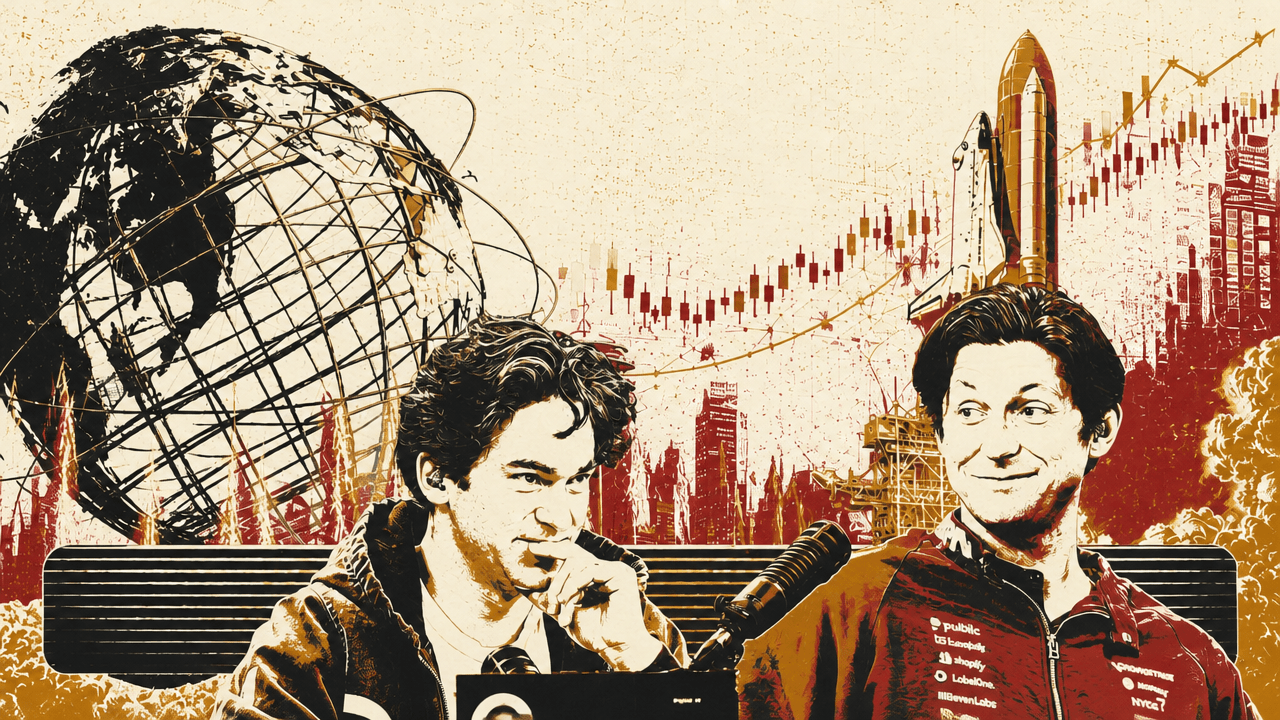
The IPO market is reopening around three companies big enough to distort the frame
The Wall Street Journal called it “America’s IPO Mini-Boom.” John Coogan rejected the adjective almost immediately. With SpaceX, OpenAI, and Anthropic all described as heading toward public listings, he asked: “How is this a mini-boom? Is this not a giga boom?”


The Financial Times front page used stronger language: “SpaceX, OpenAI and Anthropic IPOs set to ignite Wall Street trading frenzy.” Coogan read the reported mechanics from the FT: Nasdaq had loosened rules so that new fast-entry provisions could push these stocks directly into Wall Street indices, meaning passive money could flow into the companies when they go public and potentially force investors to sell rival stocks. In the FT’s framing, SpaceX’s IPO next month was expected to be the largest on record, while OpenAI could file paperwork as soon as the same week and Anthropic was also planning to float.
The Wall Street Journal’s narrower phrase made more sense to Coogan only if “mini” referred to concentration rather than size: three companies, not a broad reopening. But the companies are large enough that concentration itself becomes the story.
We're going to need a new term for the Mag 7 because Tesla has been in the Mag 7. It's been north of a trillion dollars for a long time. But SpaceX is going to go out at a higher valuation, almost certainly.
Coogan said Tesla was trading around a $1.34 trillion market cap and found it hard to imagine SpaceX listing below that. If so, Musk’s established “Mag 7” company could be less valuable than his newly public space company. “We’re going to need new terms,” he said. “We’re going to need a bigger boat.”
The Wall Street Journal’s editorial line, as Coogan read it, was that even if AI euphoria resembles the dot-com era and the bets are hard to handicap, the planned listings are “a welcome tribute to the dynamism of US markets that no other country can match.” Coogan noted that both the Journal and FT used “starting gun” language around SpaceX, taking it as a sign that mainstream financial media had converged on the same frame: the big tech IPO window had opened.
SpaceX’s business model, as summarized from the Journal piece, is no longer just rockets. Coogan cited broadband, mobile satellite internet, and data center development, including the article’s claim that Anthropic had agreed to pay SpaceX $1.25 billion per month to use its data centers to train models. He treated that reported claim as evidence that competitors can also be symbiotic: a frontier AI lab paying a space and infrastructure company to train models.
But the reported losses raised questions. The Journal material Coogan read said SpaceX as a whole had reported a $4.9 billion net loss last year, “some” of which stemmed from x.com. Coogan was skeptical that the social media platform could explain too much of the loss, noting Twitter’s revenue decline after the take-private but also major layoffs and cost reductions. He suspected the losses were spread across major investments, especially Starship.
Starship is both a vision asset and a risk factor
Jordi Hays argued that the timing of the Starship launch mattered because of the S-1 and IPO optics. John Coogan initially minimized the importance of a single launch, saying he thought the market was valuing launch capabilities, and Starship in particular, as only one piece of the SpaceX puzzle. Existing Falcon 9 launches and Starlink, he said, already support a clear business, with Starlink plausibly at a $10 billion or $20 billion run rate.

The filing discussion changed the weighting. Coogan said SpaceX’s IPO prospectus listed Starship first among the company’s risk factors. That made him give Hays “a little bit more credit.” If Starship is first in the risk factors, then the launch system is not merely a glamorous side project; it is central to the growth plan being sold to investors.
The launch had been postponed because of a hydraulic pin on the launch tower, according to a Musk social media post Coogan summarized. Engineers had worked overnight to fix it. The source displayed Starship standing vertically beside its launch tower at Starbase outside Brownsville, Texas. Coogan described the vehicle as Starship V3, a redesigned 400-foot rocket intended to deploy larger satellites and eventually support settling Mars and mining asteroids. He emphasized the importance of the Mechazilla tower and “chopsticks” for fast reuse: the ability to catch and restack the rocket is essential if SpaceX wants Starship to fly thousands of times per year.
The scale of the bet is visible in the spending Coogan attributed to the IPO materials. He said SpaceX estimated in its filing that it had spent $15 billion developing Starship.
That number reframed the loss discussion. If SpaceX is absorbing multibillion-dollar losses while developing a fully reusable heavy launch system, the losses are part of the capital story rather than a simple operating headline.
The prospectus, as Coogan summarized it, also supplied a much larger ambition. He said SpaceX foresaw $28.5 trillion in market opportunities, including data centers in space. He found the data-center framing almost comically bullish: after painting a future of Mars settlement, the money still comes back to enterprise software. Hays joined the riff: “We’re going to be automating workflows for the enterprise.”
Still, Coogan liked the vision. Musk, according to the material Coogan read, had been awarded 1 billion performance-based restricted shares that would vest if SpaceX “establishes a permanent human colony on Mars with at least 1 million inhabitants.” Hays asked whether robots or agents count as inhabitants. Coogan did not answer that, but he endorsed the goal as the kind of ambition investors can understand: “a whole lot of enterprise software and a million people living on Mars.”
The Tesla analogy sharpened the retail-investor stakes. Hays asked what Tesla’s market cap was at IPO; Coogan and Hays landed on roughly $1.7 billion. Coogan observed that a day-one Tesla IPO investor could have made about 1,000x, and that “many people did not.” Tesla, he said, always had good reasons not to buy: it looked disconnected from other car companies and was never a classic Warren Buffett purchase. That is part of how retail conviction gets built — and part of why a SpaceX IPO could be such a magnet.
Memory is becoming a bottleneck in the agent boom
Micron’s new U.S. memory production was presented as part of the broader shift from chatbot use to agentic workloads. John Coogan said Micron had begun manufacturing 1-alpha DRAM, described as “the most advanced memory ever produced in the United States,” at its Manassas, Virginia fab. The timing, in his account, is not incidental: AI agents require longer context windows and more memory than simple back-and-forth chatbot use, contributing to an industry-wide memory shortage.
The market reaction, using Coogan’s numbers, was extreme. He said Micron’s market cap was nearly $850 billion; the stock was up 2% on the day, 3% over five days, 246% over six months, and “almost a thousand percent” over the past year.
Jordi Hays’s response was a plain “Just wow.” Coogan called it an “absolute run.” The point was less a deep Micron analysis than a reminder that AI infrastructure is not only about GPUs or model labs. If agentic systems demand longer context and heavier memory use, memory manufacturers can become direct beneficiaries of the same boom.
Microsoft’s reported Claude Code move was less about money than product discipline
The reported cancellation of Microsoft’s internal Claude Code licenses became, for John Coogan and Jordi Hays, a useful window into how large software companies may rationalize AI tooling internally. Coogan said an anonymous account had claimed Microsoft canceled internal Claude Code licenses because token-based billing made the cost untenable. That post, he said, catalyzed discussion on X, including Box CEO Aaron Levie using it to argue that token-price optimization would become a major trend inside companies reliant on LLMs.
But Coogan added an important caveat: a proposed community note on the original post denied that cost was the reason. On that account, Microsoft was trying to move developers toward its own Copilot CLI, not simply save money on Claude Code. Coogan’s read was that Microsoft would build its own harness, “their fork of Claude Code, their fork of Codex.”
Hays described the logic as making engineers “eat dog food.” For him, the reason Codex, Claude Code, Cursor, and similar tools had improved so quickly was that the engineers building them use them constantly. A coding tool gets better when its own creators are forced to rely on it all day, because the product’s friction becomes unavoidable.
Coogan complicated the dogfooding frame with the economics of model supply. If Microsoft’s engineers are using the company’s own tool, he asked, “what’s the dog food made of?” It could still be powered by future GPT tokens or Anthropic’s Opus tokens. The product wrapper, the model, the internal procurement politics, and the usage-based bill are separable questions.
That distinction matters because the story can be read two ways. One version is a pure cost-control story: token bills force enterprises to optimize usage. The other is a product-strategy story: Microsoft wants its own engineers producing constant internal pressure on Copilot CLI. Coogan and Hays preserved both readings, while leaning toward the latter as the more interesting explanation.
The AI review fight turns on whether models are strategic software or nuclear-scale systems
John Coogan treated the reported cancellation of a frontier-AI executive order as a test of how the U.S. government now balances safety review against the politics of staying ahead of China. According to Coogan, Politico had reported that David Sacks made an “11th hour appeal” to President Trump to stop an order that would have created a voluntary program for frontier AI companies to submit models to the government for review 90 days before release.
Coogan did not dismiss red-teaming or benchmarking. He said there is obvious value in “other eyes on the project.” But he immediately raised the harder question: what does a government review program actually add, and what liabilities or frictions does it create?
Trump’s explanation, as Coogan read it, put the issue in explicitly competitive terms: “I didn't like certain aspects of it. I think it gets in the way of — we're leading China. We're leading everybody. And I don't want to do anything that's going to get in the way of that.”
That led to a short but revealing safety-politics exchange. Tyler Cosgrove said he assumed the LessWrong-aligned AI safety world would be unhappy, because the move looked “anti-safety.” If one is “super AGI-pilled,” he said, the analogy becomes nuclear weapons: the government has to be involved. Coogan pressed the implication. If AI systems are being treated like nuclear weapons, is there a serious argument that they should not be regulated by the government because people distrust the government and would rather “my favorite megacorp” control them?


The bit turned toward Disney, but the policy tension remained. Coogan noted that some companies poll better than the federal government and imagined people preferring Disney to hold nuclear-scale powers. He tied that back to EPCOT’s original ambition as Walt Disney’s “Experimental Prototype Community of Tomorrow,” a 1960s vision for a functioning city. Coogan explicitly cautioned that the next part “might just be viral clickbait,” but said he believed Disney had received permissions broad enough to include building a nuclear reactor to power the city of the future.
Hays played along — “I trust Bob with the nukes” — but the exchange left the governance dilemma intact. If frontier AI is merely a strategic technology, government review may look like drag. If it is closer to nuclear weapons, private self-governance starts to look insufficient.
Executives are still negotiating what AI productivity means for jobs
The SpaceX IPO also produced an investment-banking subplot. John Coogan read a post from Xtine Fang quoting reporting that Goldman Sachs CEO David Solomon had worked with staffers to message Musk directly on X as banks jockeyed to get their name first on the SpaceX deal. Jordi Hays summarized the caption: “this is how you work for the bag at Goldman Sachs.” Coogan imagined Solomon asking staff how to send an X message and concluded, “he’s puttin’ in the work.”
Solomon’s separate AI-jobs argument was more substantive. Coogan said Solomon had written in the New York Times that the AI job apocalypse is overblown and that AI is a job creator. Coogan withheld judgment: “We’ll see what he’s saying in a couple months.” He contrasted Solomon with Ken Griffin, who Coogan said had shifted in tone as models moved from “slop to usable,” though not to the point of declaring a job apocalypse or making clear statements about Citadel’s hiring plans or the broader U.S. economy.
Hays added that Griffin had been particularly excited about software engineers becoming more efficient because there is “no cap on how much software” can be produced. That made software the easiest case for an optimistic productivity story: better tools create more output, and demand for more output remains open-ended.
The thread ended in a joke about Coogan’s own intern days writing Visual Basic. With Codex or Claude Code, he said, he would have worked “one minute a day instead of an hour a day.” Hays imagined a future “intern simulator” where someone time-travels into VR to become the most elite intern using future AI tools.
World’s fairs once made technological futures public
Before Silicon Valley product launches and CES, world’s fairs gave countries a public stage for technologies, products, and ideas that might reshape daily life. John Coogan and Jordi Hays used a Wall Street Journal retrospective to contrast that older civic spectacle with today’s more fragmented demo culture. Coogan wondered whether someone should revive the format, though he suspected a modern version would become “a lot of screens.”
The Journal’s broader frame was that world’s fairs were not just cultural events. Paul Greenhalgh, a British historian and author of books on the subject, was quoted saying many big expos were commemorative, but they did something else too: “they changed the shape of cities.” Coogan compared them to the Olympics as large-scale planning efforts and economic investments. Chicago’s 1893 fair, for example, helped recast the city from a gritty second city into a cultural and architectural hub after it defeated New York for hosting rights.
Philadelphia’s 1876 Centennial International Exhibition paired two enduring technologies: the telephone and Heinz tomato ketchup. The more substantive point, beyond the hosts’ condiment jokes, was that Philadelphia normalized side-by-side presentation by private companies, inventors, and governments. Hays read that the telephone was initially greeted with skepticism before its importance became clear. The same fair also showcased Thomas Edison’s automatic telegraph, the typewriter, machinery, and packaged consumer goods. Coogan liked the model: public exposition as a platform for both hard technology and entrepreneurial culture.
Chicago in 1893 produced a different pairing: the Ferris wheel and popcorn. The hosts treated the contrast as a reminder that these fairs mixed infrastructure, consumer habits, entertainment, and spectacle. Hays drew a modern analogy: a present-day fair might pair AGI with creatine gummies. The useful point was the pattern: American innovation has often presented the profound and the trivial in the same venue.
Buffalo’s 1901 Pan-American Exposition represented electricity. Coogan read that it was remembered mostly because President William McKinley was shot there and died a week later, but the fair itself was meant to showcase U.S. dominance in innovation, electrical power, and infrastructure. It featured electric lighting and electric streetcars powered by hydroelectricity from Niagara Falls, at a moment when electricity was moving from novelty toward utility.
St. Louis in 1904 became, in Hays’s phrase, a “snack food extravaganza” and a “Cambrian explosion of snacking.” The Louisiana Purchase Exposition nearly destroyed the city’s finances, but it popularized ice cream cones, peanut butter, hot dogs, hamburgers, and cotton candy. Hays emphasized that not all of these foods were invented there; the fair made them widely available. That distinction matters: fairs did not merely invent the future, they gave existing inventions and products a mass public setting.
Seattle in 1962 returned the fairs to geopolitical display. By the mid-20th century, Hays read, world’s fairs had become games of one-upmanship in the shadow of the Cold War. The Soviet Union had launched Sputnik and declined Seattle’s invitation. The U.S. federal government became deeply involved because America needed to demonstrate technological leadership. The Space Needle was built for the fair.
New York’s 1964 fair brought the Picturephone, color television demonstrations, and punch cards. Coogan treated the Picturephone as the striking one: AT&T had effectively demonstrated video calling decades before FaceTime. Hays noted the cost — $16 for a three-minute call, which he said was $121 in current money. Coogan called that expensive; Hays translated it into today’s AI economics by joking about CEOs forcing employees to spend more than their salaries on Picturephone usage. Coogan wondered if people were already invoking Jevons paradox.
The decline was blunt. Coogan read that the last officially sanctioned U.S. world’s fair, in New Orleans in 1984, produced no defining technological debut. By then, the functions of world’s fairs had migrated to museums, television, theme parks, and technology conferences. “Stagnation theory undefeated,” Coogan said. Hays thought a revival would likely collapse into another tech conference.
Other threads: exoskeletons, DeepSeek capital, and BYD in Formula 1
The closing technology notes were brief, but they were concrete enough to stand as adjacent signals rather than a single grand thesis.
John Coogan brought up the Hypershell X Ultra S, an exoskeleton demoed by the Wall Street Journal. He described it as “1000 watt hips” that help users hike and run uphill. The source showed a woman walking and jogging up dirt stairs and coastal paths while wearing the device, and WSJ personal tech columnist Nicole Nguyen demonstrating it outdoors. Coogan said he might try it, but Palmer Luckey’s warnings about Iron Man-like suits potentially ripping a person apart had made him cautious.
Jordi Hays turned the same product into a security and social-risk joke: if a bad actor took over the suit, they could force the wearer to do a bad Michael Jackson dance in front of peers. The joke carried a real failure mode: once consumer technology becomes motorized and body-worn, product risk is physical rather than only digital.
Coogan also mentioned that CATL, the Chinese EV battery giant, was investing in DeepSeek. Separately, a Financial Times post said BYD was accelerating talks to enter Formula 1 after a meeting with former Red Bull Racing chief Christian Horner in Cannes. Coogan asked whether BYD had any gas-powered internal combustion engines. Hays did not know. Coogan’s answer: “They’re about to.”