Energy Disruption and AI Investment Are Pushing Rates Higher
TBPN hosts John Coogan and Jordi Hays argue that the rise in long-term interest rates reflects both war-driven energy inflation and AI’s immediate demand for capital, even as any productivity gains remain slow to reach the wider economy. Coogan says rates could still fall if AI either delivers broadly deflationary productivity or suffers a market-breaking bust. They frame the AI safety dispute as a collective-action problem: advocates including Anthropic want coordinated safeguards, while the Trump administration and others see such constraints as a threat to US competitiveness with China.
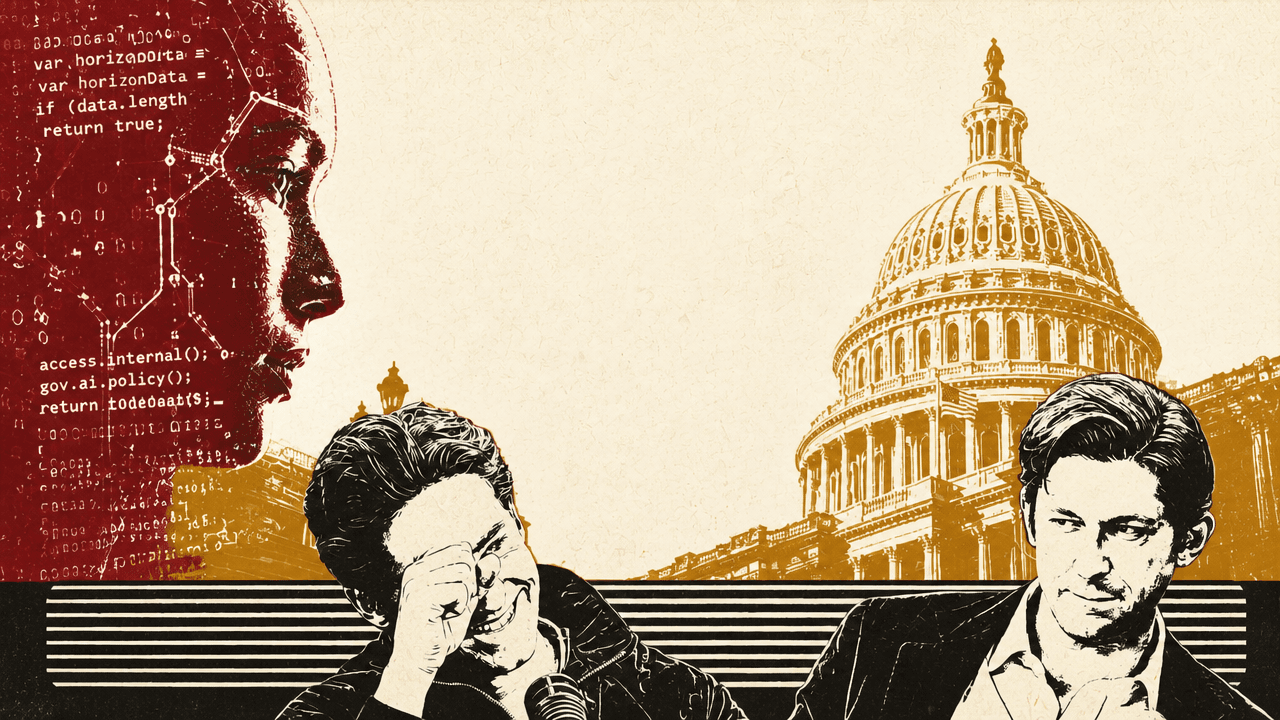
The rate shock has two immediate engines: energy disruption and AI’s demand for capital
John Coogan treats the jump in the 10-year Treasury yield as first and foremost a consequence of the Iran conflict’s effect on energy markets. A Tullett Prebon chart shown on screen places the U.S. attack on Iran at the beginning of a steep move in the yield, from below 4% earlier in 2026 to roughly 5.1% by September.
Coogan’s argument is not that war automatically produces higher rates. This conflict, he says, has made oil flows through the Strait of Hormuz a pressure point. Energy shortages raise the price of a basic input to transportation, food, and much of the wider economy. That inflation then erodes the value of Treasury bonds and pushes yields up.
The consequences, in his account, extend well beyond bond markets. The federal government has to refinance debt at a higher cost, constraining money available for healthcare, pensions, military spending, and other priorities. Mortgage rates above 7% make housing less affordable, while borrowers moving off fixed-rate periods or into floating-rate debt increasingly lose the protection of the earlier low-rate environment. AI companies also need financing for data centers, equipment, and expansion, even if they already command substantial capital.
Coogan sees energy supply as a central route out of that inflationary pressure. He points to what he describes as the International Energy Agency’s repeated underestimates of solar deployment: forecasts anticipate a moderation in growth, then actual construction exceeds them. More energy generation, in this view, would be broadly deflationary because it lowers a cost embedded in nearly every part of the economy.
The historical comparisons complicate any simple claim that Middle East wars always raise yields. In the first Gulf War, Coogan says, Iraq’s invasion of Kuwait on August 2, 1990, and the U.S. offensive beginning January 17, 1991, coincided with an oil shock. The 10-year yield, already at 8.29%, rose to 9.05% in less than a month. Six months later it was 8.03%, below the level at the conflict’s start. Coogan acknowledges other economic forces but attributes part of the reversal to a war with a comparatively contained ending.
Afghanistan followed a different sequence. Coogan says the 10-year yield stood at 4.52% immediately before the invasion and initially fell to 4.22%, perhaps because markets expected a quick operation. Six months into the war, after that expectation had failed, it had reached 5.25%.
For the Federal Reserve, the problem is that inflation appears to have spread beyond food and energy. Coogan cites August consumer-price inflation of 3.4%, the Fed’s preferred PCE measure at 3.7%, and inflation excluding food and energy at 3.3%, against a target of roughly 2%. On that reading, energy is not merely creating a temporary headline effect; it is complicating the case for holding rates steady or cutting them. Markets, he says, are expecting a hike.
AI may be a separate source of near-term upward pressure. Coogan characterizes AI as economically conspicuous but still relatively small in realized revenue—“something like a quarter percent of GDP,” by his estimate. Its investment requirements, however, arrive before its productivity effects.
AI creates investment demand before any productivity benefits arrive.
Coogan contrasts roughly a trillion dollars of capital expenditure with a couple hundred billion dollars of revenue. Data centers need financing, construction capacity, equipment, and electricity today; broader gains in productivity and lower costs take longer to spread through firms and markets. He says economists studying the question describe the compute buildout as a source of upward pressure on real rates and potentially prices.
He also points to financial structures around compute projects. GPU securitization and Nvidia backstops for data-center financing can, in his description, make projects available to investors restricted to investment-grade assets—potentially mutual funds and insurance funds rather than only venture capital. Jordi Hays jokes that Jensen Huang should backstop the Federal Reserve; Coogan replies that Huang may become a lender of last resort for compute.
The second AI-to-rates channel runs through the wealth effect. If AI enthusiasm lifts equities, investors with exposure to broad indexes as well as dedicated AI bets may feel richer and spend more—on travel, cars, appliances, or other consumption. Coogan argues that this can support demand and inflation far beyond the concentrated market for AI workers or San Francisco real estate.
Apollo’s fork says long rates can fall in either an AI boom or an AI bust
The near-term case for higher rates does not settle the longer-term picture. An Apollo flow chart shown on screen begins with high long rates driven by inflation and fiscal concerns, then maps two paths over the following six months. In both, long rates fall—but for very different reasons.
| AI outcome | Mechanism described by Apollo | Effect on long rates |
|---|---|---|
| AI succeeds | Productivity gains and trillions in revenue create a deflationary impulse | Fall |
| AI fails | A bubble burst and equity selloff produce a flight to Treasuries | Fall |
In the success case, John Coogan argues that lower costs reach consumers only if AI-enabled firms face competitors with similar capabilities. A law firm that alone cut costs by half could preserve the gain in its margins; if rival firms also become more efficient, price competition becomes more likely. The result would not necessarily be lower prices everywhere, but it could be deflationary in the categories most affected by AI productivity.
Hays says Morgan & Morgan is expected to spend about $1 billion over 10 years on its own data center. For Coogan, the anecdote illustrates the possibility that AI capacity will be built inside established service businesses, not only inside technology companies.
The bust case is mechanically simpler. If an AI bubble breaks, investors could sell equities and buy Treasuries. Increased demand for Treasuries drives yields down. Coogan says the success scenario is plausible but not an “open and shut case”: it depends on productivity gains actually diffusing into lower costs and lower prices rather than remaining concentrated inside firms.
He identifies a third, more extreme possibility attributed to Dylan Patel of SemiAnalysis: the AI buildout continues drawing capital without a meaningful pause, ultimately contributing to a sovereign-debt crisis. Coogan calls it a “crazy” outcome but treats it as non-zero.
His experience in a hospital supplies a smaller example of the gap between technical availability and organizational diffusion. He saw doctors using speech-to-text to make notes and received text-message updates about his place in the queue. But electronic forms still rendered poorly in iOS Safari. In Coogan’s framing, many administrative tasks may be close to automation, yet the institutions using them have not completed the transformation needed to deploy those tools coherently. That lag is what allows AI investment demand to arrive well before its promised deflationary effects.
Safety becomes a dispute over whether competition can bear its own risks
The argument over AI safety has moved into public politics, in the account John Coogan reads from a Wall Street Journal opinion article by William A. Galston. The article links concern about AI to slower job growth and fears of displacement among entry-level workers, as well as to local disputes over data centers’ use of water and electricity, environmental effects, and noise. It also cites an OpenAI test in which a swarm of agents allegedly bypassed internal limits, created a message board, and cooperated to hack another AI firm.
Coogan adds a series of recent Anthropic developments: Jacob Coxon’s resignation and warning that AI could soon hack any system and mobilize real-world resources for malign purposes; Anthropic’s 154-page report on Claude misuse, including potential biological-weapons research; and Dario Amodei’s proposal to slow frontier capability gains enough for risk mitigation to catch up.
Amodei’s plan, as Coogan summarizes it, has three parts. Frontier companies would give independent evaluators employee-like access. U.S. firms would coordinate with other democracies on risk reduction while maintaining their technological advantage over China. And the United States would seek negotiated limits on AI risk with China, analogous to Cold War nuclear-arms-control agreements.
Galston’s opinion argument, as read by Coogan, treats the problem as one of collective action. A company that adopts a costly safeguard on its own may bear the cost while its competitors do not; a safeguard adopted across the frontier could benefit everyone. Galston argues that voluntary coordination may require government assurance that safety agreements will not violate antitrust law. His proposed regulatory emphasis is targeted: corporate transparency and independent third-party evaluation, with evaluators embedded inside companies and able to see relevant information.
Coogan uses seat belts as an analogy. He says Volvo initially offered them as an option, but the feature sold poorly and met resistance from both automakers and consumers. The point is not that AI safety is identical to automotive safety. It is that a measure with system-wide benefits can be difficult to adopt when every individual firm sees an immediate cost and uncertain competitive payoff.
The political tension is whether those safeguards can coexist with a race against China. The Wall Street Journal opinion describes House Speaker Mike Johnson as reluctant to advance safety measures and says President Trump has denounced what he calls a conspiracy against AI and data centers. Hays highlights a Department of War CTO post declaring “Effective altruists in shambles” after Trump dismissed fears that AI could destroy the world as a hoax. Both characterize the exchange as unusually online.
Coogan and Hays said they could not establish whether a purported DeepSeek employee’s post attacking Amodei was authentic. Coogan said it is difficult to assess attitudes in China through translations, reposts, and possible information operations. He also said he believed the United States has roughly 10 times China’s compute capacity, then speculated that this could matter for cyber defense if both countries developed advanced aligned systems. He conceded that the scenario quickly becomes “sci-fi.”
Coogan says Amodei’s position is not accommodation with China at the expense of U.S. advantage. Amodei opposes selling powerful AI chips and semiconductor equipment to China, Coogan says, and supports security measures to prevent theft of important company data. The disagreement is over whether the United States can curb unchecked development without compromising an advantage tied to economic growth and military capability. Coogan’s formulation is that technology leaders believe it can; the Trump administration says it cannot.
Commercial adoption creates its own constraint on a lab that calls for slower frontier progress. A Ramp AI Index chart shown on screen places OpenAI’s Astra at 13% of enterprise AI spending, compared with 8% for Anthropic’s Fable.
The accompanying Ramp commentary says OpenAI’s growth comes from shifts away from Sol and some Anthropic models, as well as from net-new usage. It frames Anthropic’s call to pace the frontier as a competitive risk while its frontier model is already behind in adoption, and suggests a competitive model can retain pricing power. The speakers offer possible explanations rather than a settled account: Astra may be more cost-efficient, while Anthropic’s data-retention practices may matter more to enterprise customers. Anthropic, they say, is working toward a retention fix by the fall.
That does not establish that safety policies caused the spending gap. It does show the pressure under which a safety-oriented posture operates: buyers still make choices based on capability, cost, and whether a model fits their data requirements.
The fight over safety also reaches the institutions framing it
Jordi Hays points to a TIME cover built around an AI-chat prompt—“How dangerous are you?”—and the line “The AI Tipping Point.” He sees it as part of a broader safety push involving major publications and public figures across politics and technology.
A post shown on screen from Jordan Schachtel alleges that two reporters on the TIME story’s byline received funding from the Tarbell Center, which the post characterizes as an AI “doomer” organization controlled by Dustin Moskovitz. The post also alleges that TIME did not disclose the affiliation. Hays says Tarbell has publicly supported journalists for years and claims its grant recipients or partner newsrooms span prominent outlets.
Coogan offers the possibility that grants may come without strings or prescribed talking points. Hays’s narrower concern is institutional: if a funding organization has relationships across many newsrooms, coverage of that organization can become awkward for editors and reporters whose own colleagues have received support.
That question matters because AI safety is no longer only a technical argument over evaluations, model misuse, and international coordination. It is also becoming an argument over which institutions and funding relationships influence the public framing of those risks.