Google’s AI Repricing Turns on Product Restraint and Developer Adoption


John Coogan and Jordi Hays use Google I/O to argue that Alphabet is being repriced less as a search incumbent threatened by AI than as a full-stack AI company, though they say Google still has to prove it can turn models such as Gemini Omni and Flash into useful products without cluttering every surface. The Diet TBPN episode also treats distribution as the common pressure point behind several unrelated fights: whether smartphones help explain the timing of global fertility decline, why a small Spotify icon change provoked backlash, and whether podcasts or childcare are eroding the market for serious nonfiction.
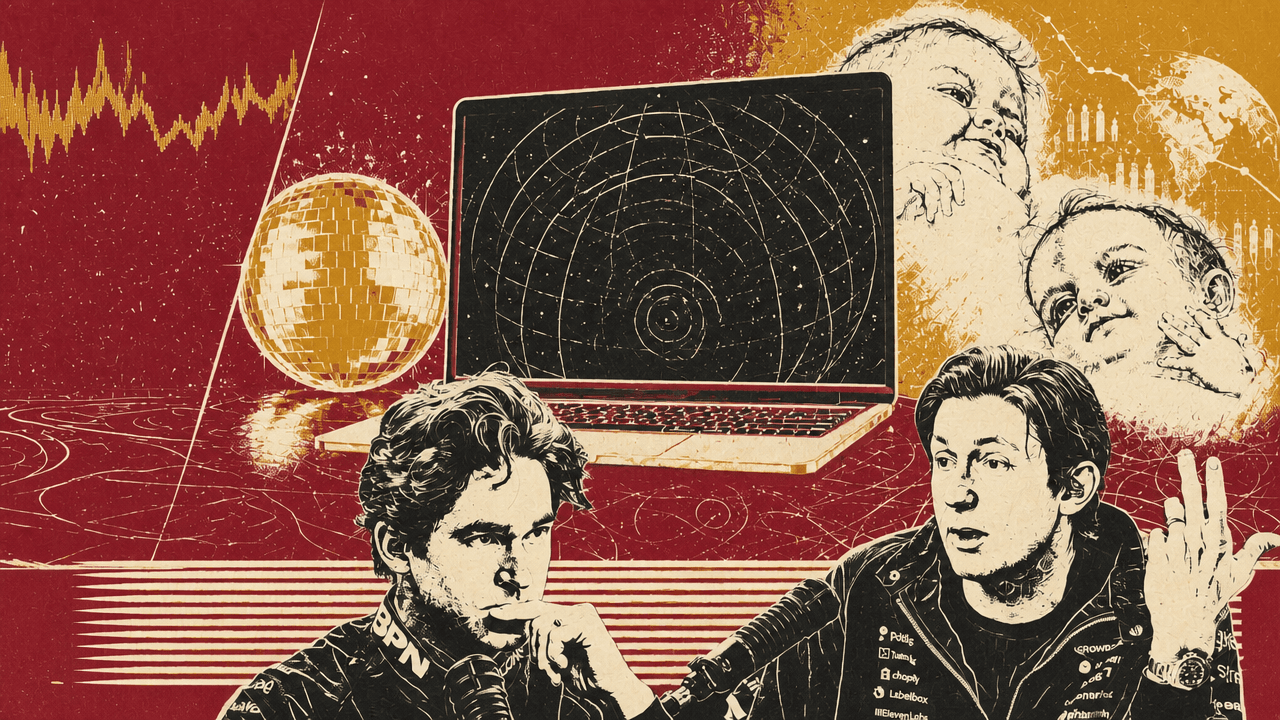
Google is being repriced as a full-stack AI company, not a search incumbent under siege
John Coogan framed Google I/O against a changed market narrative: Google is no longer being treated primarily as a company exposed to AI disruption in search. He said the stock is up 140% over the past year, putting Alphabet near a $4.6 trillion valuation, and noted that the company reported just under $110 billion in revenue last quarter.


Jordi Hays immediately corrected the time horizon — Google was down on the day, he said — but Coogan’s point was about the longer repricing. Wall Street, in his telling, has moved toward viewing Google as a “full stack AI winner” across Google Cloud, Search, Gemini, DeepMind, and the company’s model work. Google Cloud, he said, is growing faster than AWS and Azure. Core Search is also holding up better than the bearish AI-search thesis implied: Sundar Pichai said queries are at an all-time high, and Coogan cited Search and other revenue as up 19% year over year.

That sets up the central I/O question differently. It is not simply whether Google can show AI demos. It is whether Google can turn a broad AI capability base into useful products without making every surface feel like it has been stuffed with redundant chat boxes.
Coogan’s example was mundane but revealing: while writing in a Google Doc inside Chrome, he saw one Gemini star in the document and another in the browser. Opening both Gemini panels at once, he said, caused the actual document to disappear from view, leaving him with “two chat boxes to interface with the Google Doc.” The consumer demand, as he put it, is for AI that is “ambient and useful instead of pushy and desperate,” not another AI button in another corner of the screen.
That critique sat alongside admiration for Google’s experimental range. Coogan described Google’s culture as one that can produce “delightful experiments” that either become major products or end up shelved by year-end. He acknowledged the familiar “Google graveyard” critique, but argued that many users mostly remember successful products and current systems such as Gemini.
Gemini Omni pushes video generation toward on-demand explanation
The most concrete I/O demonstration was Gemini Omni, which Coogan described through generated science and engineering explainer videos. One example showed an older man in front of a partially disassembled engine and a chalkboard, prompted with “a man explaining how V8 engine works.” The generated speaker held a piston, explained the engine, and the video cut into 3D animation of internal components moving inside the cylinders.
Coogan’s immediate reaction was that the fidelity had crossed a threshold. He said the video looked HD, the motion looked good, the lips were synced, and the older “hollow sound” associated with AI-generated audio had mostly disappeared. Hays still heard it, but said it was much more subtle. Coogan described the uncanny state of the product category as “99.9%” there while still leaving viewers wanting “99.999%.”
Hays also raised a useful limitation: the engine shown might not actually have matched the prompt. “Isn’t that a V6?” he asked. The point was not just visual quality; factual and structural correctness still matter, especially for educational explainers.
The broader implication, for Coogan, is that AI video could commoditize a category of YouTube production that has historically required substantial CGI labor. He pointed to explainer channels that show the inside of a rocket, RPG, AK-47, Glock, or other complex object. Those videos can draw tens of millions of views and work across languages, but require detailed modeling of every component. If a user can prompt YouTube for an exploded-view explainer of an object and receive a generated video on demand, the value chain changes.
Hays extended that into a platform-level question: at what point does a user open YouTube and find videos already generated around their interests? That might mean analysis of a favorite sports team’s latest game, a favorite fighter, or a current-news event. But he also noted the obvious conflict: if YouTube itself generates personalized videos, it may be competing directly with the creators who supply the platform.
Coogan’s nearer-term view was that this looks like “the dawn of stock footage.” Creators have already used increasingly cheap CGI tools and templates; generative video pushes that commoditization further. The open question is whether the generated layer remains a tool underneath creators or becomes the user-facing product.
A second demonstrated video explained why the sky is blue. It began with a grassy field, blue sky, and sun, then moved into 3D animations of light waves separating into colors and scattering off stylized gas molecules. The visible narration explained Rayleigh scattering, the inverse-fourth-power relationship between scattering intensity and wavelength, and why the sky is blue rather than violet: the sun emits less violet light, and human eyes are more sensitive to blue.
For Coogan, the education use case is straightforward. Users already go to Google or YouTube with practical questions — how to fix a specific washing-machine model, for example — and the system can point them to the exact segment of an existing video. If a model can read a manual and generate the exact repair video needed on the fly, it can satisfy that use case much more directly.
Logan Kilpatrick’s on-screen post described Gemini Omni as a model that can “create anything from any input — starting with video,” available in the Gemini app, Flow, and YouTube, with API support coming later. A promotional montage emphasized “Create anything,” “From everything,” and transformations such as swapping characters, detail, style, environment, and angle. Coogan wondered whether even the motion-graphic transitions and beat-matched edits in the promo were generated by Omni, and whether users would eventually upload multiple clips and ask the model to cut them into a “vibe reel” against a chosen song.
Flash is the speed story, but developers still have to care
Google’s Gemini 3.5 Flash announcement was presented as an enterprise and developer story as much as a consumer one. Coogan read the positioning as “our most powerful model to date,” with emphasis on intelligence, speed, and cost. Google’s on-screen post called it the company’s “strongest agentic and coding model yet,” claiming frontier-level performance at four times the speed of comparable frontier models and often less than half the cost.
Coogan said Google had shown Gemini Flash running between 600 and 1,400 tokens per second on TPU 8i, peaking around 1,480 tokens per second with an average around 800. He treated that as meaningfully fast for coding and agentic use cases, while noting the tradeoff: it is more expensive than previous Flash models, which follows the broader trend that smarter models cost more.
The investor focus, in Coogan’s view, is less on the consumer app and more on the next Gemini model, enterprise diffusion through Google Cloud, and adoption inside coding agents. He named Google’s Anti-Gravity and Gemini CLI as relevant surfaces, adding that Gemini CLI has not seen as much traction. A better model, he said, could pull that forward.
He also said token generation at Google is up 7x year over year, though he cautioned that it is unclear how much of that growth reflects more reasoning work rather than broader distribution. Given that Gemini has been placed across many product surfaces, he said massive growth is not surprising.
The model-launch cadence remained a source of uncertainty. Coogan said many people had expected Gemini 4, but I/O started with 3.5 Flash. Hays asked whether there had been “vague posting” about a 3.5 Pro release that week. Coogan initially expected more over the following days, but Hays later added context that 3.5 Pro was coming the next month, not that week.
A tweet from Andrew Curran supplied a different speculative frame: the Google team’s unusual quietness might mean they had trained the largest model they had ever successfully trained, perhaps the largest anyone had, and that something unexpected had emerged at scale. Curran compared it to a “Mythos moment,” though “not in the same way Anthropic did.” Coogan treated that as possible but unresolved, and wondered what kind of “surprise” would qualify. He speculated that after cybersecurity, biology might be the next domain where a model reveals uncomfortable capability — for example, systems that can reason about dangerous pathogens and therefore need to be shared with pharmaceutical companies in advance.
A separate on-screen post from Lisan al Gaib tempered the coding excitement by saying Gemini 3.5 Flash scored “kinda low” on a coding index because of poor TerminalBench-Hard scores. Coogan’s conclusion was conditional: developers will decide whether the Anti-Gravity and Flash updates matter. Speed is important in daily coding, he said, but “the model has to be able to perform.”
Agentic commerce, wearables, and watermarking are the next distribution problems
Coogan said agentic commerce would also be “top of mind” for investors because Google’s Gemini app messaging has moved away from advertising as an immediate monetization engine. Google has obvious assets for closing the shopping loop: Google Shopping, hooks into e-commerce surfaces, and the fact that users already search Google for things they intend to buy.
But he described consumer behavior as lagging the rhetoric. Many companies have announced agentic shopping protocols, he said, but the numbers still raise the question of whether agentic shopping can reach even 1% adoption this year. Growth rates sound impressive because the base is zero. The missing piece is a user experience that makes agentic buying take off faster.
Wearables entered as another distribution question. Coogan referenced a prior discussion with Joanna Stern, saying she had gone deeper than most AI consumers or enthusiasts by consistently wearing a recording device. Her view, as Coogan summarized it, was that humanoid robots are further away because they require much more training data; AI chat apps are already diffused; Waymo is now “boring”; and the next big consumer wave may be wearables over the next few years.
Coogan contrasted enterprise AI’s “capability overhang” with what he called an even larger overhang in consumer hardware. Large companies can deploy AI through consulting firms and private equity partnerships. Hardware moves slower. Apple iterates methodically, he said, noting that Apple Intelligence had been heavily marketed roughly a year earlier and that Apple still had not launched a folding phone. Challengers face manufacturing, ramp-up, distribution, retail, and shipping constraints.
Google’s history of hardware experiments illustrates both ambition and timing problems. Coogan mentioned Google Glass as ahead of its time, with Meta Ray-Ban displays now occupying a similar zone but still early and not selling by the millions. He also recalled Google Cardboard, essentially a cardboard enclosure that let users strap a phone to their face as a low-cost VR headset. Hays reduced the experiment to its premise: “How can we strap someone’s phone to their face?”
Hays added one more I/O item: Google’s new SynthID framework, joined by ElevenLabs, OpenAI, and NVIDIA, to help identify AI-generated content across platforms. The idea, as he explained it, is that an asset generated in ElevenLabs, OpenAI, or Gemini Omni should be detectable by other platforms.
Coogan said he had seen “made with AI” tags on X but assumed they could be bypassed by screenshots. Hays distinguished simple metadata from more embedded watermarking systems, such as subtle image patterns or saturation changes in Midjourney or DALL-E 3 outputs. Coogan’s practical view was that advanced systems will find ways to strip or obscure signals, especially when AI footage is blended with stock footage and other assets. But for average posters, a durable AI label could still be useful if applied tastefully.
The Spotify icon backlash exposed how sensitive people are to small interface changes
The discussion briefly turned from frontier AI to a smaller interface controversy: Spotify’s updated app icon, a darker green disco ball carrying the familiar black curved Spotify lines. Coogan asked whether Spotify had used AI to create it; Hays said he was surprised by the intensity of the negative reaction.
Both hosts liked the icon. Hays said that if someone truly disliked it, they should “seek help,” though he admitted it initially threw him off because it was dark enough that he wondered where his Spotify app had gone. Coogan argued that this was exactly why the redesign worked. It disrupted the home screen just enough to draw attention: his eye jumped, he noticed something was different, realized it was Spotify, and then looked closer.
The icon was tied, Coogan said, to Spotify’s 20th anniversary. He saw the complaints as overdone and called the change “genius.” Hays said it was a welcome break from the flat minimalist logos people have grown used to. Coogan’s position was simple: “Keep it.”
An on-screen post from Dylan Abruscato offered the strongest defense of the critics. Abruscato said he thought the icon was fun, but when tapping an icon becomes second nature over years, even a slight visual change can force a double take, which is annoying when someone simply wants to open the app. Another reply brightened the logo, arguing the original was too dark. Hays countered that darkness was the point: “You’re at the disco, John.”
The fertility decline argument turns on whether smartphones explain the timing
Coogan then moved to what he called the root cause of the fertility crisis: why birth rates are falling “everywhere all at once.” He summarized the demographic problem as a fast-moving landslide. In more than two-thirds of the world’s 195 countries, he said, the average number of children born to each woman has fallen below the 2.1 replacement rate needed for population stability without immigration. In 66 countries, the average is closer to one child than two. In some places, the most common number of children born to a woman is zero.
The acceleration has surprised forecasters. Coogan cited a Financial Times argument that, five years earlier, the UN had predicted 350,000 births in South Korea in 2023 — a 50% overestimate against the actual figure of 230,000. High- and middle-income countries have dealt with falling birth rates for decades, but Coogan emphasized that the recent breadth and pace of decline are the puzzle.
The Financial Times question, as he presented it, is whether smartphones in particular should be blamed for the most recent fertility drop. The most important chart adjusted fertility-rate trends by when smartphones took off in each country, rather than using a single global date such as the 2007 iPhone launch. After that alignment, Coogan said, the country lines fell in a strikingly similar way.
The chart shown on screen was titled “Could digital media be affecting birth rates?” It plotted percentage change in total fertility rate relative to pre-smartphone trend, by years before and after smartphones took off, and showed multiple lines dropping after the smartphone inflection point.
Coogan quoted Luis Giancarlo’s framing: “No smoking gun but the preponderance of evidence points to smartphones not economics as the culprit.” Coogan’s own reaction was that the chart looked like a smoking gun, even if Giancarlo said it was not. He listed supporting claims: in the U.S. and U.K., births fell first and fastest in areas that received 4G earliest; fertility was stable in the U.S., U.K., and Australia until 2007, in France and Poland until 2009, in Mexico and Indonesia until 2011, and in Ghana, Nigeria, and Senegal until 2013–2015; each inflection matched local smartphone adoption. The drop was sharper among younger age groups, in-person socializing among young adults was falling, and the effect appeared largest in culturally traditional societies such as the Middle East, Latin America, and Sub-Saharan Africa.
Hays raised the obvious alternative: what else happened around the iPhone launch? There was massive economic disruption. Coogan replied that the Financial Times article attempted to control for that by comparing countries with different experiences of the global financial crisis — some hit hard, some not, some growing rapidly. China, he said, complicates the picture because it had extremely low fertility while experiencing rapid GDP growth, but it is also confounded by the one-child policy.
Ross Douthat’s on-screen pushback introduced another historical caution. Douthat warned that people should not share the standard fertility-rate chart without the “child-survival adjustment.” Coogan explained the point: U.S. birth rates had been declining since the 1800s, with a pronounced baby boom in the 1940s, 1950s, and 1960s before decline resumed. He said he had asked Gemini 5.5 Pro about the longer history and got answers emphasizing that children used to be economically valuable — useful on farms and not requiring college spending — before the economics of childrearing flipped and children became a net cost to parents.
Hays reacted to the charts by saying they made him think “it’s over,” then corrected himself with the show’s refrain: “never black pill.” Coogan sharpened the emotional contrast: if this were any wild animal population, there would be major fundraising campaigns to save the species; because it is humans, people look at the chart and keep scrolling.
The unresolved research question, for Coogan, is what high-fertility groups are doing differently with technology. If smartphones are nearly universal, the analysis has to cut more finely: are higher-fertility populations using less social media, fewer dating apps, or phones in more coordination-oriented ways? He pointed to the Amish as an interesting case because they maintain above-replacement fertility and have largely steered away from smartphones, though some use simpler cell phones.
Podcasts may be blamed for killing ‘dad books,’ but childcare is a stronger suspect
The final thread linked media consumption to family time. Coogan cited an article shared by Derek Thompson about “dad books” — serious nonfiction across biography, current affairs, business, and economics — reportedly being in free fall, with sales declining for several years. The article quoted publishing executives saying that when they discuss the problem internally, “it always comes around to podcasts.”
Coogan admitted he listens to many podcasts and still listens to serious nonfiction audiobooks, but said it is increasingly hard to find the time. Hays joked that they needed to find out “who’s doing this,” with Coogan adding, “We’re all looking for the guy who did this.”
A counterargument came from an on-screen post by fed_speak: “It’s not podcasts. It’s kids.” The accompanying chart showed father childcare per day by age and generation, with Millennials and Gen X spending substantially more time with children than Baby Boomers and the Silent Generation at comparable ages.
Hays said this matched his life. On weekends, while holding one or two of his children, he looks at the stack of Amazon books piling up and knows that if he opens one, he will get “exactly three pages” before being interrupted. Coogan wondered what the Silent Generation and Baby Boomers had been doing instead, joking that perhaps they told the child to “hit the mines” because they had reading to do.
The hosts landed on a medium-specific distinction. Hays listens to podcasts when he is not at home — when he cannot read. Coogan suggested self-driving cars might be bullish for serious nonfiction because they could restore reading time, but Hays rejected that. Autonomous cars, he said, are bullish for infinite scroll and bearish for podcasts and long-form media. Coogan added that they would be bearish for books, too.