A Router Upgrade Triggered a Nationwide FAA Ground Stop
A router upgrade at an Arkansas air-traffic communications facility was the apparent trigger for a nationwide ground stop that delayed more than 7,000 flights and left more than 9,000 canceled by day’s end. TBPN hosts John Coogan and Jordi Hays said a network-equipment failure was the more ordinary explanation than a malicious attack, though officials reported no evidence that the disruption was malicious and the investigation had not settled the cause. The accounts from the FAA and contractor L3Harris left responsibility unresolved, as the hosts argued that a routine change inside a government system can have national consequences.
A routine upgrade exposed how little separation there is between a contractor and the system it serves
A router upgrade at an air-traffic communications facility in Arkansas was the apparent trigger for a nationwide ground stop that froze departures for more than four hours. The disruption was severe; the explanation available on Monday was still provisional. For John Coogan and Jordi Hays, the incident raised two connected questions: how a routine change could destabilize air traffic across the country, and who should answer when a contractor’s approved work fails inside a government system.
The trouble began at 3:10 p.m. Eastern on Friday, when the FAA stopped flights bound for Chicago O’Hare and Midway after controllers reported communications problems. By 3:36, radar feeds and communications were becoming unstable across facilities. Coogan said investigators later traced the disruption to network equipment being upgraded by L3Harris in El Dorado, Arkansas. A router was reportedly flooding the FAA network with roughly 1,000 connection attempts every four to five seconds. Hays’s shorthand was that it was “DDoS-ing itself”; Coogan agreed.
At 3:54 p.m., the FAA stopped departures nationwide. About 3,500 aircraft were already in the air. More than 7,000 flights were delayed, and more than 9,000 had been canceled by the end of Friday. Coogan recalled hearing a recording in which a pilot initially seemed to think the ground stop might be a joke. He also remembered receiving a bare CNBC alert: just the headline that the FAA had issued a ground stop, without an article explaining what was happening. Someone on the team had family members in the air. The most striking outcome, he said, was that no accidents appeared to have occurred: the FAA got everyone down safely.
The nationwide stop began to ease at 5:46 p.m., when local centers could request permission to release individual flights. Coogan watched flights move on Flightradar and noticed that the skies had not emptied: aircraft were still aloft, and some departures resumed while others were landing. By 8:15 p.m., the stop had been lifted after investigators isolated problematic network traffic and blocked locations in Arkansas and Texas.
The hosts contrasted Friday’s disruption with the shorter FAA ground stop in 2023. Tyler said that one lasted about 90 minutes and followed a failure in the NOTAM system, which supplies pilots with safety alerts and hazard information. The comparison did not explain Friday’s failure, but it put the event in context: a nationwide halt had happened before, though for a much shorter period.
Officials said there was no indication of a national-security threat, and intelligence agencies found no evidence the disruption was malicious. That did not prevent online speculation. Coogan described two camps he saw on the timeline: people connecting the failure to the Iran war, and AI-watchers joking that the machines had begun taking over. The hosts regarded a botched upgrade as the more ordinary explanation, while acknowledging that the initial account was not satisfying to everyone.
On Saturday, Transportation Secretary Sean Duffy said maintenance work by L3Harris, replacing old copper connections with fiber, appeared to have triggered the failure. The FAA was still investigating whether the cause was a faulty router, an installation mistake, or something else. The accounts from Duffy, L3Harris, and the FAA described different parts of the work and its oversight, without settling where responsibility lay.
Duffy said the contractor “didn’t meet the moment,” or the equipment did not. L3Harris said it was cooperating with the investigation, that its installation plan had received FAA approval, and that an FAA representative was present. The FAA said its representative helped an L3Harris employee gain access to the facility to install the equipment. The statements put responsibility in dispute: a contractor’s equipment or installation may have caused the disruption, while the agency had approved the work and had a representative on site.
Coogan discussed a clip in which Duffy appeared to nudge another official as the official described the upgrade. Coogan read the gesture as possibly signaling that Duffy wanted the other official to stop talking, but he also acknowledged that the exchange could be interpreted in more than one way. The clip did not settle whether the explanation had been coordinated or what the gesture meant.
The scale of L3Harris’s government work made the dispute more consequential than a simple exchange of blame. Coogan described a company with $22 billion in revenue the previous year and said it had taken on complex projects other firms had mishandled or avoided. He cited its work retrofitting a 747 donated by Qatar for President Trump’s use as Air Force One, after delays in Boeing’s planned replacements, and a $1 billion Pentagon investment in its missile-parts business. Hays and Coogan also briefly discussed the company’s valuation relative to revenue: Hays corrected Coogan’s estimate from roughly two and a half times revenue to about two times.
The incident, as described on Monday, was neither evidence of an attack nor a demonstration of an AI system controlling the skies. It was a cascading failure associated with a communications-system upgrade. That is reassuring in one sense, but it also leaves a less exotic problem in view: a routine infrastructure change can have national consequences, and the agency and contractor involved can each point to the other’s role while the investigation is still open.
Nvidia’s China strategy has become a question of national-security obligations
The dispute around Jensen Huang’s leadership was also a dispute about what Nvidia is. Is it a computing company competing for customers around the world, as Huang has presented it, or a supplier whose products have become critical to national security and therefore carry obligations beyond ordinary commercial compliance?
Jordi Hays described Huang’s position as a balancing act. He has argued that AI is transformative enough to justify enormous infrastructure spending, while selling Nvidia’s products as computing technology that should be broadly available. That framing helps explain Huang’s resistance to giving up the Chinese market: he sees Nvidia as a company that can keep competing there, rather than as a defense contractor obliged to withdraw.
Hays said Ben Thompson’s recent writing offered a different lens: government officials increasingly view Nvidia and its chips as part of national-security infrastructure. On that view, compliance with export controls means more than observing their literal terms. Hays pointed to Treasury Secretary Scott Bessent’s emphasis on the “spirit of the law”: a company should not structure its actions to technically comply while frustrating the restrictions’ purpose. Coogan compared the issue with sanctions. A bank would not be praised for finding technically permissible routes to keep moving money for a sanctioned country; the point, in his analogy, is not to do business there.
The contrast came into focus in a clip from an interview between Huang and Dwarkesh Patel. Huang argued that about half of AI developers are in China and said Nvidia should not give up that ecosystem. Patel responded that American labs use accelerators other than Nvidia’s, so Chinese companies could also use other chips even if they had access to Nvidia’s. Huang answered that Nvidia’s share was growing, not shrinking, and rejected the premise that the company should assume it would lose in China.
Hays’s summary of the competing policy view was that the government has increasingly been viewing Nvidia as a defense contractor. Coogan argued that Huang’s “woke up a loser” line is easy to hear as swagger, but that his reasoning is more specific: Nvidia has won in China for years, and Huang wants it to keep competing there. Coogan compared that instinct with the presence of Apple and Tesla in China. A foreign company may face disadvantages and lose share, yet still see a large market worth pursuing. The analogy does not answer the national-security question. It clarifies the commercial conviction Coogan hears in Huang’s position: even a difficult market is not one Nvidia should voluntarily surrender.
Hays noted that the comparison with consumer companies has limits. China may favor domestic suppliers, and selling advanced chips there can entangle a company with government strategic interests. The underlying conflict is between two definitions of Nvidia: Huang’s global computing business, competing for customers, and Washington’s increasingly defense-like supplier, expected to act in keeping with the purpose of export controls.
That conflict sits alongside the company’s leadership and governance questions. Hays said reporting about Huang’s wife, Alice Huang, and her connection to MegaSpeed was not new information that had only surfaced in the latest round of turmoil. He also said Nvidia had hired crisis-communications firm H/Advisors the previous year, and questioned how the company could appear so unprepared. Hays’s criticism was that Nvidia had resources and time to prepare for scrutiny but had still allowed a confusing public situation to develop.
Coogan criticized the company’s silence, saying he had not seen a public statement from Huang saying that he did not believe Alice Huang was a spy. Coogan called that a relatively simple clarification if it were true. His broader complaint, shared in different terms by Hays, was that Nvidia’s communications had not clarified the situation before speculation filled the gap.
The question of Huang’s possible return was similarly unsettled. A joint letter from Altimeter and Atrides Management asked Nvidia’s board to pursue a clear process and leave open the possibility of Huang returning. Coogan cautioned that the firms’ current holdings were unclear and that their leaders had long-standing ties to Huang. The letter showed their position; it did not establish that shareholders broadly agreed.
Hays said Financial Times reporting that Huang was discussing a comeback with allies briefly encouraged people hoping he would return. He also cited a later CNBC headline saying the board was not considering it. Hays’s assessment was that a comeback would require a significant change in Washington’s posture. He described pressure from multiple directions: China hawks were angry about Nvidia’s China strategy, critics of AI opposed its expansion, and Bessent had criticized the company publicly.
The hosts also differed in how they framed the weight of Huang’s departure. Hays said people in technology could see it as painful to be pushed out of a company someone had founded and led for decades. He called the situation a tragedy even while saying Huang had made serious mistakes. Coogan objected to treating the issue as purely emotional: Nvidia’s long success under Huang was also a practical reason for shareholders to want a deliberate leadership process.
Coogan argued that a return would be difficult if, as he understood the reporting, the conduct that led to Huang’s departure involved a relationship with a direct report and a violation of Nvidia’s code of conduct. His point was about the company’s rules: even a founder-led company could not simply decide that workplace rules did not apply. The governance question was not only whether shareholders wanted Huang back, but whether the board could pursue that outcome amid scrutiny of the conduct and the company’s own standards.
Hays raised Financial Times reporting that Nvidia lacked comprehensive directors-and-officers insurance. Bill Gurley responded that the arrangement was not necessarily irrational for a company of Nvidia’s size: policies have caps, insurance can cost more than self-insuring, and substantial coverage can attract litigation. Coogan compared self-insurance with large companies funding employee health claims from their own capital. Gurley’s explanation complicated any assumption that limited insurance coverage, by itself, demonstrated poor governance.
The immediate test, according to Hays, was Nvidia’s earnings call. He expected analysts to press CEO Colette Kress on export controls, MegaSpeed, Southeast Asian sales, and possible resale of computing capacity into China. Those questions would bear on Nvidia’s prospects in Asia and its broader standing, but Hays did not expect the call to resolve every issue. He anticipated substantial uncertainty afterward, observing that confused investors are less likely to buy a stock and confused customers less likely to buy a product.
Hays suggested that uncertainty could make a company with clearer leadership and momentum, such as Anthropic, more attractive to investors. He presented that as a possible market consequence, not a settled outcome. Nvidia’s exposure, in the discussion, was no longer only about demand for chips. It also depended on how the company explained its China strategy, its leadership, and the obligations Washington believed came with its products.
The AI investment case is being revised, not settled
A research note on AI accelerator spending offered a measure of the uncertainty around the buildout. Coogan said SemiAnalysis had cut its capital-expenditure forecast by 28%, citing slower growth at frontier labs and tighter capital markets. Hays added a qualification: the revised forecast was still above consensus, and it continued to project higher spending in 2028 than in 2027.
The distinction leaves two questions open. One is whether infrastructure spending will grow more slowly than earlier forecasts assumed. The other is whether the revenue that AI companies expect to generate will justify spending beyond even the revised estimates. Hays said that if the revenue ramps being projected materialize, he would expect them to justify substantially more spending. He was interested in how those expectations fit together, and said the week ahead could bring more information.
That uncertainty connected directly to the Nvidia discussion. A lower forecast does not, by itself, establish that the AI buildout is excessive; nor does a forecast above consensus show that the investment will pay off. Investors were being asked to weigh revised expectations for spending against the possibility of large future revenues, while Nvidia faced questions about its leadership and access to markets.
The successful Starship booster catch offered a different kind of evidence about how a technology changes from an idea into something investors can evaluate. SpaceX’s booster descended and was caught by the mechanical arms of its launch tower, Mechazilla. Coogan cited investor Delian’s description of the achievement as proof of a fully reusable orbital spaceship. In the comparison on air, Falcon 9 still meant losing half the rocket; the catch suggested a different degree of recovery.
Hays said that in science-fiction films, he had assumed that a spacecraft returning from space and landing precisely on a particular point was a compelling idea but not physically possible. The demonstration changed that intuition. Coogan relayed investor Shaun Maguire’s claim that Starship was now “de-risked as a concept.” That phrasing did not mean every technical or commercial question had been answered. It described a shift in confidence: the central idea of launching a vehicle and bringing it back for reuse had become less hypothetical.
The hosts’ playful speculation about a faked Moon landing tested a related question: does a spectacular demonstration make a future business easier to finance, or can it make the sector look like an expensive stunt? Coogan joked that investors might have faked the Moon landing to make later space ventures easier to underwrite. Hays offered the opposite argument, which he associated with Blake Scholl: a historic achievement can raise expectations and leave people thinking of space as a place for costly spectacles rather than economic activity. Their exchange was a joke, but it surfaced a tension in the discussion. Proof of possibility may encourage investment; it can also make the difficulty and expense more visible.
The viral AI-generated Nuremberg trailer raised a parallel issue: a technology can widen what is possible to produce without showing that the result will work as a product. Hays and Coogan were struck by its visual ambition. Hays said the images suggested a film whose scale would normally imply an enormous visual-effects budget. He hoped that filmmakers would see a way to pursue visions previously constrained by production costs.
Coogan was more cautious about what the trailer demonstrated. It showed striking scenes, he said, but a feature still needs a story that can hold attention: a protagonist, an antagonist, setbacks, and reasons to care about what happens. A sequence of elaborate images might be compelling as a trailer and still become exhausting over a feature-length film. He compared the premise with a post contrasting a familiar superhero sequel with an elaborate time-traveling war story. Unusual settings and ambitious set pieces can attract attention; characters facing tradeoffs and interacting with one another give an audience a reason to stay.
Coogan did not rule out the possibility that AI could help create a new kind of film. He compared that possibility with making a visually ambitious story that would once have been out of reach on budget grounds. But the production method would not supply narrative momentum by itself. As he put it through the Spider-Man example, a viewer still needs a hero they want to see succeed, a villain they want to see lose, and meaningful interaction between them.
Across the spending forecast, the rocket demonstration, and the AI trailer, the unresolved question was not simply whether technology could do more. It was whether the new capability would support a durable business or a compelling result. A changed forecast, a successful catch, and a striking trailer each offer different evidence. None, on its own, settles the economics or the value of what comes next.
Cybercab’s launch turns a delivery date into an argument about what counts
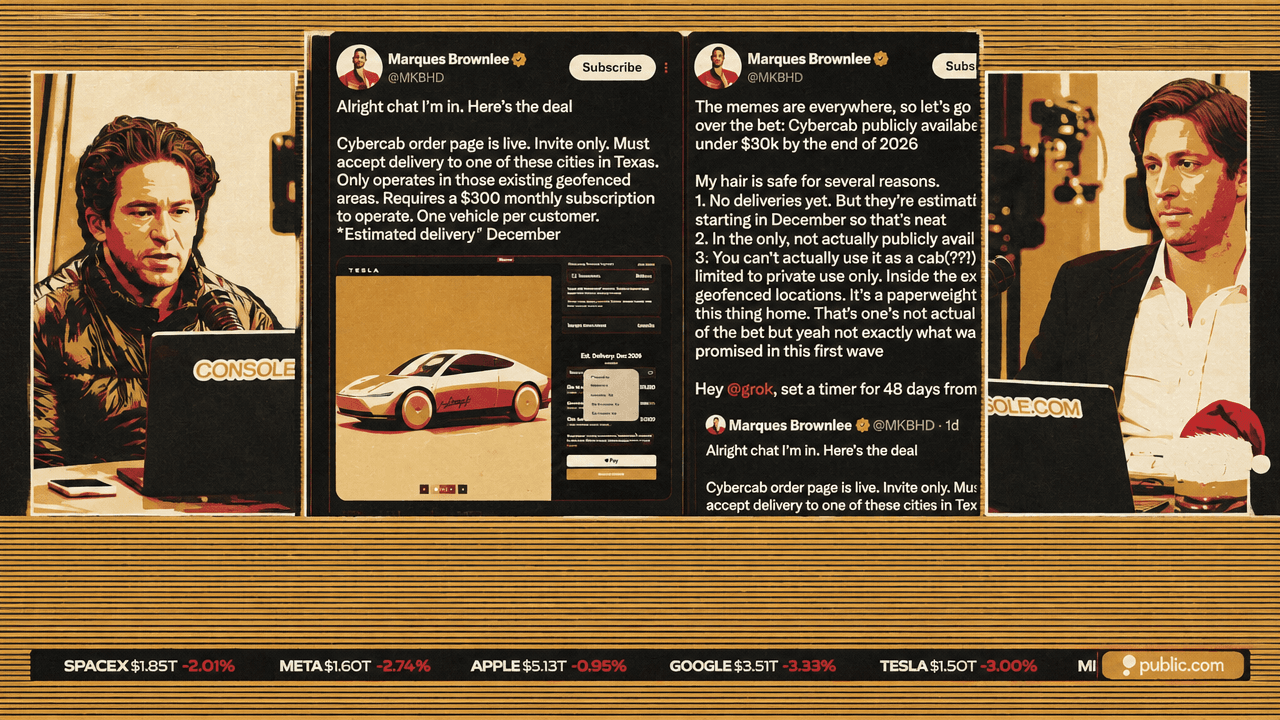
Tesla had begun inviting selected customers to purchase Cybercab for personal use, with estimated deliveries in December, according to the posts discussed on air. The displayed post said the offer was invite-only, limited to certain Texas cities and existing geofenced areas, and required a $300 monthly subscription. The vehicle has no steering wheel, so customers cannot drive it themselves.
The launch brought a public bet between Tesla and technology reviewer Marques Brownlee into sharper focus. Brownlee had argued that a Cybercab would not be publicly available for under $30,000 by the end of 2026. After the order page appeared, he said the first wave did not meet the terms as he understood them: it was invite-only, limited in where it could operate, and could not yet be used as a cab. He placed an order, but said the launch did not settle the bet.
Hays described the Tesla community’s response as turning Brownlee into a target, even though his prediction concerned the timeline and feature set rather than whether self-driving cars were desirable. Elon Musk called Brownlee a chicken; Brownlee replied that he had confirmed his order. The disagreement was partly about delivery and price, but also about definitions: does making a vehicle available to a limited set of customers count as public availability, and does a personal-use vehicle count as a cab?
The $300 monthly fee prompted speculation on air about what the price covered. Coogan suggested it could help pay for the research and development behind the vehicle and potentially support remote human assistance when the system encounters a difficult situation. That was his theory, not a feature description supplied in the displayed order details. Musk, in a post discussed by the hosts, said the fee should eventually match the cost of FSD and connectivity on other Tesla models, which he put closer to $115 a month.
Hays and Coogan joked about the missing steering wheel, proposing an improvised set of controls that would let a passenger move the vehicle without calling anyone. The joke sharpened the product question: when the system is restricted to specific areas and the rider cannot take over, customers are relying on the vehicle’s operating limits and whatever support Tesla provides.
Brownlee’s post said the estimated delivery was December and asked Grok to set a timer for 48 days. Coogan said Tesla appeared to be pushing to deliver the first vehicles before the year ended, rather than waiting until January. The bet therefore depended on more than whether a Cybercab arrived: the scope of the launch, its price, and whether it could operate as a cab all mattered to the terms Brownlee laid out.
The Bond casting claim leaves a question of tone and staying power
The hosts discussed Robert Pattinson as the next James Bond after a post from the official James Bond account stated, “Robert Pattinson is James Bond.” They treated the post as the end of years of speculation about who might follow Daniel Craig’s five-film run, while focusing on what Pattinson would bring to the role.
Coogan saw Pattinson’s performance in Tenet as an audition of sorts. He pointed to the tailored suits, the art-heist sequence, and the scenes involving cables and building climbs as having a Bond-like quality. Pattinson has also played Batman, but Coogan argued that the role has not become uniquely identified with him in the way Spider-Man is closely associated with Tom Holland. Hays raised Twilight as another possible association; he had not seen the films, and the exchange did not settle whether either franchise would follow Pattinson into Bond.
The casting also reopened a question about what tone the series should pursue. Coogan hoped the new films would recover some balance after Craig’s darker, grittier run. He described the problem through the relationship between Bond and Austin Powers: the spy films had long included knowingly silly names and comic touches, but the parody treated Bond as if the series played everything straight. Coogan’s account was that this made the Bond films respond by becoming more serious, as though the jokes had been exposed rather than intended.
For Hays, Casino Royale had felt intensely serious when it came out; he was young enough that its damaged, violent Bond seemed unlike a light adventure. Coogan agreed that the film’s severity was a reaction to the way Austin Powers had changed the frame around the franchise. The disagreement was less about whether the Craig films were gritty than about why that tone took hold.
The number of films Pattinson might make was another open question. The hosts noted that Bond actors’ runs have varied: Roger Moore appeared in seven films, while George Lazenby made one. Coogan said a guaranteed multi-film commitment could be a risk if the franchise’s tone or audience expectations shifted. His preference was for the series to find a workable balance—serious enough to sustain action and stakes, but not so solemn that it loses the playfulness the hosts saw in earlier Bond.