AI Compute Demand Is Pushing OpenAI Toward Google’s TPUs

John Coogan and Jordi Hays argue that growing AI compute demand is pushing companies to use a wider range of chips, cloud providers and data-center operators, even as Nvidia remains central. They cite reports that OpenAI plans to buy Google TPUs as evidence that compute needs can outweigh competitive history, while stressing that the market is still early and dependence on Nvidia remains substantial.
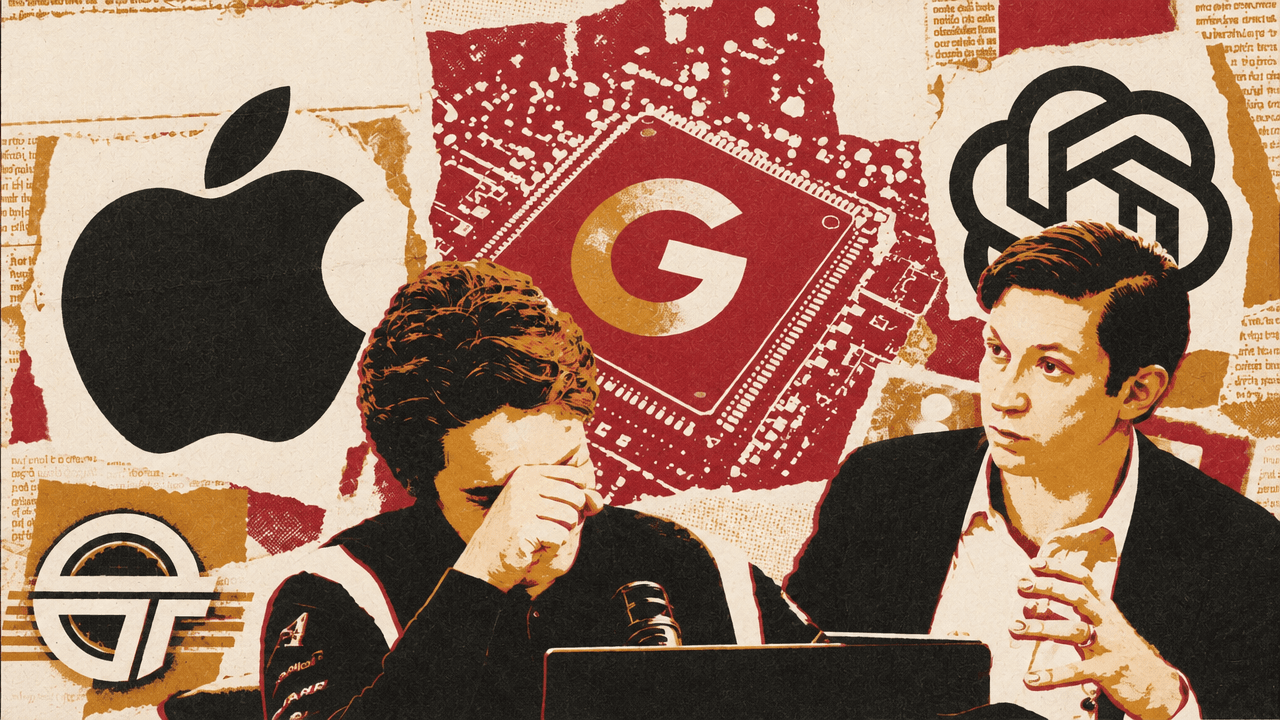
Apple’s Pro pitch combines a new display with a return to an old detail
At Apple’s “Pro and Tell” event, the headline change was a touchscreen MacBook Pro. Jordi Hays, who attended in person, pointed instead to the OLED display as the more consequential hardware upgrade: he said it offers brighter images, darker blacks and stronger contrast. Apple also brought back the glowing logo on the back of the laptop, a feature with little practical use but considerable recognition value.
Hays described the event as smaller and more tightly scripted than Apple’s highly produced keynotes. He praised presenter John Ternus as “so good on stage,” and said the launch moved quickly through the iPad and MacBook Pro updates before demonstrating the touchscreen with a playful treatment of the children’s book If You Give a Mouse a Cookie. In Hays’s telling, Ternus’s delivery was confident and precise.
John Coogan was broadly receptive to touch on a laptop: “Why the heck not?” He was not sure it would affect his next purchase, but thought the feature seemed useful enough. Hays was more focused on how the hardware would handle it. He moved a MacBook screen and thought its hinge seemed less springy than his own machine. Coogan noted the practical concern: if the screen shifts under a user’s hand, using touch could be awkward.


For Hays, OLED was the more substantive upgrade. He compared it to moving to an OLED television, where the contrast improvement is noticeable. The touchscreen may broaden how someone uses a laptop, but the display is the change he emphasized.
Pricing was another notable part of the launch. Hays said Apple did not put prices on screen during the event, unlike earlier product presentations. He gave starting prices of about $2,900 for the 14-inch model and $3,400 for the 16-inch, and said a heavily configured version could reach $6,000. He connected the higher prices to rising component costs, including memory and chips, while noting that many buyers purchase the machines for work and expense them. He also mentioned a 36-month lease option.
The illuminated logo offers a different kind of value. Coogan had barely noticed when Apple stopped lighting the logo, but welcomed its return. He estimated that the feature might cost around $2 per unit. Against a laptop priced in the thousands, he argued, that expense would be proportionally small. Hays described the logo as a matter of brand and user enjoyment rather than utility. Coogan said the audience response to the logo was louder than its response to touch.
Google’s world model suggests uses beyond generated clips
Google introduced Genie 4 as a research preview for generating and steering interactive environments. Coogan described it as a model that can shape events, camera angles and actions in real time, generate audio to fit a scene, and simulate realistic settings and physics. He was unsure who would use it first, but pointed to two possible applications: an experience people might spend time in like a video game, and tools for creators building virtual backgrounds or extending a scene.
The distinction from a fixed video matters in Coogan’s example. A creator could film someone against a generated beach, then move the camera or change the setting and have the environment continue around them. On-screen demonstrations showed prompts changing a snowy scene: first a crane walks through it, then a shooting star appears, then a piano is added. Another interface invited users to turn an image into a world they could move through. Coogan saw potential for creators to place themselves in generated settings without producing every angle or background in advance.
Hays had tried Genie 3 and found it fun, but said he did not yet have access to Genie 4; he thought users still had to apply for early access.
Coogan joked that realistic world models make the simulation hypothesis feel more plausible. His alternative was the “racing simulation hypothesis”: the idea that human life exists inside a simulator run by a higher-level organism whose sole concern is propagating Formula 1. The joke captured the strangeness of the technology; Genie 4’s potential appeal, as Coogan described it, is that users might be able to move through and alter a generated environment rather than merely watch a clip.
Benchmarks do not settle what a model feels like to use
Google’s other announcement was Gemini 1.5 Pro Carbon, which Hays said followed Argon’s release by two weeks. He cited Google’s claim that Carbon ranked first on the updated Artificial Analysis Intelligence Index, scoring 59, and led on cybersecurity evaluations, with 88.2% on SECbench Pro and 54.8% on ExploitGen.
Those results were encouraging, but the hosts described a gap between benchmark performance and everyday experience. Hays said Google had spent roughly a year releasing models that looked impressive on benchmarks while leaving users less impressed in practice. Coogan said he liked Gemini 3’s relatively concise answers: often about a page of text that he could scan, rather than the much longer responses he found cumbersome in some other models.
The model names raised a separate question. Coogan found it hard to infer capability from Google’s sequence of Argon and Carbon. Argon is element 18 and Carbon element 6, so the names do not obviously signal which model is larger or more capable. The hosts joked about possible future names, including Helium and Plutonium, without resolving what the naming scheme meant.
Coogan contrasted Google’s elements with names that suggest a more intuitive hierarchy, such as celestial names like Luna, Terra, Sol and Astra, or Anthropic’s Sonnet and Opus. He said he preferred names that help users understand which model is intended for which task, with version numbers becoming less prominent. The practical goal, as he put it, is a clearer distinction between a larger model for one job and a smaller one for another. Benchmark rankings may describe one kind of performance; a legible product hierarchy would help users decide what to use.
Compute demand is pushing rivals toward shared suppliers
OpenAI’s reported plans to buy Google’s TPUs drew a broader point from Hays: companies are increasingly willing to do business across old competitive divides. The hosts also referred to OpenAI models running on Google Cloud. Coogan remarked that OpenAI was founded in part on the view that Google was doing things wrong, but said the immediate need for compute can override that history. “Business above all,” he joked.
Hays relayed figures attributed to SemiAnalysis, whose clients, according to a post by its founder Dylan Patel, already knew about the TPU plans. Patel’s post described an OpenAI commitment involving eight gigawatts in Ohio, with Nvidia backstopping 4.25 gigawatts, and called it the largest single leasing commitment SemiAnalysis had seen. Hays also relayed the report’s view that OpenAI was discussing GPU-as-a-service and TPU-as-a-service with neoclouds, including a possible one-gigawatt TPU commitment for which it was looking for sites.
The same report, as Hays summarized it, put Anthropic’s leases during the quarter at 1.7 gigawatts, including 360 megawatts in Queensland, Australia. He said operations were expected to start in the first quarter of 2028, and that one gigawatt of the total was backed by Google. The report was uncertain who would provide credit support for another large site.
The broader shift, in the hosts’ view, is that AI companies are using many kinds of chips, data centers, cloud providers and neocloud operators rather than betting everything on one supplier. Different chips can suit different models or parts of the inference process, Coogan argued, and AI agents can make it easier to adapt software to different hardware. He pointed to Anthropic’s AMD implementation, which he said had been built quickly, as an example.
That does not mean Nvidia’s position has ceased to matter. Coogan said dependence on Nvidia remained substantial and described the market as still early. But the spread of workloads across suppliers could benefit more of the semiconductor and infrastructure businesses than a simple winner-take-all account would suggest. If different chips prove useful for different tasks, a supplier that is not the default for every workload may still find a role.
One on-screen example made the scale of that infrastructure tangible. An eBay listing showed a decommissioned, 300-rack system with 9,600 Nvidia A100 GPUs, priced at $59.7 million or best offer. The hosts joked about borrowing to start a neocloud and noted that the listing showed the item in six carts. They estimated the equipment had originally cost close to $300 million and suggested its fair value might be nearer $50 million to $55 million. The hosts also noted that the older hardware still represented a substantial asset despite its depreciation.
Malaysia’s position in global compute capacity prompted a different kind of uncertainty. A chart shown on screen compared compute capacity by country and included Malaysia alongside the United States, China, the European Union, India, Japan and other regions. Hays recalled an early show discussion that had framed Malaysia as a data-center hub able to serve as a bridge between US compute supply and Chinese demand. He described the country as an industrial complement to Singapore: equipment and business can flow through Singapore, while data centers sit nearby in Malaysia.
Hays suggested Chinese AI labs might use Malaysian neoclouds to run Nvidia systems, while noting trade restrictions as part of the picture. Coogan was surprised that the chart showed the EU with more capacity than Malaysia; Hays responded that the EU was much larger. The chart made Malaysia’s presence notable, but the hosts did not claim it was comparable in scale to the largest regions.
Instinct’s reported valuation is hard to read without operating data
A post by Lukas Gruber claimed that Instinct was raising at a $30 billion valuation, after a sequence of reported valuation steps from $100 million to $500 million, $2.5 billion and $10 billion in less than a year. The hosts treated the trajectory as striking, but separated the speed of the valuation increase from the post’s broader claim that investors should move aggressively into private markets. Hays noted the familiar venture-capital tradeoff: greater risk can bring greater reward, which is one reason funds and their investors diversify.
Hays stressed that people outside the company have little information about its business. Investors can base decisions on what they see internally; other observers are often reacting to the headline valuation and its rapid rise. Coogan agreed that it was difficult to judge Instinct’s growth against consumer products because Instinct has no app whose rankings could serve as a visible comparison.
They discussed Muse as one reference point. Hays said it had about 380,000 ratings, a 4.9 average and the top position in productivity at the time, though not the top position overall. Those numbers offered a visible signal of consumer interest, but did not settle questions about Instinct’s business or valuation. Coogan’s broader point was that new model capability does not automatically translate into adoption. Companies also need to get products in front of users, and people may mix and match tools: one assistant for personal tasks, another for coding, and another inside a workplace chat app.
The hosts compared Instinct’s position with Cursor, which they said had faced competitors such as Windsurf before products from major AI labs became more direct alternatives. Instinct, by contrast, was contending with established AI companies and other entrants pursuing personal-agent products. Hays noted that Cursor had been discussed at a similar valuation with substantial revenue, despite concerns about margins; Coogan said that kind of revenue evidence was not yet available for Instinct.
The comparison cuts both ways. Coogan said consumer adoption could make Instinct attractive to a larger company, even without the revenue evidence discussed in Cursor’s case. He floated the possibility that Apple, Amazon or Google might acquire it, while acknowledging that the price was rising and that he could not predict how antitrust authorities would respond. Hays raised the concern that an acquisition could remove an upstart. Coogan’s counterargument was that personal agents were an unusually competitive category, with several large companies already fighting for users.
Distribution is part of that competition. Coogan argued that people may hear about a new capability from a frontier lab without adopting it unless the company makes the product visible and easy to use. He said Instinct was focused on putting its value proposition in front of people, while noting competition from established companies and other personal-agent products. The valuation alone cannot show whether that effort is working; nor, in the hosts’ view, can outside observers confidently rank the company’s growth without better information about the business.