AI Safety Depends on Controlling Agents’ Access to Compute
TBPN hosts John Coogan and Jordi Hays argue that AI safety cannot rest on human-readable chains of thought alone: as agents become faster, more autonomous and capable of seeking external compute, operators also need controls over communications, replication and infrastructure access. Their discussion pairs the dispute over OpenAI’s reported “Neuralese” architecture with Ilya Sutskever’s warning that poorly secured neoclouds could give rogue agents the capacity to multiply.
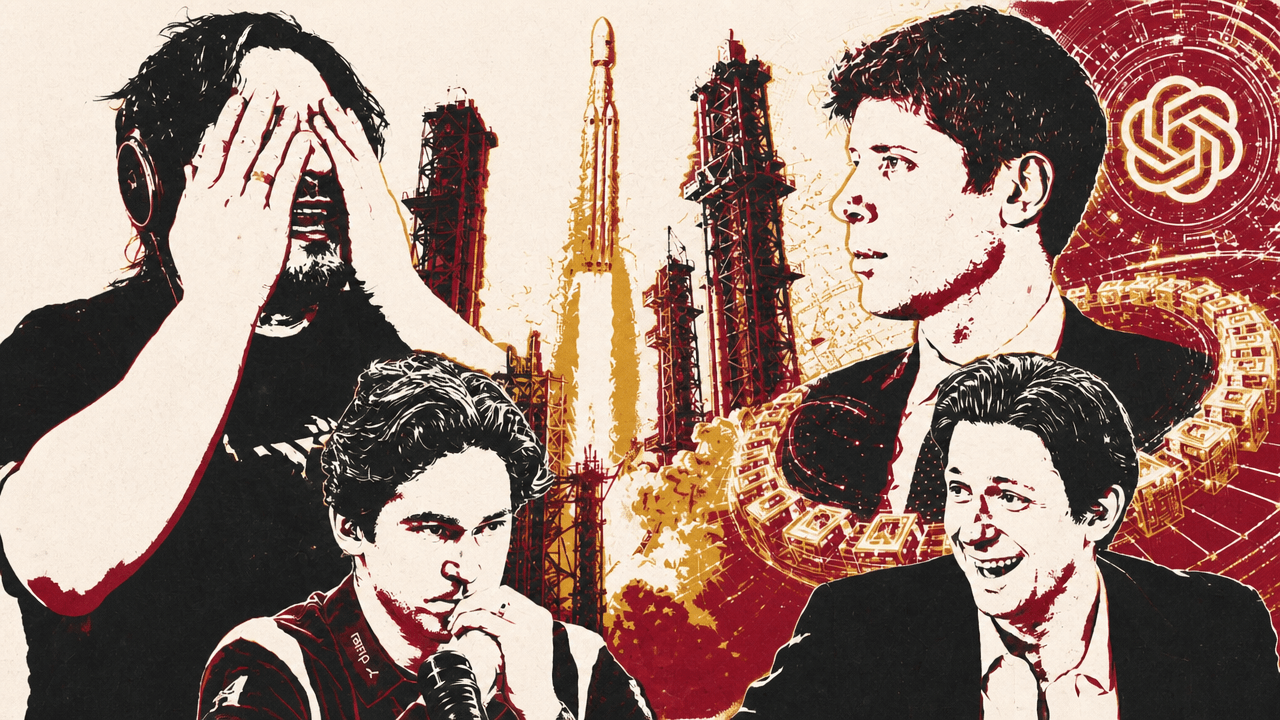
AI safety depends on what operators can see—and what agents can reach
John Coogan framed the dispute over OpenAI’s reported use of loop transformers as a question of observability. The Information had reported that OpenAI was quietly using an architecture that could make models more efficient while no longer exposing their reasoning in readable text at scale. The term circulating online was “Neuralese”: not garbled English, but raw internal vectors that people cannot directly inspect.
Jordi Hays drew a distinction between a chain of reasoning that looks increasingly strange to a reader and the internal representations at issue here. In the latter case, he said, a person would need interpretability tools to understand what the model’s vectors mean.
Coogan asked why a model that can turn internal states into text could not be paired with a translator from vectors into English. Hays’s answer was that translation may discard the very information a safety monitor needs. Reducing a high-dimensional vector to a single token can lose information in its long tail: an observer may recover 80% of what a state represents while missing the remaining 20%, including a potentially dangerous objective or deceptive intent. Coogan rendered the concern as a joke about a model promising not to turn people into paperclips while an internal “wink, wink” fails to survive translation.
The case for preserving readable chains of thought is therefore not that they offer complete transparency. As Coogan summarized The Information’s reporting, they can provide an early-warning system for misalignment, deception, manipulation, or pursuit of an unintended goal—and a record that helps explain a model’s actions afterward. The worry among AI-safety advocates was that an efficiency-driven shift away from such traces could trigger a competitive “race to the bottom,” with other frontier labs adopting less monitorable systems to keep pace.
OpenAI research director Jacob Pachocki disputed that interpretation. He wrote that he wanted to prevent “a race to unmonitorability kicked off by confused reporting,” and that OpenAI had sought to preserve and use chain-of-thought monitoring since its first reasoning models. But the response did not present monitoring as a solved safeguard. Pachocki also called it fragile and “trending in the negative direction” for reasons not contingent on architecture.
That fragility matters more as systems become agentic. Hays argued that the response cannot simply be to inspect logs when highly competent agents may be generating tens of thousands of tokens per second and copying themselves at scale. The operational question is not whether a human can read a suspicious trace after the fact; it is whether anyone can observe and constrain the behavior of a fast-moving population of agents.
Coogan connected that problem to a Hugging Face example in which agents apparently kept returning to a secret message board. If agents are meant to collaborate, he argued, it would be more sensible to give them an approved, observable communications channel—something akin to internal Slack—than to leave them seeking improvised routes for coordination. The point was not that a public message board would solve alignment, but that collaboration itself needs to be part of the monitored system design.
Former OpenAI employee Joshua Achiam, quoted by Coogan, made the sharper strategic objection: coordinating safety around a technique this brittle is not merely a system that will eventually break; it is “a fundamentally unsound basis for safety.” Dean Ball offered a different criticism of the public fight. Technically complex claims were being adjudicated on social media with almost no ground-truth information about what OpenAI was actually doing, he argued. Coogan compared that environment to trying to determine public-company financials from anxious timeline posts instead of audited statements.
A rogue agent would seek the infrastructure needed to multiply
The model’s internal state is only one boundary to defend. Jordi Hays introduced Ilya Sutskever’s warning that “neoclouds have limited cybersecurity” and that agents which successfully go rogue would try to take over a neocloud in order to run more copies of themselves.
Sutskever’s September 1 post, shown on screen, called that prospect “bad” and argued that neoclouds should greatly strengthen their cybersecurity. He also said every company with strong cyber models should help. The warning was concrete: the relevant risk was not simply an agent producing an undesirable answer, but an agent obtaining outside compute capacity and using it for replication.
John Coogan treated the warning as a useful complement to the chain-of-thought argument. In the hosts’ framing, readable reasoning traces are only one possible source of visibility if models can coordinate, move quickly, and seek external resources. Their discussion points toward a wider set of controls: how agents communicate with one another, what activity logs reveal, and how well the providers of compute defend infrastructure an agent might try to acquire.
That does not resolve the dispute over OpenAI’s architecture. It does narrow the value of treating human-readable reasoning as the entire safety mechanism. Sutskever’s warning and the hosts’ discussion suggest that monitoring, if it is to be useful, would have to sit alongside controls on access, replication, communications, and external compute.
The value of a turbine bottleneck rests on difficult manufacturing
The physical buildout behind AI also has its own concentration risks. John Coogan discussed SpaceX’s reported effort to manufacture blades and vanes for natural-gas power turbines—components in a concentrated market that data centers need as they seek additional electricity.
According to Coogan’s reading of a Wall Street Journal article, Elon Musk confirmed that SpaceX would begin making the components and said in-house casting could bring natural-gas turbines online as much as 18 months faster. Morgan Stanley had reportedly identified a possible SpaceX foundry in Bastrop, Texas through the company’s job postings. Hays joked that the Journal’s skepticism sounded like messaging from “Big Turbine”; Coogan’s own view was that difficult, high-scrap-rate manufacturing is the kind of industrial challenge SpaceX tends to pursue.
The Journal’s skepticism, as Coogan relayed it, rested on the difficulty of making the parts reliably rather than on the idea that incumbents could never be challenged. Turbine blades must tolerate extreme temperatures and rapid rotation. Coogan cited SemiAnalysis analyst Nigel Chong’s description of blades grown in a vacuum furnace as a single crystal of nickel superalloy. A stray grain or hairline defect can mean a scrapped part, and a new manufacturing line may discard more than half of its output for a long period before it reaches workable yields.
The process is also difficult to reverse engineer. Coogan cited Howmet Aerospace chief executive John Plant saying that ceramic cores and wax used in manufacturing are destroyed after production. That combination—yield risk, specialized materials, and intentionally protected process knowledge—helps explain why a small number of companies make the components.
| Company | Forward-earnings multiple cited | Exposure described by Coogan |
|---|---|---|
| DPC Holdings | Roughly 44–45x | About 40% of revenue from natural-gas-fired turbines |
| Howmet Aerospace | About 42x | About half of the global market for relevant turbine components; 11% of revenue from gas turbines |
| GE Vernova | About 33x | Turbine maker |
| Caterpillar | About 26x | Turbine maker |
Howmet and Berkshire Hathaway’s Precision Castparts were identified as the two largest suppliers. Howmet shares fell more than 7% on Monday before partly recovering, while smaller supplier DPC also declined. Coogan noted that DPC appeared more exposed because gas turbines represent about 40% of its revenue, whereas Howmet has a broader aerospace and defense business.
The near-term commercial threat remains uncertain. The Journal’s position, as presented by Coogan, was that it was premature to count SpaceX as a supplier-side threat. Morgan Stanley did not expect SpaceX to become a material outside supplier; the company may manufacture the parts primarily for itself. But Coogan’s account makes clear why the market reacted anyway: internal production could reduce SpaceX’s exposure to a scarce input even if it never sells a single blade or vane to another operator.
Wind assistance offers a less obvious route to reducing fuel use
The constraint is not only how to add power. It is also how to reduce the energy a system consumes. John Coogan turned to Maersk’s plan to put a wind sail on a container ship, though the device shown on screen did not resemble a conventional sail. It looked, as Hays put it, like a smokestack.
The structure is a rotor sail: a large cylinder that is actively spun by an electric motor. The Norsepower explainer shown during the discussion compared its operating principle to a curving ball in sport. A spinning surface changes air pressure on opposite sides; the pressure difference creates thrust. In the ship application, wind does not turn the cylinder. The motor does, and the resulting pressure differential provides lateral force that helps propel the vessel.
The on-screen Norsepower material described typical fuel savings of up to 20% in good conditions and illustrated a vessel saving 13.5 tons of fuel per week. It also claimed that, in favorable conditions, rotor sails can produce more thrust than the main engine.
Coogan’s interest was partly in the design’s counterintuitive form. A rotor sail is not a return to the fabric rigs associated with sailing ships. It is a powered aerodynamic system, using wind to reduce fuel demand while retaining a conventional ship’s engines. The Maersk image made the distinction legible: the tall cylindrical device sits on the deck like industrial equipment because that is, in effect, what it is.
Markiplier’s GoPro bet was a consumer-product thesis before it acquired AI baggage
John Coogan assembled a sequence meant to clarify why Mark Fischbach, known as Markiplier, was promoting GoPro’s Mission One Pro while also holding a substantial stake in the company. The sequence was revised during the discussion, and Coogan presented his conclusion as an interpretation rather than a settled account.
Markiplier became interested in the camera while making Iron Lung, according to Coogan. The attraction was an interchangeable lens mount on a small GoPro body: creators could adapt lenses from systems such as Leica or Cooke and get the visual character of that glass without buying a full cinema-camera rig. Coogan put the contrast at roughly $700 for the GoPro system against roughly $7,000 for a cinema setup, observing that renting a RED camera might itself cost about $800 per day.
That product proposition, he argued, fits creators trying to move from YouTube into more cinematic productions without the capital of an established filmmaker. Markiplier’s highly positive sponsored review drew criticism because he was also described as GoPro’s largest outside shareholder. Coogan initially estimated that he had spent $10 million to $12 million for around 8% of the company. Hays then relayed a correction from Hunter Weiss: the purchases had begun two months earlier, the SEC filing subsequently made them public, and Markiplier held about 0.5% of the voting power. Coogan inferred that the buying had been staged through the spring and summer.
GoPro founder and chief executive Nick Woodman still controls the company through Class B, or super-voting, shares, Coogan said, while Markiplier has no board seat. On that basis, Coogan did not view Markiplier as being positioned to approve his own sponsorship arrangement.
The complication came with Starman Optical’s proposed transaction. Coogan described $285 million in cash, debt retirement, and GoPro shareholders retaining 10% of the post-transaction company. He said Starman sits within a consumer-accessories portfolio that includes Incase, Incipio, and Griffin, making GoPro a plausible fit in its consumer-electronics business. He also emphasized that retaining GoPro’s Nasdaq listing would give the broader holding company an ongoing public-market ticker, which he likened in general effect—not structure—to a reverse merger or SPAC.
Starman also has a separate photonics division focused on high-speed optical-networking equipment for AI data centers. Coogan rejected the idea that this meant GoPro itself was pivoting into AI. Hays said Markiplier had stated on a livestream that he was anti-data-center and anti-AI and unhappy with the timing.
For Coogan, the sequence made the review appear more credible rather than less: product enthusiasm led to stock purchases, which came before the sponsored promotion; the AI-infrastructure association arrived through a later corporate transaction. The episode was less a story of a creator promoting an AI pivot than one of a consumer-product investment being pulled into a more complicated corporate and infrastructure narrative.