A $1 Million Card Heist Leaves Collectors and PSA Disputing Who Pays


TBPN hosts John Coogan and Jordi Hays disagree over who should bear the cost of a $1 million trading-card theft and whether Trevor Milton can turn an inherited aircraft certification into a credible jet business. Their discussions of airline etiquette, pricing and cabin amenities return to a common question: who should adapt when travelers’ preferences and expectations collide.
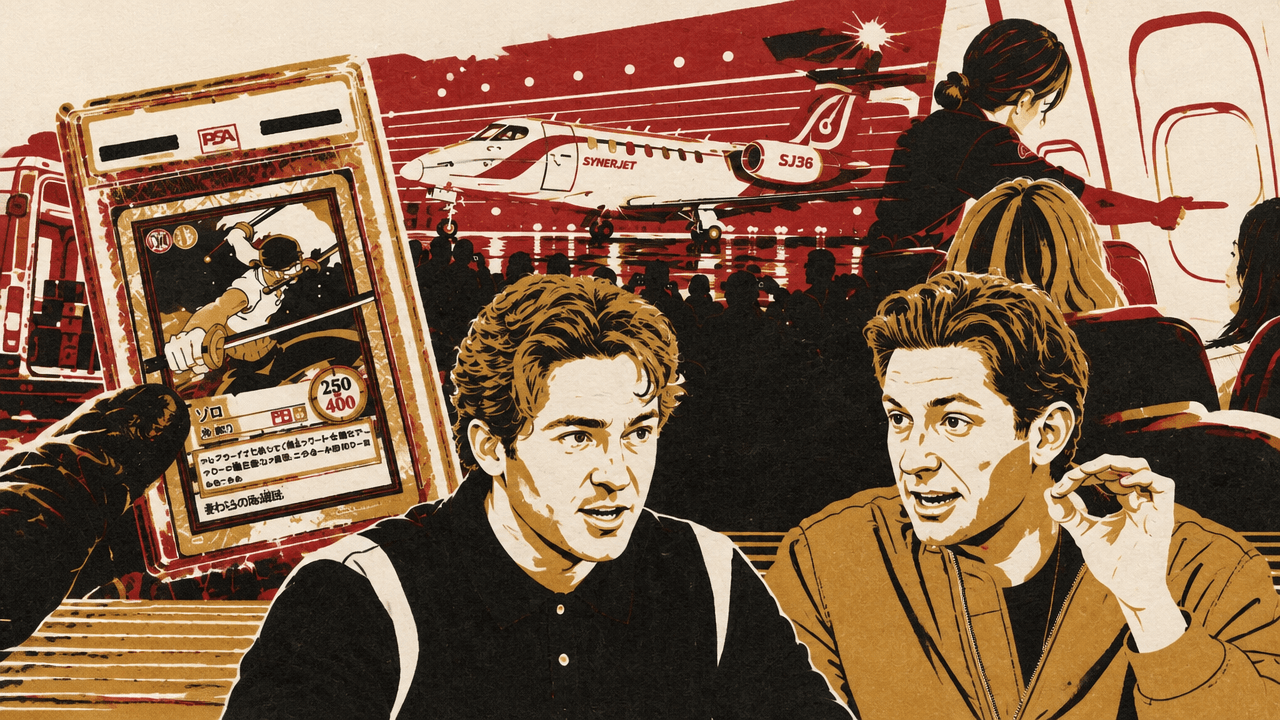
The theft leaves collectors and PSA disputing who should bear the loss
A FedEx truck parked outside PSA’s grading center in Santa Ana was broken into on October 13, and thieves took 250 packages of graded trading cards being shipped back to customers. John Coogan said the driver had left the truck unattended for 60 to 90 minutes. Three pallets were stolen: two held around 100 packages each, and the third held 50. The contents of the first two pallets were estimated at about $963,000; PSA was still determining the value of the third.


The truck was carrying cards that had already been graded by PSA, which assesses their condition and assigns each a unique certification number. Coogan said PSA had deactivated the numbers for the stolen cards. Someone trying to sell one through ordinary channels would see that it had been stolen, he said, though he doubted the deactivation would stop sales on black markets.
The practical dispute was who should cover the loss. Coogan said PSA was determining compensation based on the cards’ fair market value, subject to the insurance limits collectors had selected at checkout. Jordi Hays objected that customers should not have to choose extra coverage when PSA’s service involves shipping valuable cards. Every shipment, he argued, should be fully insured. Coogan thought PSA should take the matter up with FedEx, while noting that the truck was off PSA’s property when the theft occurred. The hosts did not resolve whether the selected insurance limits should determine what collectors receive.
The theft also exposed a gap between the cards’ prices and what some people think they are worth. Coogan showed a Zoro card from the anime series One Piece and read from a post by collector Tortugo, who said that this particular card was valued at $500,000 and suggested the truck’s contents might be worth a mid-seven-figure sum. When Coogan asked what he would pay, Hays said he would rather have a dollar than the card, even if he could resell it for the stated amount. He said he was fascinated by the hobby but did not understand it.
Hays did see a practical question in the high prices: if the cards are valuable enough to command such sums, why ship them in a regular delivery truck rather than use an armored-car service? Coogan agreed that it was a good question.
An inherited aircraft certification is an opening, not a complete sales pitch
Former Nikola CEO Trevor Milton, whom Coogan described as convicted of fraud and pardoned by Donald Trump last year, is now CEO of SyberJet. Coogan read from a post by private-jet commentator Preston Holland, who said the company was unveiling its SJ36 light-jet model and described it as supposed to fly nonstop from New York to Los Angeles, faster than any competitor in its class. Coogan initially wondered how quickly a new aircraft company could make progress, given the time involved in developing and certifying planes. Hays pointed out that SyberJet’s aircraft program had already received FAA certification.
As Coogan described the program’s history, that certification is the foundation of a possible comeback. He traced the aircraft to aviation engineer Ed Swearingen, who developed the design between 1986 and 1991, with early backing from Gulfstream. The aircraft received FAA certification in October 2005, after a development effort that Coogan said reportedly exceeded $700 million by 2008. Production did not scale: he said about ten aircraft were built across the program, production stopped in 2009, and Emivest Aerospace filed for bankruptcy in 2010. Later efforts to restart production did not lead to large-scale deliveries. An investor group led by Milton acquired SyberJet in 2024, and his role as CEO became public in 2025.
Coogan saw the inherited certification as a possible advantage. He described the aircraft as already approved, with a Williams engine, and suggested buyers might see value while the company works to deliver planes. He also said SyberJet was promoting a broader aerospace platform, including the SJ34 and SJ36 and in-house avionics. Hays focused on what he understood to be an ambition to develop the cockpit and autonomous features rather than simply make and sell an already certified design. He questioned why buyers would trust a new cockpit concept from a company whose CEO was associated with a vehicle venture he described as having rolled a product downhill.
For Hays, the market makes that concern consequential. Buying a private jet is a major decision, and buyers depend on the aircraft’s quality and reliability, he argued. He expected prospective customers to research both the company and Milton. Even if the aircraft had a history of certification and credible performance, Hays saw no obvious reason to reinvent the cockpit or make autonomy part of the pitch. He also questioned whether reducing the number of pilots would matter enough to buyers to justify the effort, given the cost of operating a jet and the amount of time its owners might spend in the air.
Coogan offered a different possibility: cost-conscious private-aviation buyers might consider an older design at an attractive price. He cited T-Pain’s account of buying a 2004 Gulfstream and saying it was essentially the same plane as a new one, at a much lower cost. Coogan’s view was that much of the progress in private jets involves comfort and convenience—such as noise, Wi-Fi, and heated or cooled seats—rather than a wholesale change in safety standards. The SyberJet promotional material shown during the discussion highlighted features including an Italian leather interior, internet access, and heated and cooled seats. Hays did not think those features made the case for the aircraft.
The disagreement remained open. Hays called the company’s prospects bleak and joked that its appeal might be “private aviation for adrenaline junkies,” drawn to the thrill of not having decades of operational excellence. Coogan thought reviving an older aircraft design could work if the company manufactured and sold planes at a reasonable price. He also suggested that strong demand for private aviation might help a revived design compete while other aircraft were trading above market. The hosts returned to whether SyberJet could manufacture and sell the planes.
Cabin courtesy becomes a question of who should adapt
A Wall Street Journal opinion essay by Andy Kessler gave Coogan a concrete example of the behavior he called a decline in common courtesy. Kessler described a seatmate who talked on the phone before takeoff and dictated messages aloud during a two-hour flight. Noise-canceling earbuds and music did not block her out. Kessler acknowledged that he could have confronted her, but said he was too angry to do so politely and questioned why the disturbed passenger should have to restore basic manners.
Hays added the example of a passenger watching social-media videos at full volume. Coogan said he enjoys seeing what other people are watching, even describing the appeal of a “secondhand scroll” through someone else’s feed. Hays said travelers are already confined together in a cramped space; when there is little room or control, small breaches can become harder to ignore. The hosts’ joking suggestion of a button that would beep out speech captured their frustration with disruptive behavior.
A dispute over window shades made the question of control more explicit. Coogan described a story about a Delta flight attendant ordering a passenger to close a shade during a daytime flight. Hays said the person in the window seat should retain that choice, calling it one of the few freedoms left on a plane. He also said passengers should consider whether the light would disturb someone trying to sleep, taking the timing of the flight and time zones into account.
Coogan proposed that a window-seat passenger negotiate with nearby travelers about their plans. Hays extended the idea as a joke: convene a small conference, gather everyone’s preferences, and appoint a “window operator” to manage the shades. Another participant took the opposite position, arguing that windows should generally stay open and sleepers should bring eye masks.
Hays said he and Coogan had sometimes been seated apart and tried to arrange trades, including situations where one traveler wanted to avoid a middle seat and another passenger was willing to take one. Coogan joked that the whole cabin should instead board into a live auction, with passengers bidding for extra legroom, exit-row seats, peanuts, or eye masks.
Airline pricing and amenities answer different questions about a tolerable flight
United CEO Scott Kirby, as Coogan described his remarks, argued that it should cost more not to sit in a middle seat. Kirby also said flying airplanes is expensive and airfares may need to rise further. Hays characterized the pitch as opportunistic, saying United seemed ready to raise prices while Delta was dealing with a Wi-Fi crisis. Coogan quoted Kirby’s ambition to make United “the best airline in the history of aviation,” and his view that the airline had become the best overall, though not at everything.
Coogan said Kirby took over United during the COVID-19 pandemic and reported that the airline’s stock had risen more than 300% during his tenure. He also described Kirby’s focus on Wi-Fi, movies and television, and a user-friendly app, especially for families traveling with children. Coogan noted the tension between that promise and problems travelers still encounter: delays, lost luggage, chaotic boarding, cramped seats, and disruptive behavior.
A discussion of in-flight movies showed how much passenger preferences vary. An unnamed participant preferred seat-back screens to watching a movie on a phone, saying the built-in screen felt more suited to flying. That preference put airlines without screens lower in the participant’s ranking. Delta came out on top for its movie selection, including older and art-house films; the participant named Ingmar Bergman’s The Seventh Seal. United ranked behind Delta, though Coogan noted that Starlink Wi-Fi could let passengers watch what they wanted rather than rely on the airline’s selection.
The participant’s preference was not unqualified: seat-back screens could be frustrating when it was hard to connect headphones. Still, a phone holder attached to a seat did not seem an equal replacement. The conversation also recalled a different kind of shared entertainment: screens mounted overhead, with passengers in part of the plane watching the same film. Hays said that had offered a sense of community; the unnamed participant said they did not remember experiencing it.
The electric SUV’s power figure does not settle whether it works as a daily car
Mercedes’ announced 2028 AMG GT 63 SUV was described on the show as an 1,153-horsepower electric vehicle, with a zero-to-60 time of 2.4 seconds. Jordi Hays said the design looked fine, especially the rear, but that he would not buy it or recommend it to a friend or family member. He predicted it would struggle in the market. John Coogan also questioned whether a high-performance electric SUV could compete once depreciation and price were considered.
Their concern was not simply that the vehicle was electric. Coogan wondered whether an SUV buyer would want the flexibility to drive in cold weather or reach places with limited charging, even if this model was intended mainly as a comfortable daily driver rather than an off-road vehicle. Hays said electric SUVs made sense in general, but did not think this particular vehicle would succeed.
The hosts compared the SUV with a small electric sports car. Hays said an electric Cayman could appeal as a “street legal go-kart,” and thought there would be buyers for that kind of car. Coogan raised the alternative of a larger, five-seat electric SUV, while Hays returned to the daily-use question: the SUV could not drive itself, he said, and would be competing in a difficult category.
Price remained unresolved. Hays thought the Mercedes might cost less than the BMW XM, which he called a major flop. Coogan said a price around $130,000 would be more manageable, while a figure closer to $220,000 could put it up against vehicles such as the Lamborghini Urus and a new McLaren SUV. Those were possible price points, not a confirmed price.
Cooley says conscious effort can interfere with a practiced response
Asked about making 34 saves, Calgary Flames goalie Devin Cooley said he “felt nothing.” He explained that when he has too much fun during a game—smiling and talking with people—he can shift from what he called an “unconscious goalie” to a conscious one. His conscious mind, he said, is bad at playing goalie: it reacts more slowly, falls behind the play, and can lead to giving up goals. In the game he was describing, he tried not to think and let his practiced reactions take over.
When the buzzer went, that's when I was like, okay, now you can let it all go.
After the game, Cooley said, he could feel the rush of dopamine, serotonin, and adrenaline and enjoy himself. He also credited luck: three shots hit the posts, and none went in off a teammate. Hays connected Cooley’s account to surfing, where he sometimes reaches the end of a wave with little memory of what he did, despite feeling fully present at the time. Coogan liked the interview because it offered a specific account of performance rather than the familiar formula of thanking the team and saying the work paid off.
Leno reduces the job to three steps
At the close, Jay Leno offered a compact description of writing and performing comedy: “Write joke. Tell joke. Get check.” Hays called it a simple process and a fitting place to end.