Game Studios Are Overbuilding for Competition as Players Seek Stress Relief

Cheryl Platz, a game developer, designer and author speaking at Stanford’s CS547 HCI seminar, argues that game strategy should start with why people play rather than with genre conventions, monetization or production scope. Her case is that the industry still overbuilds for competitive, mastery-driven players while evidence she cites points to rising demand for stress relief, self-expression, companionship, comfort and education. Platz presents a nine-part motivator framework as a practical tool for decisions about mechanics, teaching, community design, monetization and modernization.
The market mismatch starts with why people play
Cheryl Platz puts player behavior before business model, monetization, or production strategy because, in her framing, those decisions are downstream of a more basic question: why does anyone keep playing?


A motivator of play, as Platz defines it, is “one of the core psychological needs that a player seeks to fulfill when choosing to play a game of any kind.” It may be conscious or unconscious. A player may have several at once. A single game may serve multiple motivators, and most do.
That definition matters because a great deal of game development still rests on inherited assumptions about what players want. Those assumptions may have been directionally useful 10 or 20 years ago, but the market has changed. The games players want now are not simply the games they wanted two decades ago with better fidelity, more content, or live-service infrastructure attached.
If you don't know what motivates your players to keep playing your game, how do you know you're making the right decisions?
The warning is not limited to games. Platz points to product design more broadly: when designers do not understand how people are using an app or why they are there, they can “stumble into challenges.” Her example was Bluesky’s carousel feature, which she said “came and went in 24 hours.” The lesson she draws is that design decisions become guesses when they are not anchored in user motivation.
For games, the risk is that the industry often proceeds from a narrow idea of the player: competitive, mastery-oriented, willing to endure stress, willing to invest large amounts of time, and eager for complexity. Those players have not disappeared. Platz’s claim is that the industry overbuilds for them and underbuilds for other motivations that have become increasingly important.
The useful frameworks are provisional, not sacred
Cheryl Platz situates her nine motivators inside an older lineage of attempts to describe player behavior. She does not present her taxonomy as definitive. In fact, she repeatedly emphasizes that there is no “one true list” of motivators, that many companies and researchers use other frameworks, and that her own list may change in a second edition as new signals emerge.
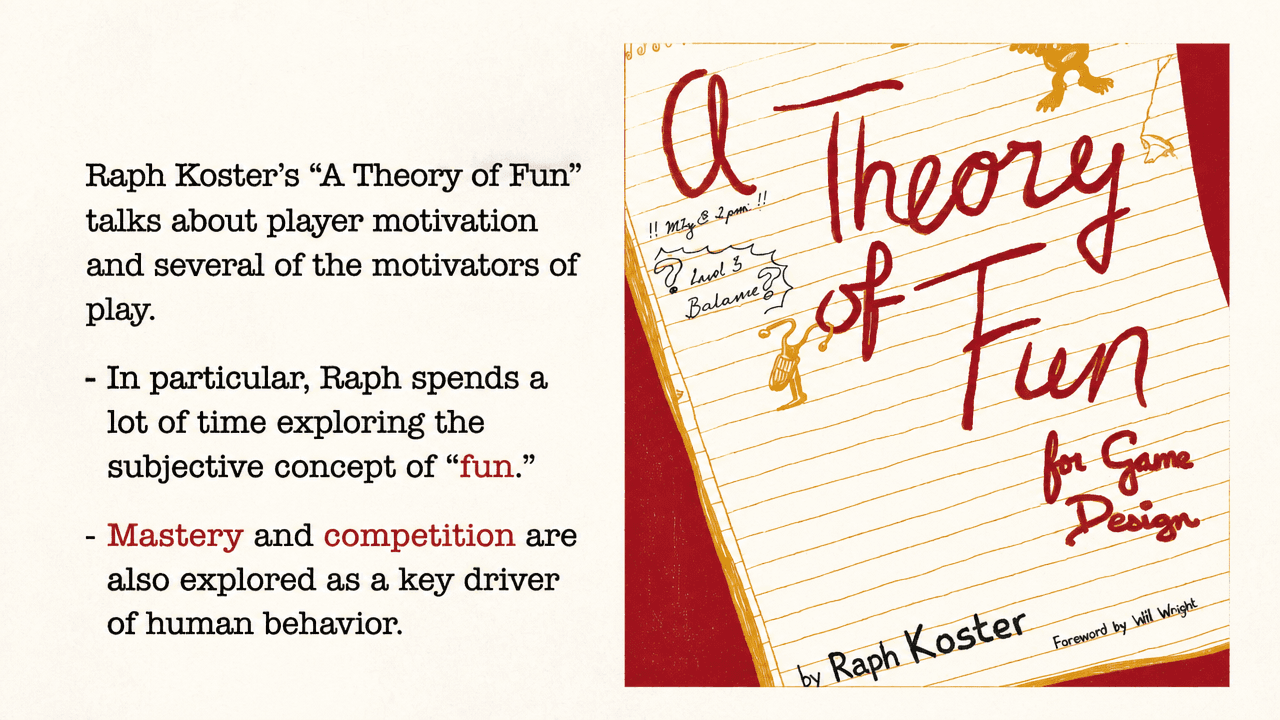
Raph Koster’s A Theory of Fun for Game Design is one early reference point in her account. Platz describes it as one of the first widely discussed industry treatments of player motivation, especially because it tried to explain “fun” beyond vibes — why humans chase the feeling at a psychological or chemical level. She also notes that mastery and competition appear there as key drivers of human behavior.
Celia Hodent’s The Gamer’s Brain supplies another foundation: intrinsic and extrinsic motivation, and more specifically self-determination theory. Platz highlights the three needs in that theory — competence, autonomy, and relatedness — as explanatory roots for several concrete motivators in games. Competence branches into progression and mastery. Autonomy connects to meaningful choices and self-expression. Relatedness explains cooperation, competition, and other forms of social play.
Richard Bartle’s 1996 taxonomy of player types is useful, in Platz’s telling, less as doctrine than as a historical framework worth studying for its axes. Bartle’s model maps players across multiplayer-versus-world interaction and interaction-versus-unilateral action, producing killers, achievers, socializers, and explorers. Platz questions whether “killers” are motivated by killing itself or by mastery or some adjacent satisfaction, but she finds the axes instructive: even in the 1990s, multiplayer versus world interaction was already shaping player archetypes.
Jon Radoff’s 2011 model is presented as another step in the evolution. Radoff observed that Bartle’s model was no longer scaling and proposed a matrix built around number of players and method of “winning,” introducing concepts such as immersion and cooperation. Platz’s critique is that this model assumes a game has a win state. She asks whether The Sims or Flower has one. Her point is not that the model was wrong for its time, but that gaming has moved into territories where “winning” is too narrow a premise.
| Framework or source | What Platz draws from it | Limit she identifies |
|---|---|---|
| Raph Koster, A Theory of Fun | Fun, mastery, and competition as motivations rather than mere genre conventions | Not a complete map of contemporary play |
| Celia Hodent, The Gamer's Brain and self-determination theory | Competence, autonomy, and relatedness as needs underlying player behavior | The concepts need translation into specific design motivators |
| Richard Bartle's player taxonomy | Useful axes around multiplayer/world interaction and interaction/unilateral action | Some archetypes may not explain current player behavior cleanly |
| Jon Radoff's Game On model | Immersion, cooperation, achievement, and competition as motivational categories | Assumes a win state, which many modern games do not have |
That provisional stance is important to how the taxonomy is meant to be used. The motivators are not a personality test, a market segmentation substitute, or a claim that every game must serve every need. They are a razor for design decisions: when choosing a mechanic, economy, social system, tutorial, or aesthetic direction, teams should ask what need the choice serves and whether that need matches the players they are trying to reach.
Classic motivators still matter, but they no longer explain the market alone
Cheryl Platz divides her model into six classic motivators and three modern ones. The classic motivators are fun, mastery, competition, immersion, meditation, and comfort. These do not depend on recent technology. Competition and mastery appear across sports and traditional games. Fun predates digital media. Immersion existed in text-based games before it became associated with high-fidelity graphics or VR.
The classic list is broad, but Platz spends time clarifying two motivators that are often blurred: meditation and comfort. Meditation, in her account, is tied to clinical benefit — the kind of state where play may help a person self-regulate or, as she references, where Tetris has been associated with preventing the formation of traumatic memories. Comfort is more subjective. It is “vibes”: liking Mario and therefore wanting to play more Mario, returning to a familiar space, or using a game as a soothing ritual. The two often appear together, but they are not the same claim.
Immersion is similarly elastic. It can mean wide exploration, VR, narrative absorption, or earlier forms of imaginative engagement. What qualifies as immersive changes over time as standards shift. Text-based games could feel immersive when they represented the richest available interactive world. Today, broadband, smartphones, and persistent multiplayer environments have changed expectations. Players now carry responsive, updated, networked worlds in their pockets.
That technology shift leads to the three modern motivators: self-expression, companionship, and education. Platz calls them modern not because they never existed before, but because they now operate at a scale that was not broadly possible 15 or 20 years ago. Each depends heavily on either large player bases, large data environments, or both.
Self-expression existed in pockets before it became a broad force in game design. Platz points to her early work on The Sims: Makin’ Magic, the last expansion pack for the original Sims, as a formative example. Because she saw that lineage early, she says it seemed obvious to her that play could be about self-expression. Later, when Minecraft and similar platforms appeared, the broader industry recognized something she had already seen in nascent form.
Companionship has a similar history. Platz connects it to older digital communities such as bulletin boards, but says not everyone saw digital experiences as viable “third spaces.” Multiplayer is not only competition. In her discussion of Celia Hodent and Fortnite, she describes the move from a one-versus-100 structure toward squad mode as a deliberate shift from pure competitive motivation toward companionship: players were not just competing, they were connecting with friends.
Education is the most expansive of the modern three. Platz does not restrict it to school-like content or “book learning.” It can mean preparation for real-world experience. She cites an interview with people from Backyard Sports, who, according to her account, talked about demonstrated evidence that their experiences prepare children to play sports in the real world. Education, in this sense, can include real-world preparation, leadership learned in multiplayer groups, cognitive skills, and career or education influence.
| Classic motivators | Modern motivators |
|---|---|
| Fun | Self-expression |
| Mastery | Companionship |
| Competition | Education |
| Immersion | |
| Meditation | |
| Comfort |
The list is a starting point. In teaching, Platz has seen possible additional threads around agency and exploration. She is interested in whether some motivators should merge, whether a tenth should be added, and whether academic or research partnerships could produce enough signal to refine the model. For now, she says, the taxonomy covers enough ground to start better discussions.
Stress relief and self-expression are outpacing competition
The strongest market claim in Cheryl Platz’s talk is that the industry’s supply of competitive, complex, mastery-heavy games appears out of sync with reported player demand in the studies and slides she presents.
Platz cited Fandom’s Inside Gaming 2024 study, which she described as a study of 5,000 gamers globally cross-referenced against Fandom platform data. The top reported reasons for playing, as shown on her slide, were not competition. They were unwinding and stress relief; creation, imagination, and self-expression; achievement and rank; and social connection and community.
| Reason people game | Share of players |
|---|---|
| Unwind and stress relief | 54% |
| Creation, imagination, and self-expression | 46% |
| Achievement and rank | 40% |
| Social connection and community | 39% |
| To escape | 37% |
| Challenge | 33% |
| To kill time | 31% |
| Exploration | 31% |
| Intellectual stimulation | 20% |
| Competition | 18% |
| Control and ownership | 10% |
Competition appears at 18%, far below stress relief at 54% and creation, imagination, and self-expression at 46%. Platz says this is the kind of data that makes audiences take out their phones. She also describes hearing assumptions like “all gamers want competition” and rejects that as “factually untrue” for today’s player base. It may have been more plausible 10 or 20 years ago. It is not what players are saying now.
The stress-relief finding is central to her interpretation. If 54% of players report unwinding and stress relief as a reason to play, competition is not automatically aligned with what many players want. Losing is not stress-relieving. Highly demanding competitive systems may serve a real audience, but their addressable audience may shrink as stress relief, self-soothing, companionship, and comfort become more salient.
She also calls out the growth of self-expression. In the Fandom data she presents, creation, imagination, and self-expression sit at 46%, with a 10% year-over-year increase. Platz attributes that rise partly to platforms catching up with people’s desires: when players can create broadly, they gain autonomy and agency, satisfying multiple needs at once.
The later studies she presents reinforce the same direction in her argument. The Entertainment Software Association’s 2025 Power of Play study, as shown in her slides, surveyed 24,216 players ages 16 and older across 21 countries. The reported results include 50% saying video games improved their education or career path, 54% saying sports games improved real-world athletic skills, and 43% saying video games influenced their career or education positively. Platz connects this to podcast conversations in which people describe learning leadership from World of Warcraft guilds. Some players know games made them better, she says, but do not have the vocabulary for how.
Her slide also cites a literature review in Procedia Computer Science stating that cognitive skills such as perception, attentional control, and decision-making improve when subjects were trained with video games. Platz uses that as part of the education-motivator pattern rather than as a full review of the literature.
A Boston University study released in 2026 was much smaller: just under 350 undergraduate and graduate students, according to Platz’s slide. The slide says 64% of respondents used games to cope with stress. The study language, as she presents it, aligns with her motivators even if it does not use her terms: immersive tendencies, story, social interaction, escapism, autonomy, and exploration are associated with emotional regulation or reduced negative feelings.
The implication is not that competition, mastery, or complex games should vanish. Platz explicitly says those experiences are valid and that people enjoy them. Her argument is about portfolio imbalance. She believes the industry has too much competitive, complex, active, time-demanding, mastery-focused play and not enough calming, meditative, cooperative, companionship-driven, intellectually stimulating, or passive time-killing play.
That imbalance is connected, in her view, to some of the business pain in games. She points to layoffs, failed games, and failed live-service products, and says many live-service games that have struggled have targeted the same competitive, mastery-based audience. She does not present this as a full causal account of the industry’s problems. Her operational question is narrower and more useful: if a game is aimed at the stressful side of the motivation map, what additional motivator could broaden the addressable audience without breaking the core?
Her example is Fortnite: squads added companionship to a competitive structure, and self-expression also became part of the experience. For Platz, that is the pattern to study. Which player need is missing? What motivator could an existing game support? How can a game avoid becoming another stressor for players who are looking for relief?
Prosocial design treats community behavior as something to shape before it breaks
For teams unsure how to respond to the rise of companionship and community motivations, Cheryl Platz points first to prosocial gaming. She highlights the Thriving in Games Group and its Digital Thriving Playbook as free resources created by practitioners from studios ranging from indie to AAA, with a partnership with Sesame Workshop to bring the insights to children.
Her practical argument is that teams do not need to rediscover the basics of positive online community design from scratch. In her telling, developers at companies such as Riot and Blizzard have documented lessons in ways that avoid violating NDAs while still giving other teams a starting point. If a studio is trying to build connection and companionship, it should not begin at “ground zero” on questions of disruptive behavior.
The distinction between “disruptive” and “toxic” behavior matters. Platz attributes the preference for “disruptive” to the Thriving in Games Group. “Toxic” is vibey and implies intent; disruption describes impact without requiring a claim about intent. That makes it more constructive: designers can name it, measure it, and work against it.
The more important shift is from reaction to prevention. If teams only react after disruptive behavior happens, harm, sadness, and stress have already entered the experience. Prosocial design asks how the game can reward and encourage good behavior early enough that communities move in a healthier direction. Platz cites Carlos Figueiredo, cofounder of the Thriving in Games Group and Director of Player Trust and Safety at Mojang Studios, describing prosocial behavior as activity that contributes to a thriving community: helping other players, welcoming new players, teaching them how to play, taking pride in the community, and building friendship.
This emphasis on teaching overlaps with education and companionship. A community can become part of the game’s learning system. Players can serve as greeters, mentors, and guides. In this framing, community design is not ancillary moderation work; it is a design strategy aligned with modern motivations.
Teaching the motivators changes how people see their own play
Cheryl Platz developed the motivators as a teaching tool in “What Makes Us Play: The Craft of Video Gaming,” an MBA class at Carnegie Mellon for aspiring video game leaders who may not have prior game design experience. The constraints were severe: roughly 12 hours of class time. She wanted something memorable, portable, and useful for students who needed to reason about games quickly without mistaking business decisions for the starting point.
One result, she says, is that students begin to reinterpret their own gaming. A student quote she shares says the course made them realize they “game more than I thought,” and that they had started playing more games to relax at the end of long days after learning about motivators and thinking about their own taste. Another student wrote that the course helped them think about games through emotion and player experience.
Platz says she went through a similar process herself while documenting the motivators. As someone in games, she felt the pressure to play the “big games,” including 100-hour open-world titles. Looking through the motivators helped her recognize her own self-soothing behavior and give it space alongside other forms of gaming.
That reframing has market consequences in her argument. Many people say they are not gamers and then list several favorite games or describe buying a Game Boy. The label “gamer” can feel attached to a narrow identity, genre, or intensity level. Naming motivators lets people identify play behaviors they already have. If more people self-identify as players, the market grows. Platz links that broader inclusivity to the industry’s economic health: a larger market is one route she sees toward fewer layoffs.
Her student case studies illustrate the point. Matt Lipschitz’s case study on Webkinz framed the long-running stuffed-animal-connected game as an “emotional economy.” The key observation, quoted in the presentation, was that Webkinz succeeded not through competition or complexity but because “it made me care.” Its loop — adopt, care, play, earn, customize, maintain, repeat — turned routine into something meaningful through companionship and ownership. Platz emphasizes that this kind of reflection defies reductive gender assumptions: a male student describing how much virtual stuffed animals meant to him in childhood revealed motivators that would be easy to miss if designers only looked for competition or mastery.
Game design and UX design meet at the question of friction
Cheryl Platz’s description of the relationship between game design and user experience design is precise: both design for humans, and in smaller studios the same person may do both. But when roles are differentiated, game designers and UX designers often have different relationships to friction.
Game designers, in her definition, are functional experts in designing systems and affordances that shape and guide player behavior over time toward desired outcomes, with an intentional ramp in difficulty to keep players growing and engaged. UX designers specialize in understanding and optimizing for human perception and cognition as they relate to interactive systems.
The pivot is friction. Game designers use intentional friction as a tool. UX designers remove unintended friction to maximize comprehension and satisfaction. The problem emerges when that distinction is not clear. UX designers can appear threatening to game designers who hear “remove friction” as “remove the game.” Platz says UX designers must make clear that they are removing unnecessary friction so that the meaningful friction can stand out.
Her example is inventory management that obstructs the experience a player came for. If the game’s core fantasy is throwing magic at enemies, a cumbersome inventory system may be unintentional friction. Removing that does not flatten the game. It allows the intended challenge, pacing, and emotional arc to emerge.
She also describes games as unusually complex products: “a movie and a cloud service together.” That complexity produces differentiated UX roles: UX designer, UI artist or visual designer, UX researcher, and technical UX designer. The larger the studio, the more refined those roles become.
In the Q&A, Platz adds that UX professionals in games often need to demonstrate their value internally before they can influence player-facing work. She has been brought into organizations where UX designers were seen as “just wireframers.” Her answer is to turn UX skills inward: stakeholder interviews, surveys, workshops, storyboarding, shared mental models, and process design. She describes doing that at Riot and Scopely, using collaborative methods to build trust. Within six months at Riot, she says, she was being invited into business-development conversations to provide UX perspective on contracts that had not yet been signed.
The “hill” she says she will die on is that games must teach people how to play if they want those people to continue. New players are always entering. It is an honor, in her phrasing, to be the first RPG someone plays — but only if the game teaches them how to play RPGs.
Graphics need a vocabulary beyond fidelity
Cheryl Platz introduces two evaluative tools from The Game Development Strategy Guide: the Spectrum of Gaming Graphics and the Spectrum of Game Monetization. Both are attempts to replace flattened arguments with more precise language.
The graphics spectrum addresses a familiar industry problem: “good graphics” often means high fidelity by default. Platz asks why players get upset when a favorite game is “just” on the Switch, and how the industry can move past a single model of graphical quality. Her answer is a two-axis map.
The horizontal axis is how closely the aesthetic mimics reality. The vertical axis is visual complexity. That creates four broad categories: realistic, impressionistic, artistic, and classic.
| Graphics category | How Platz describes it | Examples shown or discussed |
|---|---|---|
| Realistic | High-complexity visuals that closely mimic reality | NBA 2K26; Clair Obscur as partly realistic and partly artistic |
| Impressionistic | Lower-complexity visuals that still mimic the real world by preserving key elements and dropping detail | Old Skies; a slide example labeled Roger |
| Artistic | High-complexity visuals that do not need to mimic reality | The Moonlight Walk; Sunderfolk |
| Classic | Low-complexity visuals chosen for present-tense reasons rather than merely nostalgia | A recent low-fidelity example shown in the presentation |
Realistic games try to model reality closely and with high complexity. Platz uses NBA 2K26 as an example: it “kind of looks like a photo.” Clair Obscur sits closer to a hybrid of artistic and realistic, with people who look real alongside stylized effects. Impressionistic games mimic the real world at lower fidelity, preserving key elements while dropping detail; she cites Old Skies and a slide example labeled Roger. Artistic games do not need to mimic reality; she mentions The Moonlight Walk, which she says looks like claymation and may actually be claymation, and Sunderfolk.
Classic is her preferred term for low-complexity visuals that are not merely nostalgic. She intentionally avoids “retro” because many current games choose pixelated or low-fidelity styles for present-tense reasons: lower cost, coziness, performance, timelessness, or feel. These games are not always pointing backward. Some are modern games with classic aesthetics.
The point is not to rank quadrants. It is to compare like to like. A classic aesthetic should not be judged as a failed attempt at realism if it was never attempting realism. A low-fidelity game may better serve comfort, meditation, portability, cost, battery life, or development scope than a high-fidelity one.
Monetization is a design system, not a business afterthought
Cheryl Platz’s monetization spectrum is more pointed because she sees game designers often recoil from monetization as if it were separate from the art. Her view is the opposite: monetization changes behavior, fairness, perception, and community dynamics. It is therefore a game design and human-computer interaction issue.
She begins by challenging the phrase “pay to win.” Players are not literally paying for victory; they are paying for power. The critical question is where payment intersects with gameplay and whether that affects other players.
Her monetization map has two axes. The horizontal axis is how much gameplay is monetized, from cosmetic monetization to gameplay-affecting monetization. The vertical axis is the extent of multiplayer gameplay, from single-player to player-versus-player. The resulting categories include pay to play, pay to accelerate, pay for power, and pay to express.
| Monetization pattern | Platz's explanation | Design concern |
|---|---|---|
| Pay to play | The traditional model: buy the game and receive the experience | In its pure form, everyone gets the same game |
| Pay to accelerate | Players pay for energy, skips, boosts, XP boosts, or reduced grind | Players may technically receive the same game at different speeds |
| Pay for power | Players buy gameplay advantage, especially consequential in multiplayer or PvP | Payment can become power over other players and be perceived as pay to win |
| Pay to express | Players buy cosmetics, skins, or other expression without needing to pay to play | Its value increases when other players can see the expression |
Pay to play is the traditional model: buy the cartridge or binary and receive the game. Pay to accelerate includes energy systems, level skips, boosts, XP boosts, or other ways to move through the same game faster. The player is not necessarily getting a different game, but they are buying speed or reduced grind. That can feel unfair, but Platz acknowledges the nuance: servers cost money, and the exchange may be framed as payment for a service.
Pay for power becomes especially sensitive when multiplayer or competition is involved. In a single-player offline RPG, buying a powerful sword may accelerate one person’s game without affecting anyone else. But once players compete, that purchase becomes power over other people. That is when players experience the economy as pay to win.
Pay to express sits on the cosmetic side, and becomes more powerful as more people are present to see the expression. Platz uses League of Legends as an example: players can play for free and choose to buy skins. The purchase is not required to play and does not generally determine gameplay power. Its value is self-expression in front of an audience.
Platz tested this spectrum in her Carnegie Mellon class. It was the first year she included it on a quiz, and it was the most polarizing question. Students who lost points were given Chapter 11 of her book, “Efficient and Ethical Economies,” and offered extra credit for identifying an example from each quadrant with justification. She says the assignment produced strong results.
One student, Daniel Cortes, later presented a case study on Star Wars: Battlefront II. Platz describes the game as a sea change in game monetization history because its loot crates included pay-for-power elements: players needed randomized loot-crate items to compete effectively. The backlash led to a rework that removed pay-to-win elements, kept only cosmetics in loot crates, added free maps, heroes, and modes, and moved toward a pay-to-express model. Platz strongly endorsed the student’s business lessons: align business model with player experience; treat community feedback as a strategic signal; remember that live service requires long-term thinking.
Her strongest claim here is ethical and practical at once. If people-focused designers refuse to engage with monetization, then exploitative actors will shape it instead. Someone has to pay for servers. The design question is how to do that sustainably while centering players.
Edutainment and modernization both fail when they ignore the core loop
In the Q&A, a participant asks why edutainment has struggled for decades to become both popular and profitable. Cheryl Platz does not offer a grand unified answer, but she does give a design diagnosis: use the motivators first, then examine the gap between the educational product and the leisure play patterns of the intended audience.
If she were brought into an edutainment company, she says, she would start with a listening tour involving both children and parents. She would ask how they game, what they do for leisure, and what motivates their play. Then she would compare those motivations to the product. Is it too stressful? Is it social enough? Does it offer something worth mastering?
The generational context is unforgiving. In a world where children can play Minecraft and Roblox, anything that does not respond to them or allow self-expression can feel small. Platz does not believe contemporary children will respond well to an old Encarta-style point-and-click model that simply presents information. She sees children “light up by doing things in Minecraft.”
Her examples are about constrained creation. At a GDC talk, she says, people from Genshin Impact described their user-generated content launch, including someone building a neural network. Her lesson is not that every child will build such a thing, but that people find ways to teach themselves in constrained environments. Many edutainment products may need the right constraints, the right prosocial patterns, and enough creative room for players to overcome obstacles and “create magic.”
A separate Q&A question asks how a game can modernize — adding creativity, self-expression, or new structures — without losing its soul. Platz’s first answer is that game development is art, and part of making art is not making everyone happy. Players can be angry even when a developer releases something free. The practical response is not to chase universal satisfaction but to understand clearly what the game is trying to accomplish.
Her sharper critique is that many games overinvest. They shoot beyond what players need. Some players may want 10 or 20 hours; teams build 100 or 200. Then the game ships buggy because the team made too much game, while many players would have preferred a smaller, more solid experience.
Runaway scope often indicates uncertainty about the core. If a team does not know why players play its game, it may add every good idea, shoehorn in features, and mistake volume for value. This is why Platz puts motivators at the front of strategy. Her preferred pattern is to choose a strong core loop, pursue that loop and that alone, start small, and only expand after the core is solid and the business model can sustain the servers.
This connects back to the “soul” question. A game does not preserve its essence by preserving every old surface detail or adding every modern mechanic. It preserves it by understanding which player needs the core loop serves and protecting those needs through change.
Teaching can be optional, adaptive, social, or built into the world
The Q&A also surfaces a tension between minimal scaffolding — the Super Mario Bros. 1-1 philosophy, where environment teaches play — and modern games with quests, hints, and explicit guidance. Cheryl Platz’s position is that teaching is necessary, but it does not have to mean a rigid two-hour tutorial on rails.
She frames teaching as an accessibility issue. If a game does not make learning accessible, it excludes people with different cognitive faculties or different prior gaming experience. But she accepts that some designers do not want teaching to dominate the experience. Her recommendations are to make teaching optional, opt-out, scalable, or adaptive. A system can give help when a player struggles rather than forcing everyone through the same path.
She invokes the “yellow paint problem” as an example of crude teaching: the world is visually modified because the design has not found a smarter way to guide players. To her, the same problem appears in app design. While working on products such as Alexa, Cortana, and other apps, she wanted longitudinal data about which interactions succeeded and which failed so the product could engage only where help was needed. Those systems often do not get built because they do not directly make money.
Games can also use communities as teaching systems. Prosocial design can create roles such as greeters and mentors. If a game truly does not want to teach everything through its own interface, it can still design conditions where players teach one another.
The Disney Friends test showed that a tiny mastery signal could widen the audience
The most concrete design anecdote in the discussion comes from Cheryl Platz’s work on Disney Friends for Nintendo DS. She describes it as “Nintendogs plus Animal Crossing plus Disney characters.” The team was testing an alpha build with Stitch, bringing DS devices and early cartridges to children in Los Angeles to evaluate whether building a friendship with Stitch was valuable.
The premise was intentionally immersive. The team had hacked the DS to render 3D on both screens. They avoided menus because they did not want interface scaffolding to interrupt the relationship. Stitch could jump between screens, respond to touch and voice, accept toys, become friendly if treated kindly, and turn into “naughty Stitch” if poked or mistreated.
The first test produced a surprising split. Girls loved it and said they could play forever. Boys said they did not get it. This was alarming because Disney had told the team that Stitch was highly popular with boys at that time.
Platz and lead designer Amy reviewed the surveys and tapes and considered whether the issue was not the character, but the absence of mastery. The girls, in her interpretation, had been socialized to understand the friendship loop: be nice to the creature, receive affection, continue. The boys were looking for something to master and were given no signal that mastery existed.
The team made a minimal change. They added sparkles for nice actions and a single daily friendship meter. The game remained an immersive friendship experience with 3D on both screens. The girls still loved it. The boys now said they could play all day.
Platz is careful not to make this about fixed gender categories. Her point is that different player groups arrived with different motivators. A small mastery signal did not betray the companionship or care loop. It made the loop legible to players who needed a goal structure in order to engage.
That example compresses much of her broader argument. The question is not whether a game should be “for” competition, mastery, companionship, comfort, education, or expression in some abstract way. The question is which motivators are already present, which players can perceive them, which players are excluded by their absence, and how small design choices can broaden access without destroying the core.