OpenAI Paper Claims a Fixed Zero-Free Boundary at Re s = 7/8
OpenAI’s September 2026 paper claims that the Riemann zeta function and every Dirichlet L-function have no nontrivial zeros to the right of Re s = 7/8, a fixed boundary inside the critical strip. The result is weaker than the Riemann hypothesis, which places every nontrivial zero on Re s = 1/2, but would improve on zero-free regions whose width shrinks with height. Lean has accepted a formalized version of the zeta statement; the 199-page paper itself had not received public expert review.
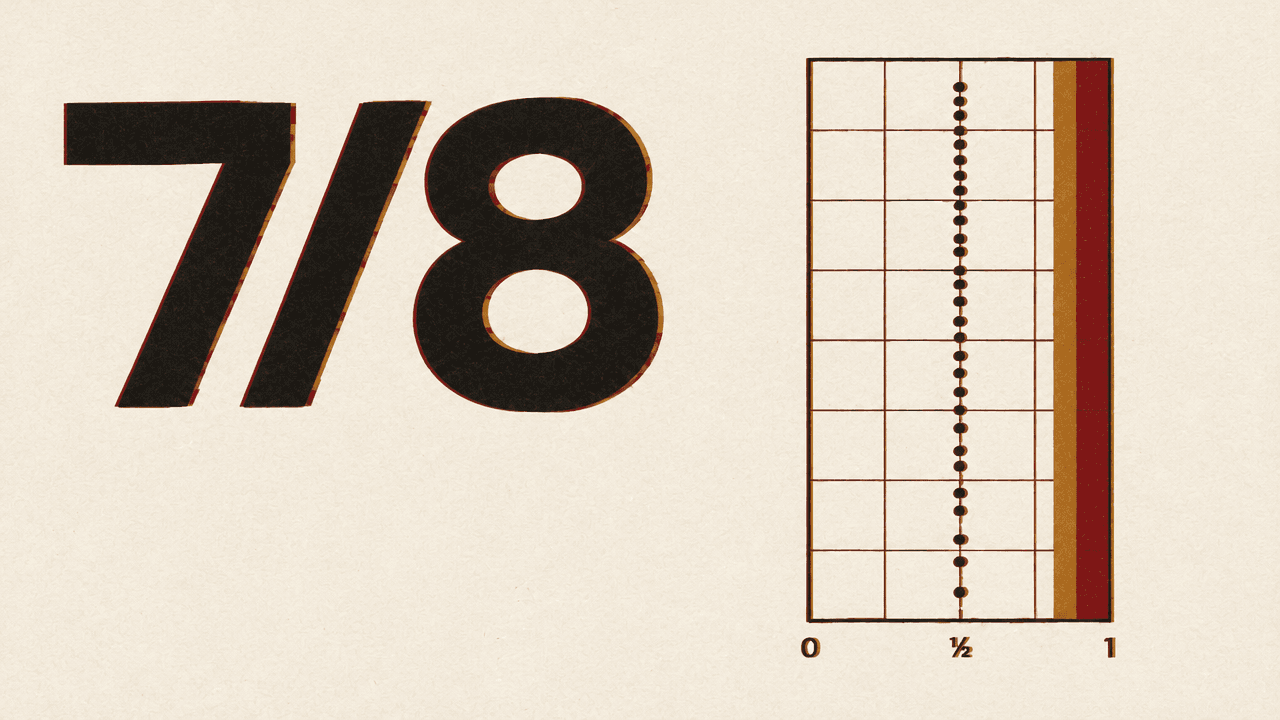
The 7/8 line is a fixed limit, not the Riemann hypothesis
OpenAI’s 199-page paper, dated September 30, 2026, claims that the Riemann zeta function and every Dirichlet L-function have no nontrivial zeros with real part greater than 7/8. The boundary itself is not included: the claim does not rule out zeros on Re s = 7/8. It also excludes any exceptional real zero between 7/8 and 1.
This is not the Riemann hypothesis, which says every nontrivial zero lies on the center line Re s = 1/2. OpenAI’s result would leave a wider range of possible locations, while placing a fixed limit on how far right the zeros can be. Rutgers number theorist Alex Kontorovich reacted that if a human had proved it, it would be an instant Fields Medal.
The distinction matters because the locations of these zeros are connected to how accurately primes can be counted. The proposed boundary would constrain how far actual prime counts can depart from a smooth prediction, even though it falls short of the Riemann hypothesis.
A fixed line would improve on a zone that narrows with height
Primes arrive irregularly, but their numbers up to a given point follow a smooth curve, the logarithmic integral Li(x). Riemann’s 1859 work connected the difference between the actual count and this prediction to waves associated with the zeros of the zeta function. In the source’s schematic explanation, each zero contributes a wave; the farther right a zero lies, the more strongly its wave can affect the error in counting primes.
The Riemann hypothesis would put every nontrivial zero on Re s = 1/2. Trillions of zeros have been computed and found on that line, but computation cannot prove that every remaining zero is there. A zero-free boundary at 7/8 would be weaker, but would still rule out zeros to its right at every height.
The history of zero-free regions shows what is new about a fixed boundary. In 1896, Jacques Hadamard and Charles-Jean de la Vallée Poussin proved that no zero lies on Re s = 1. That established the prime number theorem: primes follow the smooth curve in the long run. Later work established a zero-free zone just inside the edge. Vinogradov and Korobov’s 1958 result was the strongest such zone, but its width shrinks as the height of the zeros increases. The higher one looks, the less it rules out.
The quasi-Riemann hypothesis asks for a different guarantee: one vertical line inside the critical strip, with no zeros to its right at any height. OpenAI’s main paper claims that line is Re s = 7/8, for the zeta function and all Dirichlet L-functions. A separate, nine-page companion paper addresses the possible Landau–Siegel zero: an exceptional real zero near the edge that had not been excluded for 90 years. The main paper and this companion paper make distinct contributions; the companion paper presents the exclusion on its own.
For prime counts, the proposed fixed boundary would imply an error of about N^(7/8) for every N. Earlier bounds improved slowly with N—smaller than N divided by any fixed power of log N—but did not save a fixed power of N. The Riemann hypothesis would imply a stronger bound, about the square root of N. The 7/8 result would therefore replace a slowly improving limit with a fixed-power one, without reaching the bound associated with the Riemann hypothesis.
The papers list further consequences if their arguments hold: a century-old conjecture of Vinogradov’s would be settled, and Euler’s list of 65 idoneal numbers would be confirmed complete. Hector Pasten of the Pontifical Catholic University of Chile told Scientific American that many applications of the Riemann hypothesis do not require the full hypothesis; for those, he said, the quasi-Riemann result would be more than enough.
Lean checks a formal statement, not the 199-page argument
The checks described address different things: whether a proof assistant accepts a formal proof, whether that check can be reproduced, whether the written mathematical argument is sound, and whether its stated consequences follow. They should not be conflated.
The result has a Lean formalization, where software mechanically checks proof steps against formal rules. The theorem statement is short; the proof behind it runs to about 486,000 lines across 2,924 modules. Lean’s kernel accepted it. That verifies the formalized statement, assuming the kernel is sound. It does not verify the 199-page paper itself or its later corollaries: OpenAI’s scope note says the applications are not included in the formalization.
One person outside OpenAI independently re-ran the Lean check, using an AI agent and two separate kernels. The run took 63 minutes, and both kernels accepted the proof. The checker’s report limits what that establishes: one operator ran both checks on one machine; the re-run concerned the zeta statement only; and it says nothing about the accompanying paper. A fresh independent rerun by another party had not been done.
The written argument has a separate review status. Perplexity says it could read the nine-page companion paper but not the 199-page main paper. As of October 8, 2026, no mathematician outside OpenAI had publicly said they had read the full proof through, and no public expert review had taken place. The consequences claimed in the papers depend on the written arguments, not just on the formalized statement.
The proof’s mathematical claims remain open to review
The formalized zeta statement has been accepted by Lean, and one outside check reproduced that result for zeta. Those checks do not amount to independent review of the 199-page paper, nor do they establish the paper’s broader claims about Dirichlet L-functions and its consequences. As of October 8, 2026, the full written proof had not received a public expert review.
If the written argument holds up, it would establish a fixed zero-free boundary after 127 years of work on the problem. Whether it does is for mathematicians reading the proof to decide.