Height Fluctuations Reach the Roughening Threshold in a Gaussian Free Field Limit
An OpenAI preprint proves Gaussian free field limits for two-dimensional lattice height and planar-spin models, but the results reach different temperature regimes. For heights, the limit extends to the roughening threshold, where the effective parameter \(a\) reaches \(8\pi\); for planar spins, the theorem applies at sufficiently low fixed temperature and does not establish a limit at the spin transition. The paper’s central result is thus a pair of Gaussian free field limits with unequal scope.
The height theorem reaches roughening; the spin theorem stops short
The manuscript’s central result is a pair of Gaussian free field limits for lattice models with different microscopic rules. Their scopes are deliberately unequal: the height result reaches the physical roughening threshold, while the planar-spin result applies at sufficiently low fixed temperature and does not establish a limit at the spin transition. That distinction matters as much as the shared Gaussian description.†
In the height model, each site carries an integer multiple of 2π, and the energy penalizes squared differences between interacting sites. The interaction set is finite, includes the four nearest neighbors, and respects the square’s rotations and reflections. Here β is called temperature: increasing it weakens the penalty on height differences.
Roughening is defined through the center variance. Fix the height to zero outside a growing square and ask whether the variance at its center remains bounded. The threshold βc separates bounded from unbounded fluctuations; the manuscript includes equality on the rough side.
The field-limit theorem uses a different setup: a torus, one pinned height, and subtraction of the spatial mean. It averages the centered field against smooth test functions, so the limit describes fluctuations over regions, not values at individual continuum points.
To compare different interaction ranges, the paper defines a geometric factor vJ²: the squared horizontal steps are summed and divided by twice the number of steps. For nearest neighbors, the steps contribute 1, 1, 0, 0, giving vJ² = 1/4. The effective parameter is a = βeff / vJ². With the interaction and temperature fixed, torus sizes n = L^N tend to infinity, and the centered field converges to a mean-zero Gaussian free field multiplied by √a, with covariance a(−Δ)⁻¹.
At the roughening threshold, a is 8π. For nearest neighbors this corresponds to an effective temperature of 2π, not a formula for the bare threshold βc.
A forbidden interval pins down the height endpoint
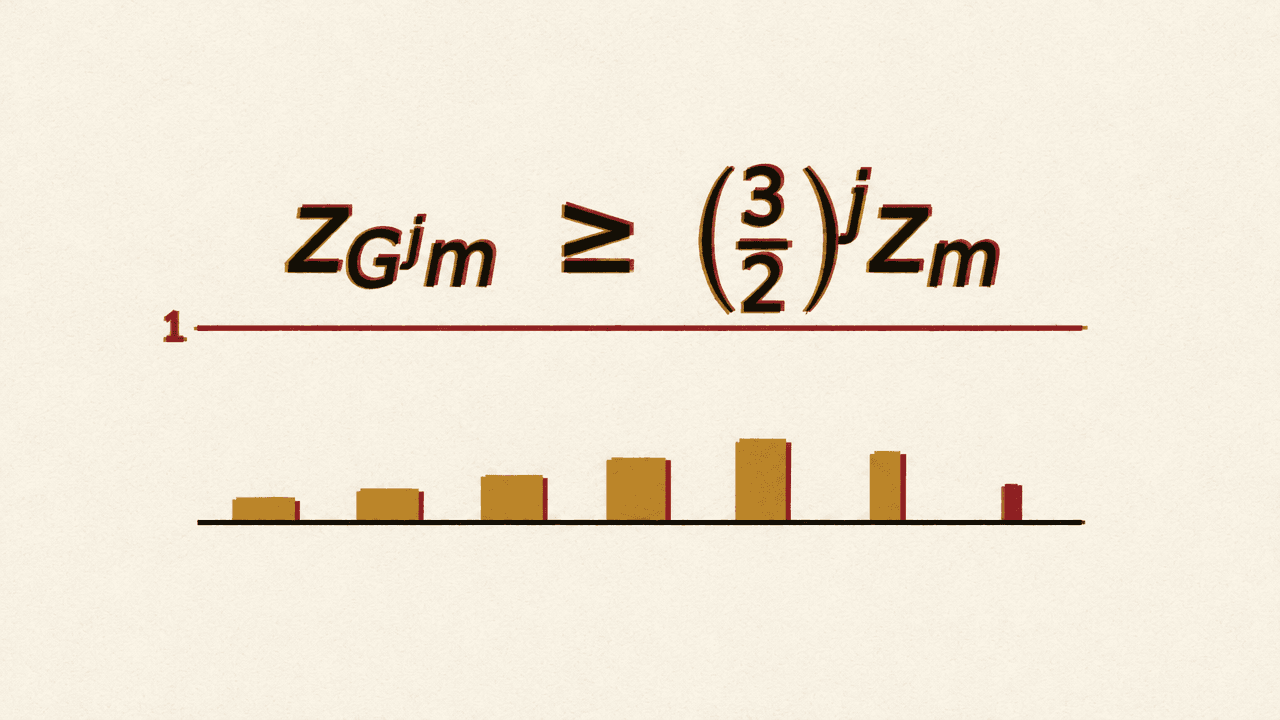
A local comparison argument rules out positive values of a below 8π. In a free square of side m, the proof averages the heights on each face, then averages the four face averages. Let zₘ be the expected complex exponential of that quantity. The manuscript proves zₘ is real, positive, and at most one.
Its comparison lemma says that, for a fixed sufficiently large integer enlargement factor G, the limiting ratio zGₘ/zₘ is bounded below by a positive constant times G raised to 2 − a/(4π). The constant is independent of G. If 0 < a < 8π, the exponent is positive, so G can be chosen large enough that the lower bound exceeds two. For sufficiently large m, each enlargement then raises z by at least a factor of 3/2. Repeating the enlargement eventually forces z above one, contradicting its bound. Thus a must be either zero or at least 8π. The comparison lemma is a technical input; the explainer does not give its proof.
That gap does not by itself identify the physical endpoint. The manuscript transfers the Gaussian limit between domains and connects positive a to unbounded center variance. It then brings the original model into a controlled small-correction expansion. Above 8π, the positive branch is open in temperature: if the first rough point had a larger effective value, nearby lower temperatures would also be rough, contrary to the definition of the threshold. The endpoint value of a is therefore exactly 8π.
The paper also proves that the effective temperature has an infinite right-hand slope as temperature approaches βc from above. The domain transfer, expansion, openness argument, and slope estimate are substantial technical steps; the explainer presents their roles, not their full proofs.
The spin limit is a normalized field, not a critical-point result
For planar spins, each site carries an angle θ, represented by e to the power iθ. The XY model rewards alignment through a cosine interaction; the Villain model uses a periodic sum of Gaussian weights. Here b is inverse temperature. The theorem fixes b sufficiently large and refines the lattice inside the square (−1, 1)², keeping all boundary angles at zero.
The raw spins are not the field that converges. Each is multiplied by a model-dependent amplitude A and by an exponential involving the full diagonal of the inverse, unscaled graph Laplacian, divided by 2K, where K is an effective stiffness. For K > 1/(4π), area-weighted averages of these normalized spins against test functions converge to an imaginary exponential of a Dirichlet Gaussian free field.
The correction compensates for Gaussian fluctuations. If Y is centered Gaussian with variance V, the expected value of exp(iY/√K) is exp(−V/(2K)); multiplying by exp(V/(2K)) cancels that factor. For the field, the normalization uses the whole variance, including its finite, position-dependent part: average over a small circle, apply the correction, then shrink the circle while testing against smooth functions inside the domain.
This is a random-distribution limit, not a claim about ordinary pointwise values. The manuscript proves joint convergence of regional measurements and their mixed moments. It must also control close or coinciding spin insertions; convergence of correlations only at separated points would not establish the full field limit.
The Villain relation does not extend the spin theorem to criticality
In the stated low-temperature range, the paper gives a precise relation for the Villain model: its stiffness KVillain(b) equals the nearest-neighbor height model’s effective temperature at π²b, divided by π². Substituting the height endpoint value 2π into that conversion gives 2/π.
That arithmetic does not enlarge the theorem’s scope. The manuscript does not prove the spin field limit at the spin transition, nor does it claim that XY and Villain have equal stiffness at the same bare temperature. The results remain distinct: heights through physical roughening, and normalized spin fields at sufficiently low fixed temperature.