The Critical Planar XY Model Has a One-Quarter Correlation Exponent
An OpenAI preprint claims that spin correlations at the critical point of the square-lattice planar XY model decay with exponent \(1/4\). The authors derive the exponent by relating spin correlations to fluctuations in a height representation, then show that the critical fluctuation coefficient must equal \(8\pi\): lower bounds rule out zero, while stability rules out larger values. The result fixes the asymptotic exponent, not the full correlation formula; the preprint leaves the prefactor and possible logarithmic corrections undetermined.
The result fixes an exponent, not a full correlation formula
The manuscript claims that the critical correlation in the planar XY model decays with exponent one quarter. It does not give an exact formula at finite distance: the exponent is determined, but a constant prefactor and possible logarithmic corrections are not.†
The model places a freely rotating arrow at each site of a square grid. Neighboring arrows favor alignment, with interaction strength b, the inverse temperature. To measure how much two distant arrows agree, take the cosine of the angle between them: 1 for matching directions, 0 for a right angle, and −1 for opposites. Average that quantity over the model’s random configurations.
The order of limits matters. Begin with a finite square with free boundaries—no fixed exterior spins and no wraparound—and count each undirected nearest-neighbor edge once. For two sites n steps apart horizontally, first let the square grow without bound while holding n fixed. Then send n to infinity. The resulting correlation is denoted C_b(n); changing the order would pose a different question.
The paper defines a mass m(b) as the limiting exponential decay rate: minus the logarithm of the correlation, divided by n, as n grows. Exponential decay gives positive mass; power-law decay gives zero, since log n/n tends to zero. The critical b_c is the infimum of positive b values with zero mass. The manuscript cites established results that this threshold is finite and nonzero, and that the mass is zero at the threshold. “Massless” does not mean distant spins stay strongly aligned; their correlation can still decay, just more slowly than exponentially.
At b_c, the theorem says that log C_{b_c}(n) / log n tends to −1/4 as n tends to infinity through the integers. Equivalently, for every positive ε, the correlation eventually lies between n^(−1/4−ε) and n^(−1/4+ε). The distance at which these bounds begin can depend on ε. This is an asymptotic exponent statement, not a precise expression for the correlation at each distance.
The proof turns spin correlations into a question about height fluctuations
The proof begins with an exact finite-box change of variables. Fourier-expanding the cosine interaction turns the angle integrals into constraints on integer-valued currents. With no spin insertion, these currents have zero divergence. On the planar grid, they can be represented as differences of heights on the faces, in multiples of 2π, with exterior height set to zero.
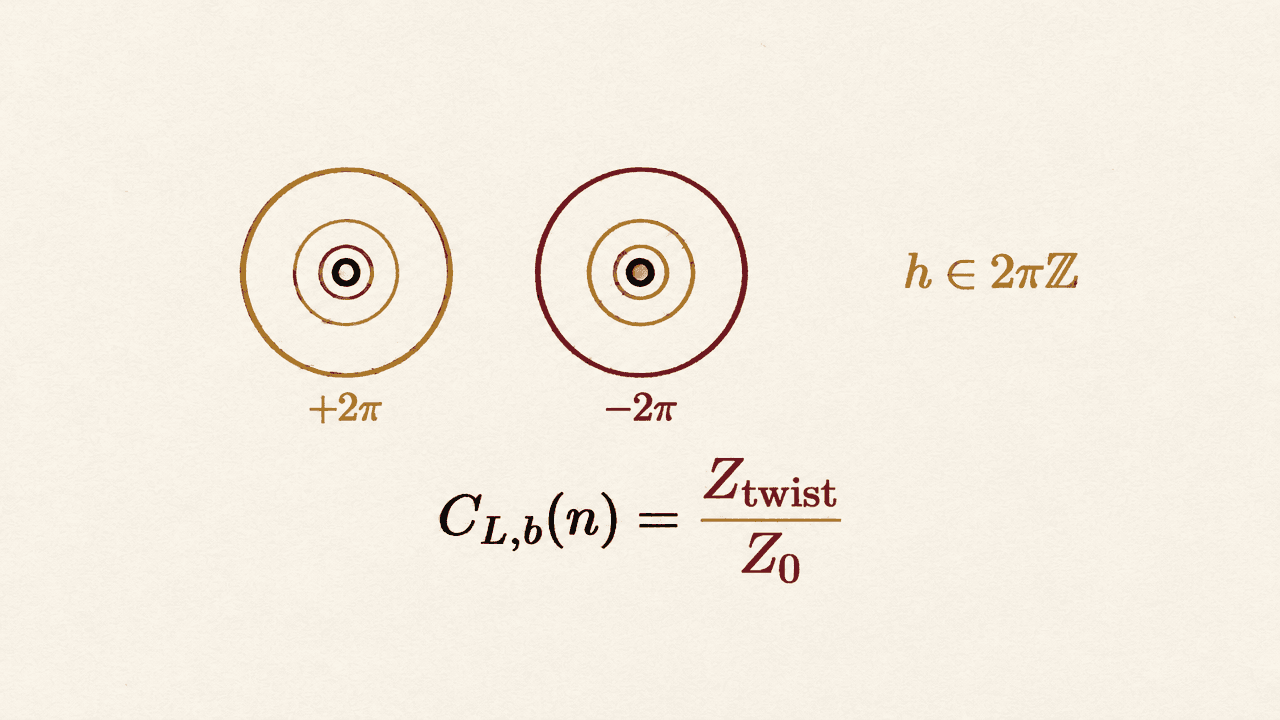
Inserting the two spin observables changes the current constraint at those two sites. In the height representation, this becomes a pair of opposite twists, with circulations +2π and −2π. The correlation is the ratio of the partition sum with these twists to the untwisted partition sum. This identity is exact for a finite box; it is not a simulation or a Gaussian approximation.
The microscopic height weights are Bessel weights, not a quadratic Gaussian law. The manuscript proves that large-scale height observations nevertheless have Gaussian limits, with a coefficient a(b) controlling the strength of the limiting fluctuations. This coefficient is distinct from the original inverse temperature b.
For positive a(b), upper and lower estimates identify the spin exponent as 2π/a(b). A separate result sharply restricts the possible values of the coefficient: it is either zero or at least 8π. If the critical point can be shown to have a(b_c)=8π, the exponent follows. The endpoint argument is what selects that value.
| Critical coefficient | Consequence in the manuscript |
|---|---|
| a(b_c)=0 | Conflicts with the established lower bound on critical correlation |
| a(b_c)>8π | Stability would force zero mass below b_c, contradicting its definition |
| a(b_c)=8π | The exponent is 2π/(8π)=1/4 |
An angular-energy calculation explains the factor 2π. Around one twist, the gradient of the polar angle has magnitude 1/r. Squaring it and integrating over an annulus gives 2π log(R/r₀). For two opposite twists separated by n, the leading energy is 4π log n. The Gaussian comparison divides this by 2a, producing (2π/a) log n; exponentiating yields a power law with exponent 2π/a. This calculation explains the coefficient, but transferring it to the original non-Gaussian model depends on the paper’s estimates.
Stability rules out a coefficient above eight pi
The stability result is the step that rules out a(b_c)>8π. First, however, the coefficient must be shown to be positive. If a(b_c)=0, the manuscript’s upper estimate makes the critical correlation eventually smaller than every fixed inverse power—in particular, no greater than 1/n². But an established lower bound, attributed to van Engelenburg and Lis, says it is at least 1/(8n) for sufficiently large n. For n>8, 1/n² < 1/(8n), so the bounds conflict. Thus a(b_c)>0, and the coefficient gap implies a(b_c)≥8π.
Nor can the coefficient be strictly larger than 8π. The manuscript proves that if a(b_c)>8π, then a(b) remains positive throughout an open interval around b_c. Since b_c is positive, that interval includes a positive value b̃<b_c. At such a value, the spin estimates give a polynomial lower bound on the correlation. The correlation is also at most one, so its negative logarithm is nonnegative and bounded above by a constant times log n. Dividing by n forces m(b̃)=0. That contradicts the definition of b_c as the infimum of positive b values with zero mass.
The coefficient must therefore equal 8π, giving 2π/(8π)=1/4. The proof does not assume continuity of a(b). Its stability step uses pinned regions, conditional height estimates, and comparisons across geometrically growing rings; the manuscript also describes strengthening the law on block averages temporarily and removing that extra term by comparison. These are substantive analytic steps, beyond the angular calculation itself.