Microscopic Pin Cancellation Establishes the Critical XY Field Limit
An OpenAI preprint proves that, under fixed boundary spins, the normalized spin fields of the critical planar XY model converge as the square lattice is refined to a corrected imaginary exponential of the Gaussian free field. The authors’ main challenge is connecting continuum height-field estimates to spin insertions at the scale of a single lattice spacing, while controlling collisions between insertions. Their proof uses cancellation against a center reference pin and uniform correlation bounds to establish convergence of the fields, not of pointwise spin values.
The proof has to resolve a lattice-scale insertion
The theorem concerns square-grid XY models with every boundary spin fixed to angle zero. As the grid is refined while the square stays fixed, the normalized spin field converges in law along the full sequence in the local negative-three Sobolev space, H_loc^-3((-1,1)^2). The limit is a distribution: the theorem concerns fields tested against smooth, compactly supported functions, not values at individual points.
The proof’s central obstacle is microscopic. A Gaussian height limit can describe a hole of fixed positive size, but it cannot by itself resolve a puncture only one lattice spacing across. The manuscript bridges that gap with nested annuli and a cancellation against a center reference pin. It must also control collisions between insertions before separated-point correlation limits can establish convergence of averages.
The paper imports critical Bessel-height and pin limit theorems from companion work. In the Fourier expansion of spin correlations, a spin insertion becomes an integer winding around its location. Fixed spin boundaries correspond to free dual heights, modulo one common height shift; the charges need not sum to zero. The fixed spin boundary imposes no current-conservation constraint there.
To pass from holes of fixed positive size to lattice-scale insertions, the proof surrounds each insertion with nested annuli. Restoring bonds between adjacent annuli introduces a gluing kernel which, after normalization, is positive and at most one, with small average loss. Summing a possible loss independently at every scale would be problematic. Instead, a contraction argument bounds the outermost data density by two. The microscopic core can have an unfavorable fixed weight, provided that weight is positive; the argument needs no uniform lower bound.
The cancellation comes from using identical translated nests around every insertion and around a center reference pin. Each insertion contributes the same microscopic factor as the reference. Dividing a k-spin correlation by the kth power of the center magnetization normalization cancels that factor. The exterior region supplies the Green-function interaction, and the finite diagonal terms are removed by the spatial correction in the definition of the field. This gives the desired correlations when insertion locations stay separated, without requiring an asymptotic formula for the center magnetization. Detailed pin comparisons, winding estimates, and the contraction proof are not supplied here.
The critical height coefficient used in the companion results is 8π, which gives stiffness K* = 2/π. This height coefficient is not the magnetization normalization: the latter is an exact finite-grid observable, not a coefficient inferred from the height limit.
Collision control extends the argument beyond separated insertions
Separated-point limits alone do not control weighted averages, whose sums include nearby sites and repeated sites. For points in any fixed compact region strictly inside the square, the paper proves a uniform two-point bound: a region-dependent constant divided by the distance between the points plus one lattice spacing. The bound covers coincident sites and either choice of spin signs.
In two dimensions, the 1/r singularity suggests why the estimate can be manageable: a ring of radius r has area proportional to r times its thickness, so the radial integral remains finite. That is intuition, not the all-order collision proof. Positivity and a Lee–Yang moment bound also control higher mixed moments and allow collision regions to be removed. Together with the microscopic-core cancellation, that control supports convergence of the full test-function averages.
Exact observables set the lattice normalization
The model weights neighboring spins according to the cosine of their angle difference, with inverse temperature b. To define the critical value, the paper first takes free boxes to infinite volume and measures the exponential decay rate—the mass—of correlations between spins separated by distance r. The critical inverse temperature is the infimum of values where that mass vanishes. No critical exponent is assumed in the definition. The theorem then concerns a square with fixed boundary spins, retaining the boundary interactions.
For a grid of spacing 1/n, let a_n be the expected horizontal component of the center spin. It is strictly positive, and every spin is divided by this same exact quantity. The construction does not guess a power of the mesh size or a logarithmic correction.
A second correction depends on location. The nearest-neighbor lattice Laplacian has no n-squared prefactor; its inverse is the lattice Green function G_n. At each site, the construction compares the diagonal Green value there with the value at the center and exponentiates the difference divided by 2K*, where K* = 2/π. The corrected spins are then summed against a smooth test function with a cell-area factor of 1/n². This is the lattice field whose limit is asserted.
The continuum target needs the full variance correction
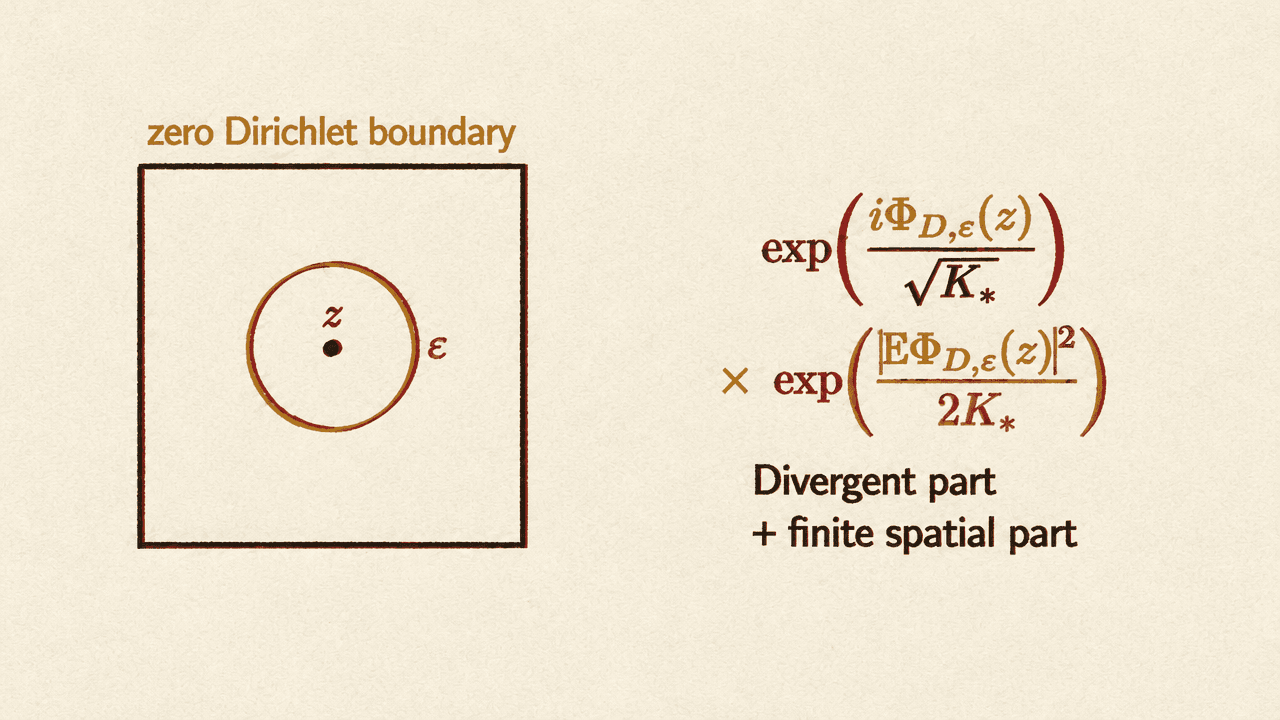
The proposed limit starts from a real Gaussian free field on the square with zero Dirichlet boundary condition and covariance given by the continuum Green function. Because the field is too rough to evaluate at a point, the construction averages it over a circle of radius ε, takes the imaginary exponential of that average divided by the square root of K*, and multiplies by the exponential of its variance divided by 2K*. The correction has a plus sign and uses the full variance, not only its divergent part. The limit is taken after integration against a test function.
A centered-Gaussian calculation explains the resulting opposite-sign moment kernel. If averages X and Y have variances A and B, and covariance C, then X − Y has variance A + B − 2C. In the expected product of the exponential at X and the conjugate exponential at Y, the Gaussian factor is the exponential of minus this variance over 2K*. The two positive variance corrections cancel the A and B terms, leaving e^(C/K*).
As the circles shrink at distinct points, C tends to the Green function. Its logarithmic coefficient is 1/(2π); dividing by K* = 2/π gives the one-quarter singularity, multiplied by the exponential of the Green function’s smooth remainder. This calculation identifies the target kernel. The lattice proof and collision estimates are still needed to establish convergence to the field.
The theorem is precise about what converges
For every finite collection of smooth, compactly supported complex test functions, the joint laws and all mixed moments converge, including moments with unequal numbers of fields and conjugate fields. The result applies to the full sequence of grid refinements in the local negative-three Sobolev space.
Its scope is fixed boundary spins, exact center normalization, and the full-variance Gaussian correction. It is not an asymptotic formula for a_n, nor by itself an infinite-volume spin-correlation asymptotic. The theorem relies on its companion results.