Critical XY Center Magnetization Decays as n⁻¹⁄⁸(log n)¹⁄¹⁶
A paper on the critical planar XY model gives a conditional asymptotic for how strongly spins at the center of a square remain aligned with spins fixed along its boundary: the expected alignment decays as \(C n^{-1/8}(\log n)^{1/16}\). The authors argue that the logarithmic correction, which fixed-ratio scaling alone cannot determine, follows from comparing scales in a dual height representation. The result relies on inputs from three companion manuscripts; it does not establish nonzero magnetization in infinite volume.
Boundary alignment decays, but with a logarithmic correction
In the nearest-neighbor cosine XY model, spins on a square lattice can point in any direction in the plane, and neighboring spins prefer to align. Fix every spin on the boundary of the square pointing right, and let a_n be the expected cosine of the angle at the center. It measures boundary-induced alignment at one site, averaged over configurations—not an average across the square.
The paper’s conditional theorem gives the critical-size asymptotic
a_n ∼ C n^(-1/8) (log n)^(1/16)
where C is a positive, finite, model-dependent constant. The logarithmic factor slows the decay relative to a pure n^(-1/8) power law, but the center magnetization still tends to zero. The result does not claim nonzero magnetization in infinite volume.
Criticality is defined through correlations in boxes with free boundaries: first take the box-size limit, then examine the exponential decay rate as the separation between spins grows. The critical inverse temperature is the infimum of inverse temperatures at which that rate is zero. The theorem depends on inputs from three companion manuscripts: the critical height, local renormalization, and spin field results. It is conditional, not a proof from scratch of all those ingredients.†
Fixed-ratio scaling gives the power, not the logarithm
A scaling relation for sizes that differ by a fixed factor d can reveal the power-law exponent: the magnetization ratio tends to d^(-1/8). But this does not determine the logarithmic correction. Multiplying n^(-1/8) by any fixed power of log n leaves that ratio limit unchanged, because
log(dn) / log n → 1.
So fixed-ratio scaling cannot distinguish a logarithmic exponent of zero from one of 1/16, or another fixed value.
That distinction matters because the companion spin-field construction normalizes its field using the exact center magnetization. The paper identifies the missing asymptotic size of that normalization. Its task is not merely to recover the power already visible in fixed-ratio scaling, but to resolve the factor that ratio scaling hides.
Duality and cancellation make the scale comparison possible
The proof preserves the observable while changing its representation. Fourier duality expresses a_n as a ratio of two partition sums over heights taking values in multiples of 2π. The numerator has a 2π circulation around the center; the denominator has zero circulation. This is an exact representation, not a picture of a physical spin visibly rotating around the center.
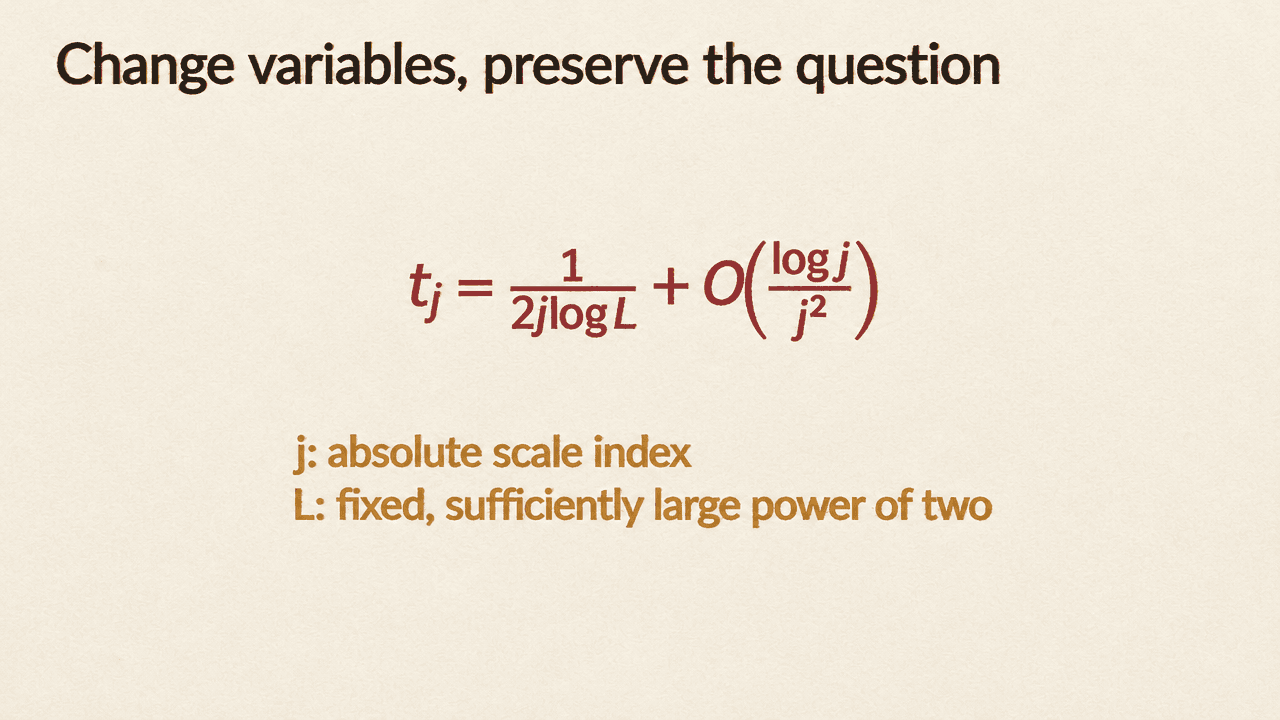
The critical-height input supplies a Gaussian coefficient of 8π, and local renormalization maps integrate over successive scales. Because those maps require small interactions, the manuscript cannot simply assume the microscopic model already starts in that regime. It constructs overlapping finite histories, cuts off exceptionally large observation differences, and compares histories through physical observables. The resulting running gradient coefficient has leading size 1/(2j log L).
The normalization near the circulation insertion may be large, so the proof does not estimate it separately. Instead, it compares two squares using the same finite history and stopping scale. The local scalar factors are then identical and cancel in the enlargement ratio, after the remaining insertion term is controlled relative to a positive lower bound. This isolates the scale-dependent contributions without requiring a standalone estimate of the potentially large factor.
Summable corrections establish a finite, positive amplitude
Take geometric sizes n_j = L^j/2, for a fixed sufficiently large dyadic L. The change in log magnetization between successive sizes is
log a_(n_(j+1)) − log a_(n_j) = −(log L)/8 + 1/(16j) + r_j
with |r_j| ≤ C j^(-1−ε) for some ε > 0.
The leading term accumulates linearly in j, giving the power n^(-1/8). The 1/(16j) correction accumulates as a harmonic sum, which grows like log j. Exponentiating that accumulated correction yields j^(1/16); since j grows like log n, this becomes the multiplier (log n)^(1/16).
The remainder bound also establishes convergence of the amplitude. Define
B(n) = log a_n + (1/8) log n − (1/16) log log n.
Along the geometric sizes, the increment in (1/8) log n cancels the leading decay, and the increment in (1/16) log log n cancels the harmonic correction up to errors of order 1/j^2. Together with the stated remainder bound, this leaves changes in B whose absolute sum is finite. Since a_n > 0, each B(n) is finite; thus B converges to a finite real limit. Exponentiating gives the strictly positive, finite amplitude C. A remainder that merely tends to zero would not, by itself, establish that convergence.
The argument first establishes the limit on geometric sizes, then extends it to all integer sizes. Place any size between two consecutive geometric sizes and pass, along any sequence, to a subsequence on which its ratio to the lower size converges. The companion fixed-ratio result supplies the needed power-law adjustment; the logarithmic adjustment tends to zero. This gives the same limit for every such subsequence and therefore for the full sequence. The result is a specified decay law for boundary-induced alignment at the center, with a model-dependent positive amplitude—not a simulation result, nor an unconditional derivation independent of the companion inputs.