Planar XY Correlations Acquire a Critical (log r)¹⁄⁸ Correction
An OpenAI preprint on the critical planar XY model claims that its spin correlation decays as \(r^{-1/4}(\log r)^{1/8}\), with a positive, finite amplitude. The result sharpens the familiar power-law prediction: the logarithmic factor captures a correction accumulated across scales, while the proof’s control of the remaining terms establishes that the rescaled correlation converges rather than drifting further.
A logarithm changes the critical decay
At the critical inverse temperature, the planar XY model’s spin correlation is not just proportional to r to the power −1/4. The manuscript claims the sharper asymptotic
C_bc(r) = B_XY r^−1/4 (log r)^1/8 (1 + o(1)),
where B_XY is positive and finite. The theorem identifies the logarithmic exponent and proves that the remaining amplitude converges; it does not give that amplitude’s numerical value.†
Each site of the square lattice carries an angle, and neighboring sites interact through the cosine of their angle difference. A configuration is weighted exponentially by b times the sum of those cosines, with each nearest-neighbor edge counted once. For the theorem’s correlation, the finite box has free boundaries: there are no interactions with sites outside it. First the box grows without bound while the separation r is fixed; only afterward does r tend to infinity. The critical value bc is the infimum of the b values for which the resulting correlation has zero exponential decay rate. The boundary condition and order of limits are part of the statement.
The logarithm matters because removing only the power law leaves a rescaled correlation that continues to grow, slowly. Removing the logarithmic factor as well leaves a quantity converging to B_XY.
A center observable separates the amplitude problem
Rather than estimate two distant spins directly, the proof studies a different boundary problem. In a square of half-side n, it fixes every boundary angle to zero and defines M_n as the expected cosine of the angle at the center. This pinned-boundary observable is not a replacement definition for the original free-box correlation.
The manuscript proves that the thermodynamic correlation divided by M_r squared tends to a positive, finite shape constant. Its comparison uses matching nests of annuli around the insertions, where shared local factors cancel. A separate pinned-rim estimate connects that calculation to the original free-box limit. The argument’s architecture is to find the asymptotic behavior of M_n, then transfer it to the correlation through this ratio.
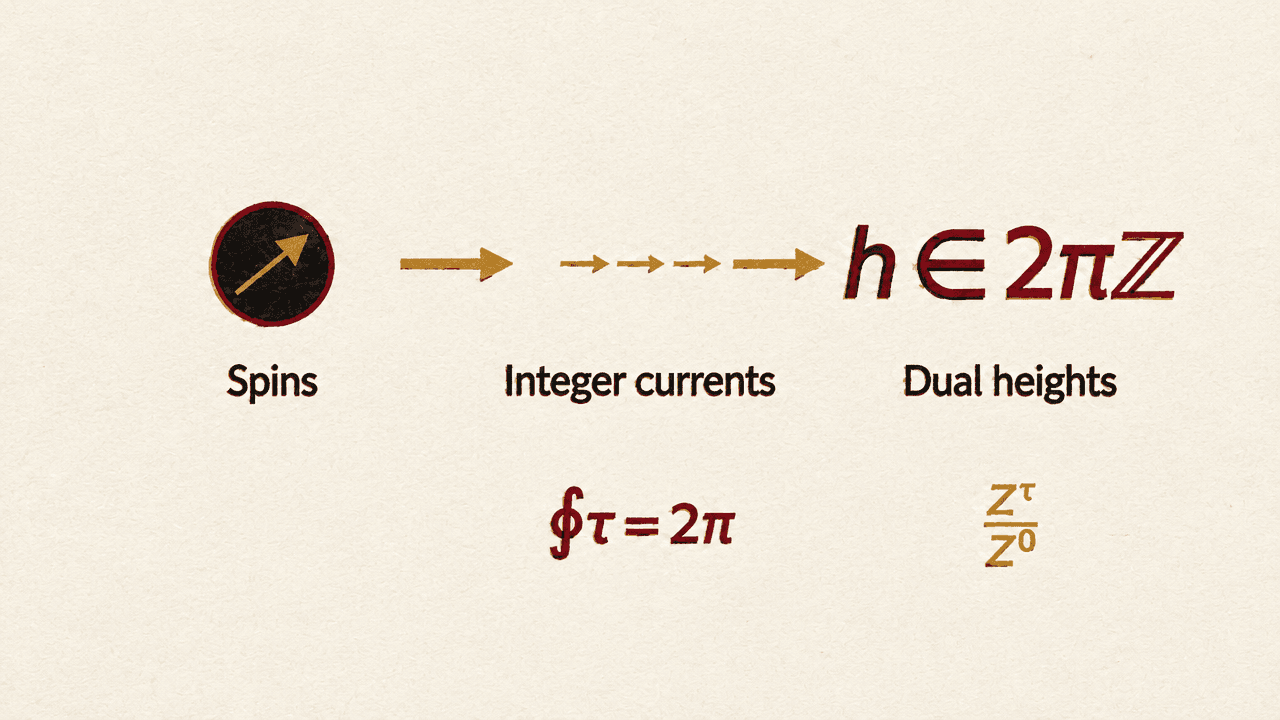
The bridge to M_n is an exact Fourier representation: spin correlations become ratios of partition functions for dual-lattice heights taking values in multiples of 2π. An inserted spin is encoded by a circulation. Convergence of ordinary height averages alone does not determine the behavior of that insertion, so the proof retains it while averaging over larger blocks. The paper supplies a cutoff construction, quantitative control across starting histories, and the extraction of the amplitude; companion work supplies height limits, local analytic maps, and annular estimates.
A small correction at each scale produces the logarithm
The scale comparison uses a fixed, sufficiently large dyadic block ratio L, with l = log L. For neighboring sizes L^N and L^(N+1), the proof compares calculations with a common starting history and stopping scale. Its key quantity t measures a gradient-energy correction. At the stopping scale, the estimate is
t = 1/(2lN) + O(log N / N²).
The manuscript presents obtaining this precision as a major technical step. Its consequence is visible in the increment of the center observable.
Let G_N be the minimum reference energy for one insertion in the corresponding dual square. The proof obtains G_N = 2πlN + c_N, where c_N converges to a finite real number. The logarithmic increment of M is the product of the energy increment and the factor −(1 + t)/(16π), plus summable error terms. The leading energy increment is 2πl, giving a contribution of −l/8. The 1/(2lN) part of t contributes an additional +1/(16N).
That positive harmonic term is the source of the logarithmic correction: it is small at each scale, but its sum grows like log N. It cannot be absorbed into a constant. Establishing this term alone, however, does not establish a convergent amplitude. The other terms in the increments must also be shown not to create a further drift.
The amplitude converges only after the residuals are controlled
The energy increment also contains differences c_(N+1) − c_N. Their unweighted sum telescopes because c_N converges. But convergence of c_N does not imply that the absolute values of those differences have a finite sum, so the proof cannot discard them on that basis.
For the differences weighted by 1/N, the manuscript uses summation by parts. This produces boundary terms and a series involving c_N multiplied by the difference between neighboring reciprocals. Since c_N is bounded and those positive reciprocal differences have finite total sum, the weighted series converges. The remaining error is absolutely summable. These are distinct controls: the argument does not assume finite total variation of c_N, but it still shows that the residual contributions converge. That is what rules out an extra slow drift in the amplitude.
Summing the increments gives a finite real limit for
log M_(L^N) + lN/8 − log N/16.
Exponentiating yields the center-observable asymptotic along geometric sizes: M_(L^N) is asymptotic to a positive constant times (L^N)^−1/8 (log L^N)^1/16. The factors involving the fixed L are absorbed into the constant.
To extend this from powers of L to every integer size, the proof compares an arbitrary n with the power L^N immediately below it. The size-ratio comparison shows that the observable and its proposed profile, n^−1/8 (log n)^1/16, have matching ratios between these sizes. This transfers the asymptotic from geometric sizes to all integer n; the proof uses a subsequence argument and does not assume monotonicity.
The center law yields the stated correlation
The annular comparison says that the original critical correlation is asymptotic to the shape constant times M_r squared. Squaring the center law doubles both exponents: −1/8 becomes −1/4, and 1/16 becomes 1/8. The resulting amplitude is the shape constant multiplied by the square of the positive center amplitude, so it is positive and finite. This gives the claimed free-boundary correlation asymptotic, with the thermodynamic limit taken before the axial separation tends to infinity.