The Two-Dimensional O(4) Lattice Mass Has an Exact Leading Prefactor
An OpenAI preprint claims an exact leading asymptotic for the mass gap of the two-dimensional O(4) lattice model at low temperature: \(m_{\mathrm{lat}}(\beta)\sim 32e^{\pi/4-1/2}\sqrt{\beta}\,e^{-\pi\beta}\). The result goes beyond identifying the exponential decay scale: the paper argues that its coefficient follows from isolating odd states with a boundary twist, ruling out slower even-sector modes, and carefully matching an auxiliary regulated model to the lattice model.
The result is an exact coefficient, not just an exponential scale
The manuscript’s main claim is a leading asymptotic for the mass of the two-dimensional O(4) lattice model:
The coefficient is approximately 42.56933. This is a ratio limit as β tends to infinity, not an exact formula at every temperature.
At each site of the square lattice, the model has a unit vector with four real components, σₓ ∈ S³ ⊂ ℝ⁴, and neighboring spins prefer to align. The arrows used in the explanation are only two-component projections: the spins are not confined to a plane. Here β is inverse temperature, so β → ∞ is the low-temperature limit.
The mass is a decay rate, not a spin’s magnitude. Taking one lattice direction as time, the transfer operator advances the system by one original lattice step. Its constant state—the vacuum—has transfer factor one. Let r be the operator norm of the transfer operator on the space orthogonal to that state. The mass is m = −log r: a mode with transfer factor r decays over n steps as rⁿ = e⁻ᵐⁿ. A tiny positive mass therefore means a long decay length, 1/m.
Spin correlations alone do not establish the full gap
A decay rate measured through spin correlations need not be the slowest decay in the system. Another observable could, in principle, decay more slowly without pointing in any particular direction. The manuscript addresses this by separating observables according to their behavior when every spin is reversed.
A spin component is odd under this reversal; a neighboring dot product is even and rotation invariant. The paper bounds correlations of odd polynomials by the spin correlation decay, and centered even correlations by its square. It then uses positive spectral measures and polynomial approximation to extend those bounds to all local-observable sectors. The consequence is that the even sector’s non-vacuum gap is at least twice the full gap. That comparison lets the paper infer the full local-observable gap from a parity-based calculation rather than risk missing a slower even excitation. The covariance bounds and the extension to all local observables are substantive parts of the proof.
A boundary twist isolates odd states exactly
On a finite cylinder, let U be the normalized row transfer operator and J the operation that reverses every spin in a row. Since reversing twice restores the original configuration, J² = I; symmetry also gives JU = UJ. States can therefore be classified by parity, with Jv = +v for even states and Jv = −v for odd ones.
With periodic closure in the time direction, the partition function is Tr(Uⁿ). Closing with a spin reversal inserts J, giving Tr(JUⁿ). Each even state contributes the same sign to both traces; each odd state contributes opposite signs. Thus:
The difference cancels even contributions and retains odd ones; the sum does the reverse. These are exact finite-cylinder identities, not low-temperature approximations. The finite spectrum shown to illustrate the arithmetic is a toy example, not measured O(4) data:
| Toy transfer factor | Periodic contribution | Twisted contribution | Parity |
|---|---|---|---|
| 1 | 1 | 1 | Even |
| 4/5 | 4/5 | −4/5 | Odd |
| 1/2 | 1/2 | 1/2 | Even |
| 1/3 | 1/3 | −1/3 | Odd |
The manuscript then controls the odd-to-even trace ratio on growing rectangles. Its logarithmic decay recovers the full lattice mass because the earlier correlation bounds exclude a slower even excitation. The trace identity alone does not deliver the asymptotic: the growing geometry and control of errors are essential.
The regulator supplies a scale; the comparison fixes its normalization
To calculate the small gap, the manuscript introduces a Brownian regulator. Space becomes a continuous circle while time remains discrete; the variables are loops in U(2), combining the original sphere with an additional circle coordinate. Expanding the time interaction gives positive transfer operators indexed by particle number, with even and odd particle numbers furnishing the parity split.
The manuscript’s spectral calculation, on chosen growing circles, gives a particle density of b² + O(b) in the maximizing sector and an odd-even transfer-norm difference with asymptotic scale 32√2 √b e⁻ᵖⁱᵇ. Here b is an auxiliary coupling, not the lattice coupling β.
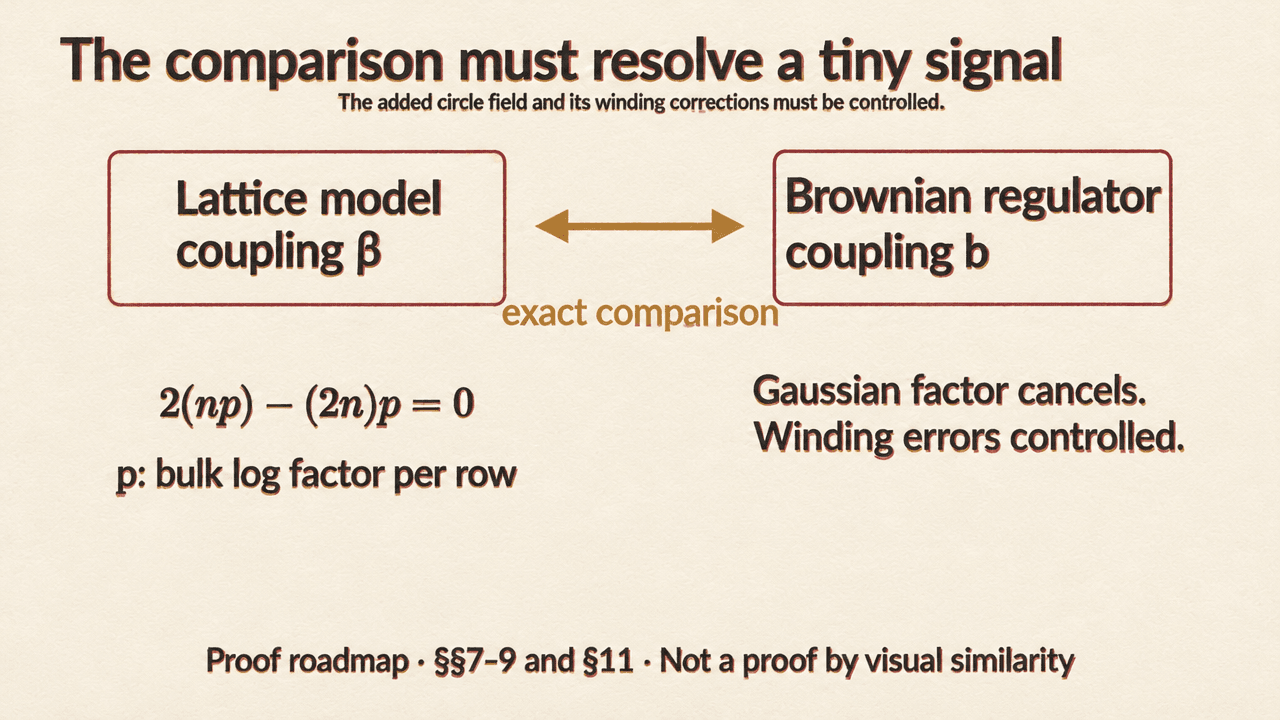
That auxiliary result is not yet the lattice answer. The comparison with the lattice model must cancel common bulk factors, control the added circle field and winding corrections, and make the comparison error smaller than the odd trace being detected. Comparing traces at time lengths t and 2t then connects them to transfer norms. Matching only the leading exponential would not determine the coefficient.
A finite shift between b and β matters because it changes the exponential by a constant factor. The manuscript determines the shift using helicity, the response of the log partition function to a small rotational boundary twist:
Write δ = 1/4 − (1 + log 2)/(2π), so b = β − δ + o(1). Then √(b/β) tends to one, while the exponential contributes e^(πδ). The coefficient therefore becomes 32√2 e^(πδ). Substituting δ, the log 2 term contributes 1/√2, canceling the √2; what remains is 32e^(π/4−1/2). Knowing only that the two couplings differ by a bounded amount would not determine this factor.
The source also notes a limit on what is independently checked in its explanation: the linked repository’s Lean scope note excludes this O(4) spectral-gap claim. The parity identities and prefactor algebra are reproducible checks, not a verification of the omitted analytic proof or its companion inputs.