The Two-Dimensional O(3) Spin Field Has an Isolated Lowest-Mass Particle
An OpenAI preprint proves that, under a specified continuum-limit construction, the two-dimensional O(3) spin field has a lowest-mass contribution with positive spectral weight, separated from the rest of the spectrum. The authors’ argument goes beyond establishing a mass gap: it bounds the number of low-energy states in finite volume, then uses that bound to show the field’s spectral measure contains an isolated atom at its lowest mass. The theorem does not give the mass or weight numerically, or claim to cover every continuum limit.
A mass gap does not guarantee a particle
A field can have no spectral weight below some positive mass and still lack a particle at the threshold. Its spectrum might begin as a continuous distribution, with no weight concentrated at one mass. The stronger claim in An Isolated Particle Pole for the Two-Dimensional O(3) Spin Field is that the vector field couples to a lowest mass with positive weight, and that this contribution is separated from all the rest.
The theorem expresses the field’s two-point spectral measure as ρ = Zδ₍ₘ₁²₎ + ρ_rest. A spectral measure records which masses the field couples to and with what weight. Here, m₁ > 0, Z > 0, and the remaining measure is supported at masses at least a positive distance δ above m₁. The measure is written in mass squared, so the point contribution is at m₁². The result establishes neither numerical values for these constants nor a complete list of particles. Its claim is narrower: the lowest contribution is both an atom of positive weight and isolated from the rest of the spectral support. In other words, a gap alone is not enough; the first mass must carry weight, and an empty interval must separate it from the rest.†
The model is a square-lattice spin system in two dimensions. Each site carries a unit vector with three components, and nearest neighbors interact through their dot product, without an external field. O(3) refers to the internal symmetry of the spins, not to three spatial dimensions; the reconstructed theory has one space and one time direction.
The theorem uses a specific prescription supplied by a companion construction: how the lattice spacing shrinks, how the coupling changes, and how the spin field is normalized. It applies with that prescription and a sufficiently large terminal coupling. Those choices are part of the theorem, not incidental setup, and the result is not claimed for every possible continuum limit.
The proof needs a budget on low-energy states
A finite-volume system has discrete energy levels, but discreteness in a box does not prove isolation in infinite volume: levels can crowd together as the box grows. The paper instead bounds how many low-energy transfer states can fit. A transfer state is an energy state counted by the operator that advances the system along one direction of the lattice.
Its inputs go beyond a mass gap. The companion construction supplies a nonzero one-field state, uniform moment bounds, and exponentially small partition-function errors when large squares are doubled. The limits are taken in a fixed order: first remove the lattice cutoff at fixed physical circumference; then grow the circumference through a prescribed sequence of doublings.
There is also a distinction between states counted by the transfer operator and states visible to the spin field. The argument must connect those two. A correlation inequality places every non-vacuum even state—one unchanged by reversing all spins—at or above twice the lowest transfer energy. That makes the lowest excitation odd. Its sign detects a connection in embedded spin clusters; local circuits then attach positive, correctly normalized field weight to that connection. These technical steps lead to the needed conclusion: after the stated limits, the lowest transfer energy cannot remain below m*, the bottom of the spin field’s mass support.
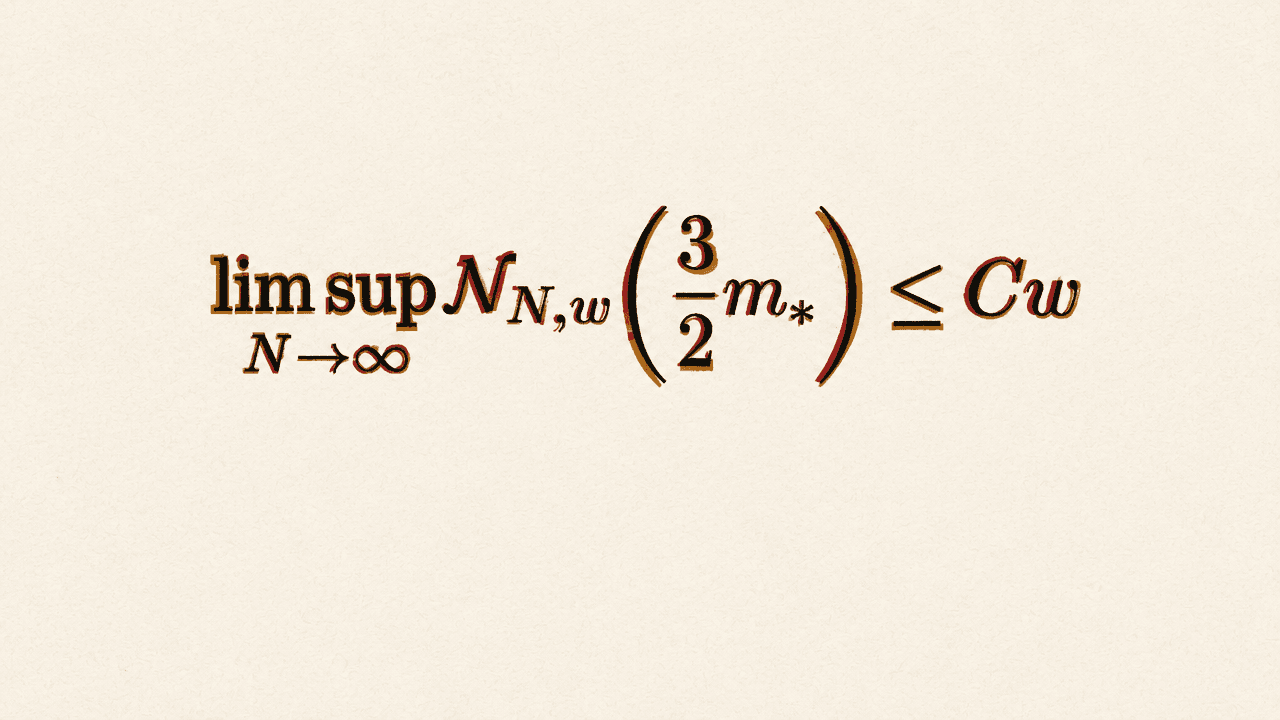
With that bridge in place, the paper establishes a linear budget. Count transfer states at energy at most 3m*/2, including the vacuum and multiplicities. For every sufficiently large prescribed circumference w, the upper limit of this count as the lattice cutoff is removed is at most Cw.
The mechanism compares a torus of twice the circumference with two copies of the original torus. In the two-copy system, energies add. Below twice the lowest excitation, both copies cannot be excited, so at least one must remain in the vacuum. Positive polynomial approximations convert that observation into a count estimate; repeated doubling, with summable errors and threshold shifts, yields the linear bound. This is the proof’s roadmap, not the full technical estimate.
The state budget forces a lowest-mass atom
The decisive step asks what the linear budget permits in the spectral support. Choose J distinct support points with masses between m* and 5m*/4. These are not particles assumed to exist as atoms. They are merely points in the support of the measure: every neighborhood of each point has positive measure.
A mass μ at spatial momentum p has energy √(p² + μ²). The proof fixes a small momentum interval in which every mass in the chosen range stays below the counting threshold 3m*/2. The interval is chosen before J. On a circle of circumference w, allowed momenta are spaced by 2π/w, so the fixed interval contains at least a positive constant times w momenta.
Support points need not carry point masses, but each has positive measure in every neighborhood. For the finite selection, the proof chooses disjoint narrow windows around the energy curves and smeared field tests with nonzero response throughout the momentum interval. Continuity gives a common positive minimum response for this selection. Once the circumference is fixed, the stated comparison transfers that positivity to the finite-volume setting when the lattice cutoff is sufficiently fine. The scales needed can depend on J; the counting constants cannot.
Each mass window therefore yields a transfer level at each allowed momentum once the circumference is fixed and the cutoff is sufficiently fine under that comparison. Distinct windows require distinct levels at the same momentum, while different momenta occupy orthogonal spaces. The required number of states is at least Jcw, for a positive constant c. But the budget allows at most Cw. Since C and c do not depend on J, the inequality forces J ≤ C/c.
If there were infinitely many support points in that low-mass interval, J could be arbitrarily large. The bound rules that out. The nonempty, closed mass support therefore has a minimum m*, and finiteness makes that minimum isolated. A neighborhood around it contains no other support; because m* belongs to the support, the neighborhood has positive measure. With nowhere else for that measure to lie, the point itself has positive weight. Thus m* = m₁ is the isolated atom asserted by the theorem.