Critical Percolation on the Cubic Lattice Has No Infinite Cluster
An OpenAI manuscript proves that, for bond and site percolation on the cubic lattice, almost surely there is no infinite open cluster at each model’s own critical parameter. Its contradiction argument assumes an infinite cluster at criticality, preserves reliable connections across finite regions after slightly lowering the opening probability, and uses an adaptive exploration to produce an infinite cluster below the threshold. The proof controls dependence between overlapping regions rather than treating their connections as independent.
At each model’s threshold, every cluster is finite
The manuscript’s theorem is a critical-point result for both bond and site percolation on the cubic lattice: at each model’s own critical parameter, almost surely there is no infinite open cluster. It does not say that cluster sizes have a common finite upper bound. Clusters can be arbitrarily large; the claim is that none is infinite.†
In bond percolation, each nearest-neighbor edge is independently open with probability p. In site percolation, the random bits belong to vertices, and an open path requires every vertex along it—including both endpoints—to be open. For either model, let theta(p) be the probability that the origin belongs to an infinite open cluster. The critical parameter is the infimum of the p values for which theta(p) is positive. The two models have separately defined thresholds.
The proof is built around a contradiction. Suppose an infinite cluster exists at criticality with positive probability. The manuscript uses that assumption to obtain reliable connections across finite regions, lowers the parameter slightly to some q below the critical value while preserving those finite estimates, and then joins enough regions to produce an infinite cluster at q. That contradicts the definition of the threshold.
The hard step is not simply making many local connection probabilities large. It is converting local reliability into an infinite connection without treating overlapping regions as independent.
A finite comparison carries the local argument
The manuscript’s finite engine is an inequality for a finite undirected hypergraph. Each independently open hyperedge joins all its incident nodes; different hyperedges may have different opening probabilities. For a source o, a nonempty relay set A, and a target set T, the comparison says:
Probability that o reaches both A and T ≥ probability that o reaches A × the smallest probability that any relay in A reaches T.
In symbols: P(o ↔ A, o ↔ T) ≥ P(o ↔ A) × min over a in A of P(a ↔ T).
In words, the probability that the source reaches both the relay set and the target is at least the probability of reaching the relay set multiplied by the worst relay-to-target probability.
This is not an independence statement about connection events. The hyperedge bits are independent, but reaching A and reaching T can depend on the same bits. The source presents the comparison as a proved result, while omitting its technical proof, which uses conditional cluster columns and a positivity argument.
A consequence gives the useful failure bound. If every relay reaches T with probability at least 1 − b, then the probability that o reaches A but misses T is at most b. Reaching A splits into two disjoint cases: reaching both A and T, or reaching A while missing T. Subtracting the comparison’s lower bound for joint success leaves at most b times the probability that o reaches A, which is itself at most b. No independence between the connection events is needed, and the argument does not select a random relay and assume its probability law remains unchanged.
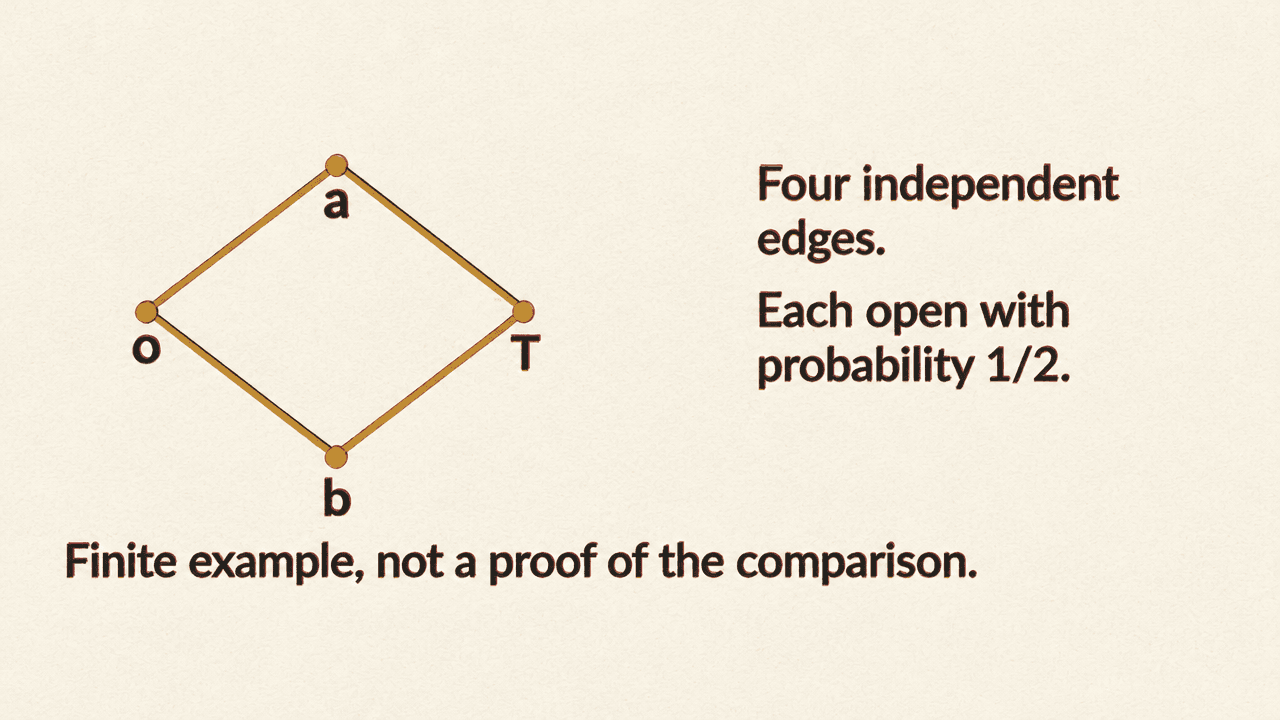
A four-edge diamond illustrates the inequality without proving it generally. With each edge independently open with probability one half, there are 16 equally likely configurations. The source reaches at least one of two relays in 12; it reaches the target in 7; and each relay reaches the target in 9. Thus the comparison reads 7/16 ≥ (12/16)(9/16), or 28/64 ≥ 27/64. Exact enumeration verifies this small example, not the theorem for all hypergraphs or the infinite lattice.
Site percolation requires a separate endpoint check
To apply the hypergraph comparison to site percolation, the manuscript replaces each original vertex with a starred node and each original edge with a connector node. A hyperedge joins a starred node to its incident connectors and opens exactly when the corresponding site opens. Between distinct starred vertices, hypergraph connection agrees with an open site path.
There is an exception: every node is connected to itself, even if the site represented by that node is closed. So a closed site’s starred node can reach itself in the hypergraph construction although the site is not open. The manuscript checks this self-connection case separately before transferring the failure bound to site percolation.
Finite estimates survive a small decrease in probability
Under the contradiction assumption, a sufficiently large seed box meets an infinite cluster with probability close to one. Symmetry and positive association turn this into reliable connections to each quarter-face of a surrounding cube: six faces times four quarters, or 24 targets.
The proof sets error tolerances and finite scales before choosing q. It uses three surrounding radii: 2r, 2r + 1, and 10r. Because each connection probability depends on only finitely many random bits, it is a polynomial in p. Strict finite estimates therefore persist when p is lowered slightly, allowing one common q below the critical value.
An extension estimate makes relays usable across fresh regions. An exterior exploration finds separated entrances; disjoint seed boxes provide independent chances to create open seeds. Relay quality is defined from the interior configuration alone, while the remaining connection probability averages over the exterior. The proof fixes only the interior before applying the failure comparison, leaving the remaining bits with their product law. Four controlled error terms—few entrances, few seeds, bad relays, and missing the target—sum to a failure probability below eta. The detailed counting and probability estimates are not reproduced in the explainer.
The geometry is explicit. Connecting neighboring boxes takes 13 relay steps: three contractions to make room inside the first box, then ten translations toward the neighbor, with the target rectangle widening by R at each translation. The last move has length 2R + 1. With r greater than 100(R + 1), the rectangle fits inside the neighboring inner box. A union bound combines the 13 extension failures into at most 13 eta; independence between relay events is not assumed.
An adaptive exploration turns promises into an infinite cluster
The large physical boxes are indexed by a two-dimensional square grid. Starting from a root whose finitely many required bits are forced open—an event of positive probability—the exploration keeps a queue of pending boxes. Each carries a conditional promise: given the history so far, its chance of connecting to the origin exceeds 1 − delta. Its bits stay reserved and unrevealed until processing. A box counts as successful only after its connection is verified; its unvisited neighbors then inherit the promise.
The manuscript bounds each conditional failure probability by a small f, with the displayed constraint delta + 52 eta/delta < f. This handles dependence directly: the boxes are not assumed independent, and the proof controls the conditional chance of failure as information is revealed.
If only finitely many boxes succeed, their outside boundary must consist of processed failures. The proof counts possible boundary cycles, selecting crossing edges with disjoint endpoints—at least n/7 on a boundary of length n—and uses successive conditional-probability bounds to control the chance of enough failures along a cycle. The resulting sum over boundary lengths is less than one. Thus there is a positive chance of infinitely many successful boxes. Each is genuinely connected to the origin, and their inner boxes are disjoint, yielding infinitely many vertices in one open cluster at q below the critical value. That is the contradiction.
The manuscript’s route to critical extinction therefore depends on linked controls: a finite hyperedge comparison, the endpoint correction for sites, geometric relay estimates, and an exploration that handles dependence rather than ignoring it. The explainer notes that its finite checks are not a formal proof certificate and that the accompanying Lean result was not reproduced in its production environment.