Exponential First-Passage Limit Shapes Have No Corners or Flat Sides
An OpenAI preprint dated September 24, 2026, claims that the planar exponential first-passage percolation limit shape has neither flat sides nor corners: it is strictly convex and has a continuously differentiable boundary at every positive rate. The authors use separate arguments to rule out corners and flat segments, and say differentiability extends to gamma-distributed edge times, though strict convexity is not claimed across that broader family. The result is qualitative; the manuscript provides no formula for the shape or bound on its curvature.
The theorem rules out both flat sides and sharp corners
In planar first-passage percolation, each edge of the square grid receives an independent random travel time. A path pays the sum of the times on its edges, and the passage time between two points is the infimum over all paths connecting them. The fastest route need not use the fewest edges: the source’s example of a three-edge route costing nine and a five-edge route costing five is deliberately constructed to illustrate the distinction, not sampled from the model.
For exponential edge times, the established shape theorem says that travel time grows linearly at large distances. For a fixed vector v, passage time from the origin to the lattice point near tv, divided by t, converges almost surely to a deterministic norm μ(v). The corresponding limit shape is the unit ball, all v for which μ(v) ≤ 1. The growing cluster shown in the source is a finite simulation; its smooth outline is schematic, not a formula for the unknown shape.
The September 24, 2026 OpenAI manuscript claims that for exponential weights at every positive rate, the limit shape is strictly convex and has a C¹ boundary.† These properties exclude different defects. Strict convexity rules out flat boundary segments, where one supporting line touches the boundary at multiple points. Differentiability of the norm away from zero rules out corners, where one boundary point has multiple supporting lines. For gamma weights with any positive shape and rate, the manuscript claims differentiability and a C¹ boundary, but does not claim strict convexity across the whole gamma family. The arguments for corners and flat segments are separate.
A corner makes sideways motion expose a deficit
The corner argument assumes that in a fixed direction there are two different extreme supporting functionals, f₋ and f₊. Let f be their average, and let r measure a path’s displacement transverse to the direction. If the transverse slopes differ by 2c, a corner means c > 0. The larger support value is then f + c|r|.
This relation turns sideways movement into a penalty. A path’s defect relative to the average support is its passage time minus f applied to its displacement. Relative to one of the extreme supports, the defect is smaller by c|r|. So a path unusually cheap relative to the average becomes cheaper still relative to at least one extreme support when it moves sideways. The manuscript uses this algebra to constrain crossings that are near-fastest under the assumed corner geometry.
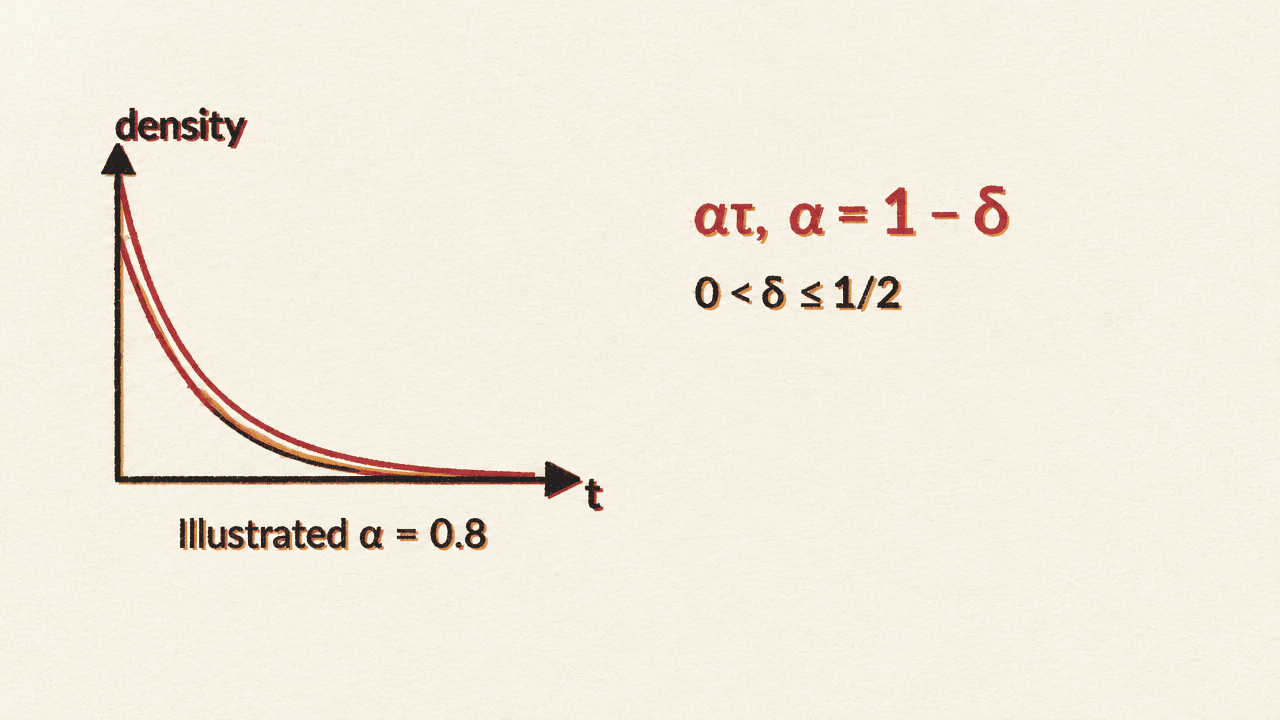
A second ingredient changes the edge-time law slightly, making edges faster while controlling the cost of the change. For a rate-one exponential weight with density p(t) = e⁻ᵗ, multiply the weight by α = 1 − δ. The new density is q(t) = α⁻¹e⁻ᵗ⁐ᵅ. The squared likelihood ratio, averaged under the original law, is 1/[α(2 − α)] = 1/(1 − δ²). Its leading change is quadratic in δ, not linear. For M independent gamma weights of shape κ, the corresponding quantity is (1 − δ²)⁻ᵏᴹ.
In a strip of length n and width proportional to s, the construction uses at most a constant times ns edges. Taking δ proportional to s/n makes the logarithm of the likelihood cost at most a constant times s³/n. At n = s³, that cost stays bounded. A crossing allowed under the original law becomes rare under the faster law; a Cauchy–Schwarz estimate then bounds the probability of that crossing under the original law as well.
The manuscript combines this estimate with endpoint extensions and edge-disjoint witnesses: separate paths that provide independent opportunities to detect a crossing. Together, these arguments force a positive excess along long simple paths from the origin at one fixed scale, under the corner assumption. The shape theorem requires excess relative to forward distance to vanish, producing a contradiction. The cubic scale is a proof scale, not a claim about a fluctuation exponent.
A flat face would force an impossible repeated improvement
To rule out a flat segment, the proof uses a different defect. A hypothetical face supplies a stationary additive random function B, dominated by passage time. For a path from x to y, its defect is its cost minus B(x,y), so the defect is non-negative. Unlike the support defect in the corner argument, it cannot be negative.
The manuscript considers pairs of local random roads tracking two nearby directions near the ends of the supposed face. Let b(n) be the best common expected defect bound per period among admissible pairs at scale n. Here, admissible means the roads satisfy the construction’s tracking and locality requirements. A local perturbation gives a fixed positive lower bound, b(n) ≥ c₀, for sufficiently large admissible n. But the main construction produces a better pair at a larger scale: for fixed D and 0 < ρ < 1, b(Dn) ≤ ρb(n).
A cheap crossing alone does not make a better road. The construction must pay to reach the shortcut and leave it, without letting a supposedly local road depend on far-away information. Local endpoint adjustments keep joined costs consistent. Long geodesics provide candidate crossings, while shortcut estimates control the losses. Capped costs are only an estimate, not a physical route: instead, the construction groups rare expensive slots into short clusters and uses an independently built spare road, connected forward at both ends. After rescaling, the improved roads must still satisfy the original tracking and locality rules.
Iterating the improvement gives b(Dᵏn₀) ≤ ρᵏb(n₀), which tends to zero. That contradicts the fixed positive lower bound, so the hypothetical flat face cannot exist. Changing the exponential rate only rescales edge times, passage times, and the norm; it preserves both conclusions.
The result is qualitative: no flat segments and no corners. It gives neither an exact formula for the limit shape nor a quantitative curvature bound. The September 24, 2026 manuscript is the source of these claims.