Planar First-Passage Percolation Has No Bigeodesics Under a Moment Bound
An OpenAI manuscript claims that planar first-passage percolation has no bigeodesics almost surely when edge times are independent, identically distributed, nonnegative and atomless, and the expected square of the minimum of four independent edge times is finite. Its proof addresses a limitation of fixed-label exclusions: a bigeodesic’s large-scale label could depend on the random environment. The authors argue that a compact range of labels cannot support the arbitrarily large extra costs a hypothetical bigeodesic would incur.
The difficulty is ruling out labels chosen by the environment
A geodesic minimizes travel time between two endpoints, where a path’s cost is the sum of its edge times—not its geometric length. A bigeodesic is a simple path extending infinitely in both directions such that every finite stretch remains a geodesic, even when competing paths can leave it.
An OpenAI manuscript dated September 24, 2026 claims that planar first-passage percolation has no bigeodesics almost surely under specific assumptions: edge times are independent, identically distributed, nonnegative, and have no atoms; the expected square of the minimum of four independent edge times is finite. That last condition is not a finite second-moment assumption on each edge. The claim does not require a smooth or strictly convex limit shape, and the manuscript does not claim the result without its stated moment condition.†
The central obstacle is that ruling out a bigeodesic for every label fixed in advance does not rule out all bigeodesics at once. A label records the large-scale pattern of travel-time differences along a ray. It need not identify a unique compass direction. A hypothetical bigeodesic could have a label selected by the random environment itself.
The distinction is a quantifier problem: each number named beforehand has probability zero of being drawn from a uniform distribution on ([0,1]), yet some number is drawn with certainty. Likewise, separate probability-one results for fixed labels do not exclude an exceptional label that depends on the environment. The manuscript’s claim concerns the existence event itself: one probability-one event excludes all bigeodesics, including environment-dependent ones.
A finite label width must pay for every large detour
The proof turns that quantifier problem into a cost constraint. Suppose bigeodesics exist with positive probability. A countable reduction confines attention to one compact sector of labels, with total horizontal width (W). Along a horizontal line, place sites a fixed distance (L) apart. At each site, mark it when a selected bigeodesic in a modified environment incurs at least (M) extra cost on an initial portion.
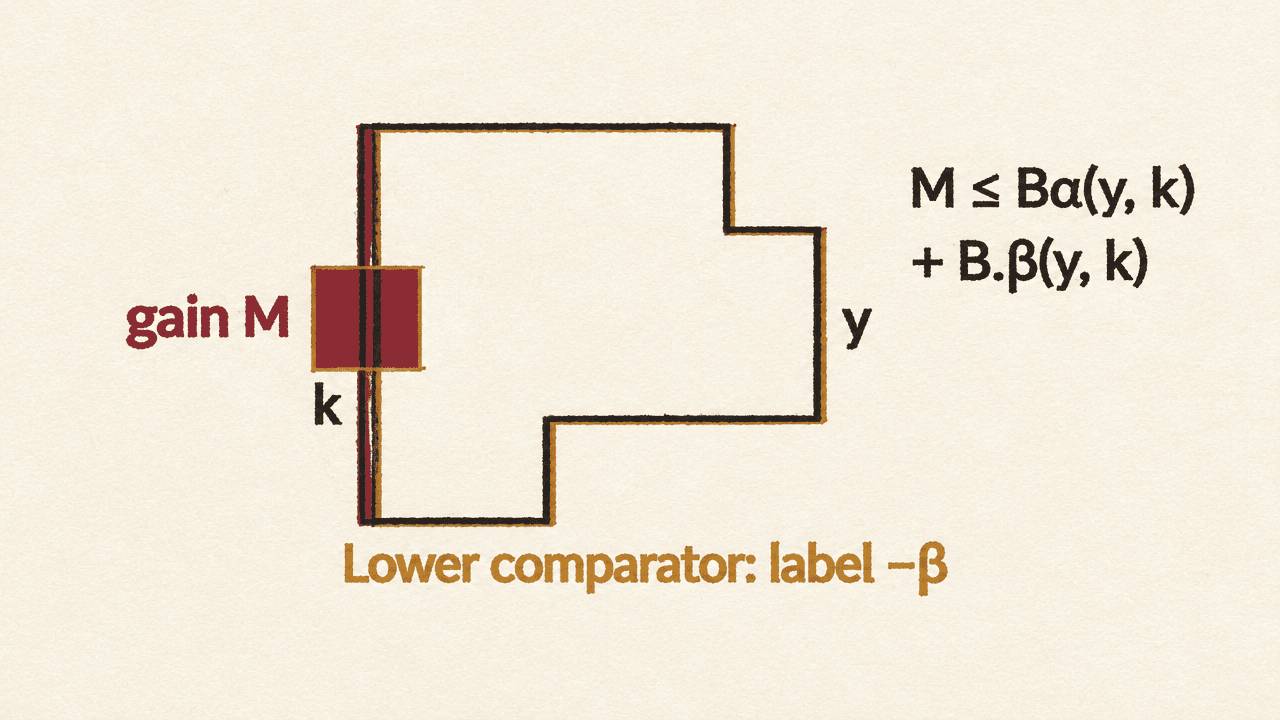
The key bound is that the probability (q) of a mark cannot be too large: (M q \leq L W). To obtain it, divide the sector of labels into bins. Under suitable confinement and separation conditions, rays at the endpoints of a bin provide a bypass around a marked path. Because the path is geodesic, the extra cost is bounded by Busemann increments—limits of differences in travel time to increasingly distant points along a ray.
Those limits exist because the travel-time difference from a fixed point to a distant ray vertex decreases as the vertex moves farther along the ray, while the triangle inequality bounds it below. Taking such limits for two starting points gives their Busemann difference; these differences add across intermediate points. That additivity lets the bypass costs telescope across consecutive marks. At large scale, only the bin’s label width remains; summing across bins gives the bound. The marks do not need to be independent.
The inequality makes the proof’s tension explicit. If (L) and (W) stay fixed, a large (M) forces (q) to be small. To get a contradiction, the construction must make the extra cost (M) arbitrarily large while keeping a positive lower bound on the marking probability.
Small changes to the environment create large costs
The manuscript raises selected low edge weights inside a finite region that widens with distance. At height (h), the probability scale for a replacement is (\eta/((h+2)\log(h+2))). There are order (h) eligible edges at that height. The sum of (h) times the squared scales converges, controlling the change in probability law; the sum of the scales diverges, allowing arbitrarily large extra cost over sufficiently long finite prefixes.
A complication is that the path being tested is chosen from the modified environment. It is not fixed before the edge changes. The argument conditions on the entire selected path; once that output is fixed, the hidden raises along it have a product law. The resulting calculation preserves a positive probability of marking as (M) increases.
The path modifications must also distinguish labels. The construction uses the same raised samples at every site, and an edge in overlapping modification regions is raised only once. If two selected paths had the same label, their shared Busemann information would give a detour with arbitrarily small excess cost. That detour crosses an edge raised near the other site but outside the first site’s region. In the first site’s individual metric, it becomes strictly cheaper while the selected path’s cost is unchanged—contradicting geodesic optimality. Thus distinct marked sites have distinct labels. A fixed near radius makes the required spacing independent of (M).
Separation makes the lower bound survive refinement
Distinct labels at marked sites are not enough by themselves: the proof must handle random labels, not only labels fixed in advance. The manuscript’s technical separation argument starts from planar ordering, which makes exceptional labels countable within each environment. It then resamples complementary half-planes independently, transferring rays while preserving their labels and finite portions that certify the relevant geodesic properties. This forces rays associated with an exceptional label to coalesce at the opposite end. A finite tree count and a one-edge budget rule out forks. The stated consequence is that two bigeodesics with the same upper label share both Busemann functions simultaneously, even when the label is random. This is not a claim that every one-sided family coalesces at every random label.
Now fix (M). Each site has only finitely many neighbors within the comparison distance. Since nearby marked sites have distinct labels, sufficiently fine bins separate those conflicts; the probability lost by filtering them tends to zero. After confinement and refinement, the marking probability remains at least (p/8), where (p) is the fixed positive probability of a bigeodesic through the origin in the chosen sector with fixed cone bounds.
The budget gives (q \leq LW/M), while the refined construction gives (q \geq p/8). The quantities (p), (L), and (W) stay fixed, so choosing (M) large enough makes the bounds incompatible. The argument does not need a rate for how quickly labels separate as bins are refined.