Subcritical FK and Spanning-Tree Maps Converge to the Liouville Quantum Gravity Sphere
An OpenAI preprint argues that two ensembles of decorated random planar maps converge, after deterministic distance rescaling, to the unit-area Liouville quantum gravity sphere: maps sampled with an FK configuration for \(0<q<4\), whose associated LQG parameter \(\gamma\) is below 2, and maps sampled uniformly as map–spanning-tree pairs. The claim uses shortest-path distance across all map edges, not only edges in the decoration, and carries the degree-weighted measure into the limit. The authors say proving this joint metric-and-measure convergence requires separate strategies for the two ensembles.
The limit concerns every edge, not the decoration
A spanning tree can make two vertices farther apart than the full map does. In the four-vertex example, the tree route from A to D takes three edges, while the full map has a direct one-edge route. That difference sets the paper’s central choice: the metric is shortest-path distance using all primal edges, not just the edges in the decoration used to sample the map.
The manuscript considers two random planar-map laws. A planar map here is a connected graph embedded in the oriented sphere; loops and parallel edges are allowed, and a root is a distinguished oriented edge. In the Fortuin–Kasteleyn (FK) ensemble, a map and a subset of its edges are sampled together, with weight proportional to q raised to the power ℓ/2, where ℓ counts interfaces between primal and dual FK components. The parameter q is fixed strictly between zero and four. The FK model is critical; “subcritical” refers to the Liouville quantum gravity parameter γ being less than 2.
In the other ensemble, a map and one of its spanning trees are chosen uniformly among such pairs. A map with more spanning trees consequently receives more weight. In both cases, the decoration changes the probability law on maps, but not which edges may be used to measure distance.
The measure is also part of the claim. For an n-edge map, mass is assigned by choosing a corner uniformly. There are 2n corners, and a vertex of degree d touches d of them; a loop contributes twice. Thus the mass at a vertex v is deg(v)/(2n), rather than a uniform share per vertex. In the five-edge example, the four vertices have degrees three, two, three, and two, giving masses 3/10, 2/10, 3/10, and 2/10. These sum to one. This degree-weighted corner measure is the discrete area measure carried into the limit.
The theorem keeps distance and area together
The manuscript’s Theorem 1.1 says that, for either ensemble, there are positive deterministic scale factors tending to zero such that the rescaled graph distances, together with the degree measure, converge in law to the ordinary unit-area Liouville quantum gravity sphere.† The convergence is in the Gromov–Hausdorff–Prokhorov sense: it compares the metric spaces and their probability measures, rather than depending on a chosen drawing of a map.
The target is not a round sphere equipped with its usual surface distance. It is a random metric space with a random quantum area measure. For FK maps, the displayed relation between the parameters is q = 2 + 2 cos(πγ²/2), with √2 < γ < 2. For the spanning-tree ensemble, γ = √2. The root and decoration are forgotten in the limit, and the claimed convergence runs through every positive integer edge count.
The theorem does not cover the FK endpoint q = 4, uniform vertex measure, a convergence rate, or an explicit power law for the normalization. The tree case is a separate proof, not obtained by taking an FK limit as q tends to zero.
Sampled distances cannot certify that no point is missing
Convergence of distances among typical sampled points is not enough to establish convergence of the whole space. An exact warning example uses the unit interval: put mass 1 − ε at the left endpoint and spread the remaining mass ε uniformly across the interval. For five independent samples, the probability that all five land at the endpoint is (1 − ε)⁵. As ε decreases, their distance table is increasingly likely to show only a single point—even though the far tip remains one unit away. This example concerns general metric probability spaces, not either map ensemble.
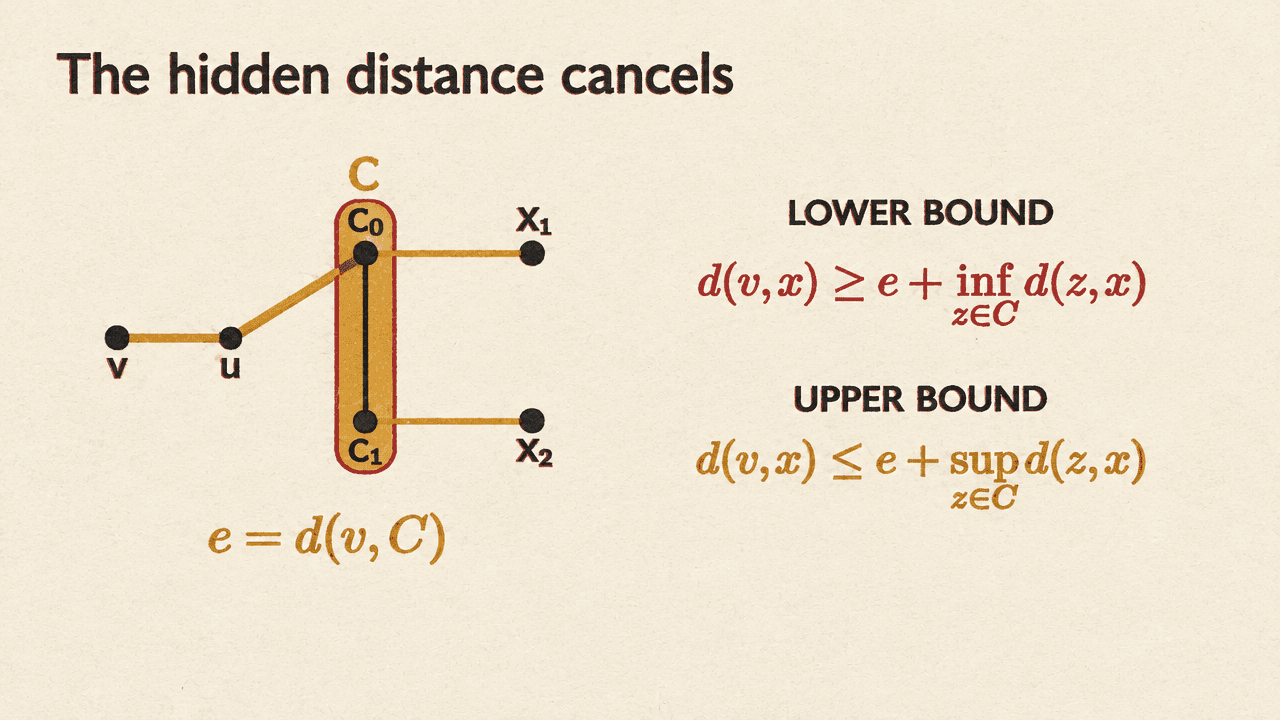
The manuscript therefore needs a covering argument: as the number of sampled corners grows, every vertex must eventually lie within a small metric radius of a sample. One local ingredient explains how samples can constrain a vertex hidden behind a separator. If a set C meets every path from v to each sample xᵢ, and all points of C are within t of a reference distance aᵢ to xᵢ, then the distance from v to xᵢ has the form e + aᵢ + εᵢ, where e is the distance from v to C and |εᵢ| ≤ t. Subtracting the corresponding relation for a reference sample cancels e: the difference of distances to the two samples is within 2t of aᵢ − a₁. The hidden distance need not be bounded. This cancellation is a local step used by the covering proof, not the covering proof itself.
Two roots rule out an escaping vertex
The FK covering argument uses two independent uniform corner roots of the same map and one shared sequence of sampled corners. If a vertex could escape every finite sample net, it would have to hide near the missing root in both limiting descriptions. Small separating bands, together with the cancellation argument, force the two root points to have the same distance differences to every sample. Because the samples are dense, their distance functions would then differ by a constant everywhere.
That is impossible unless the roots coincide. If their distance is D, the difference of their distance functions is −D at one root and D at the other. A constant function requires D = 0. But the limiting roots are independent quantum-area points, whose mutual distance is positive almost surely. This contradiction closes the loophole: no vertex can remain hidden outside all finite sample nets.
The metric proof requires more than contour convergence
The manuscript presents the remaining proof as a technical roadmap, not a reproduced global proof. Earlier work identifies contour encodings with quantum surfaces; matching the graph’s intrinsic distances to the Liouville metric requires additional arguments. The manuscript reconstructs local path information, proves conditional passage laws, and uses local field changes in a rigidity argument to rule out unequal optimal comparison constants.
The two ensembles then require different controls. For FK maps, the roadmap includes surrounding circuits, multiscale estimates for arbitrary endpoints, and the two-root covering argument. For spanning-tree maps, it includes independent increment arguments, moment bounds, and control at both contour endpoints. The tree case is not proved by sending q to zero.
A normalization based on the unconditional distribution of the log-diameter removes a deterministic subsequential multiplier. It supplies one ruler for the ensemble, rather than rescaling each random map by its own diameter.
The measure and the points both survive the limit
The claim is a joint limit: all-edge graph distance and degree-weighted mass converge together, with the two map ensembles requiring distinct proof strategies. The covering argument addresses a specific risk in that claim: sampled points might give a convincing picture of the metric while missing a part of the space. The conclusion is stronger than agreement among typical distances; the limiting surface must retain its area measure and leave no point outside the reach of increasingly dense samples.