Subcritical FK Maps Converge Jointly in a Canonical Quantum-Sphere Coordinate
An OpenAI manuscript on subcritical FK planar maps claims that their conformal embeddings converge jointly: area, rescaled graph distances and nested cluster-boundary loops all approach continuum objects in one prescribed coordinate on a random quantum sphere. The authors’ emphasis is that the limit identifies not only an abstract surface and its geometry, but also where those objects sit in the conformal drawing, with the loops retaining their order and nesting.
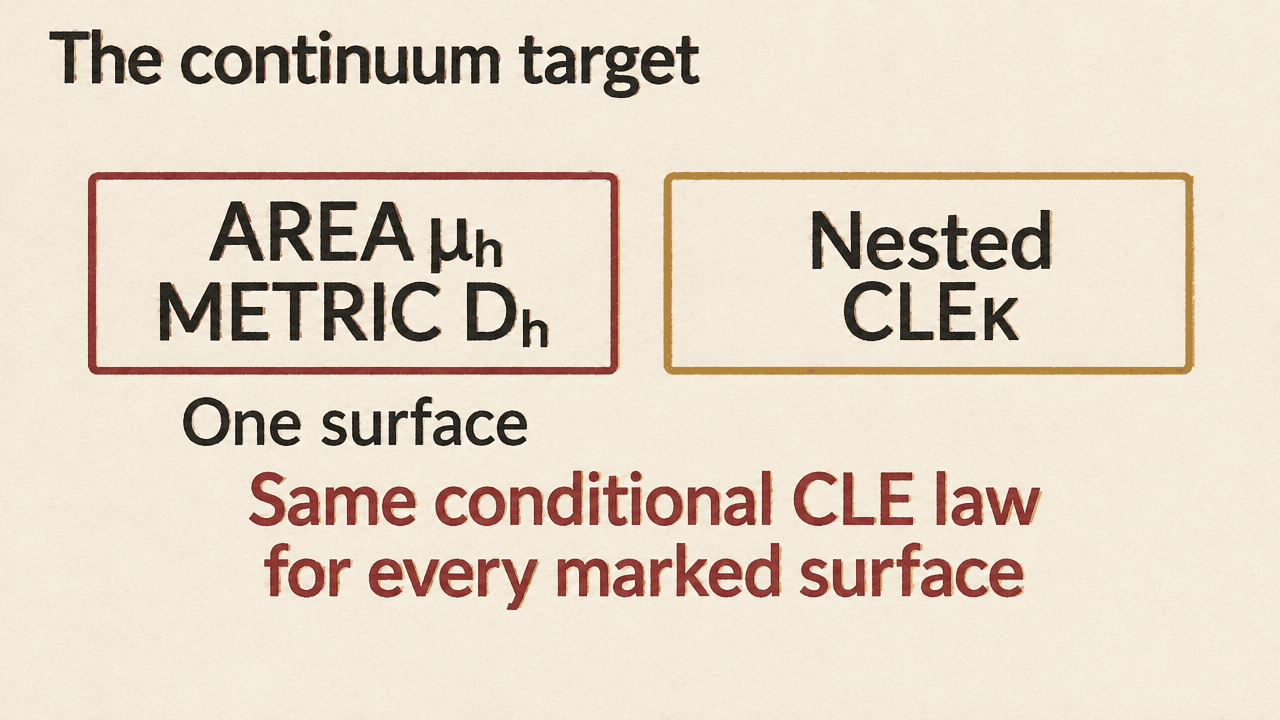
The limit is pinned to one coordinate, not just one abstract surface
The manuscript’s central claim is joint convergence in a prescribed conformal coordinate: area, rescaled graph distances, and the nested loops separating random clusters all converge together to objects on the same random quantum sphere.†
That coordinate matters. Two drawings can represent the same abstract graph and preserve all graph distances while placing vertices very differently. An abstract limit can therefore identify the shape of a large random map without specifying where its vertices sit in a particular drawing. The manuscript aims to identify both the limiting geometry and its placement in a canonical coordinate.
The target is the ordinary unit-area Liouville quantum gravity sphere, with its area measure and intrinsic metric. “Quantum sphere” refers to random geometry, not a physical sphere in three-dimensional space. The limiting loops are a whole-plane nested conformal loop ensemble, or CLE, on that sphere. The claimed independence is conditional: given the normalized quantum surface, the CLE has the same law. Area and distance, by contrast, belong to that same random surface.
For a fixed q strictly between 0 and 4, the manuscript relates the model parameters by and , with . Thus κ lies between 4 and 8. At q = 2, for example, γ² = 3 and κ = 16/3. The title’s “subcritical” describes the quantum-gravity parameter γ < 2; the FK model itself is at its self-dual critical point.
Interfaces are boundaries of clusters, not graph edges
The discrete object begins with a connected graph embedded on the sphere, with n edges and a distinguished oriented root edge. Loops and repeated edges are allowed. A set of edges is marked occupied, and its cluster boundaries form the Fortuin–Kasteleyn interfaces, or FK loops. These boundaries should not be confused with the original edges: an interface is a loop around clusters, not necessarily an edge of the graph. A decorated map receives weight q raised to half the number of interfaces.
Graph distance uses every original edge, whether occupied or not. The manuscript’s distance limit is therefore not a distance measured only within occupied clusters.
To put the map in a conformal coordinate, the construction breaks each edge into four flags: two endpoint occurrences, each with two side occurrences. Each flag becomes an equilateral triangle whose corners are labeled by a vertex, an edge midpoint, and a face center. The triangles are glued according to the incidences of the map. Loops and bridges still contribute all four flags. Each triangle has area 1/(4n), giving a discrete surface on which a conformal uniformization can be defined.
The coordinate is fixed by sampling three fresh, independent points from area and sending them to 0, 1, and infinity through the orientation-preserving uniformization. These are not selected graph vertices or marks inherited from an exploration. Using fresh area samples is part of the normalization.
A local count links flag area to vertex mass
One useful bridge between the triangular construction and the map’s vertices is an exact counting identity. Project the area of every flag triangle onto its primal vertex. A vertex of degree d has d incident edge ends, and each end has two sides, so 2d flags project to it. Out of 4n total flags, its mass is therefore
A self-loop contributes two edge ends at its vertex and counts twice toward degree. In the three-edge illustration, vertices A, B, and C have degrees 1, 4, and 1, so their projected masses are 1/6, 2/3, and 1/6. Equal-area flags do not imply equal vertex masses.
| Vertex | Degree | Flag occurrences | Projected mass |
|---|---|---|---|
| A | 1 | 2 | 1/6 |
| B | 4 | 8 | 2/3 |
| C | 1 | 2 | 1/6 |
The same construction gives a conditional coupling argument. If the largest flag image in the prescribed coordinate has diameter εₙ and εₙ tends to zero, a uniform area point can be paired with the vertex of its own flag, with the two images at distance at most εₙ. For any continuous function on the compact sphere, the difference between its averages under these two measures is bounded by the function’s largest variation over distances of at most εₙ. That variation tends to zero. The measures consequently have the same weak limits.
The counting identity and this coupling are exact. The coupling establishes matching weak limits provided the flag images shrink; proving globally that every flag shrinks in the prescribed coordinate is a much harder step, not established by this local argument.
The metric claim covers every vertex pair
For distances, the theorem considers the positions of both endpoints together with their rescaled graph distance, for every pair of vertices. It claims convergence in distribution of this entire distance graph to the graph of the quantum metric. On a coupling where the distance graphs converge, vertices whose positions approach two limiting locations have rescaled distance approaching the quantum distance between those locations.
This includes atypical vertices: high-degree vertices and vertices near the exploration root are not set aside. The scale factor aₙ(q) is deterministic, depends on q, is positive, and tends to zero. The manuscript gives no explicit formula for it. It imports an abstract intrinsic-metric limit from a companion manuscript; its additional task is to pin that metric to the canonical coordinate, rather than establish only an abstractly isometric sphere.
Loop convergence preserves order, multiplicity, and nesting
For loops, matching only their visible traces would discard information. The comparison allows a change of speed and even reversal of direction around a loop, but retains cyclic traversal order. At accuracy ε, every loop with diameter greater than ε on either side must have a partner within ε. Only loops of diameter at most ε may remain unmatched. This criterion retains multiplicities and all levels of nesting, not merely the outermost boundaries.
The manuscript’s loop argument tracks an encoded chord system and uses exploration and winding tests to rule out missing portions. The proof roadmap ties this branch to the same coupling as the area and metric claims: contour encoding places discrete and continuum objects on one topological sphere; protected local records retain every exploration visit; conditional local laws and annular estimates support the geometric comparisons. The conformal branch controls distortion and identifies area, the loop branch identifies the ordered nested collection, and the metric branch compares local passage costs before using the companion intrinsic limit to reach every vertex and fix the scale.
That shared coupling is essential. Separate convergence results for area, loops, and distances would not by themselves establish that all three limits are compatible in one coordinate with the same fresh area marks.
The result is stated for each fixed q in (0, 4), through every positive integer map size. It provides no endpoint theorem, convergence rate, or explicit distance scale. Finite checks of the examples verify the illustrated counting and geometry; they do not prove the general convergence theorem.