Tree-Weighted Planar-Map Walks Converge After Exactly n-Fold Acceleration
An OpenAI preprint on random walks on tree-weighted planar maps identifies an exact clock: on a map with \(n\) edges, accelerating the rate-one walk by \(n\) yields convergence to stationary Liouville Brownian motion on the limiting sphere, with no additional time constant. The paper argues that this factor follows from an exact energy identity, then establishes that the maps preserve the limiting energy and that their area measures give the walk the correct speed.
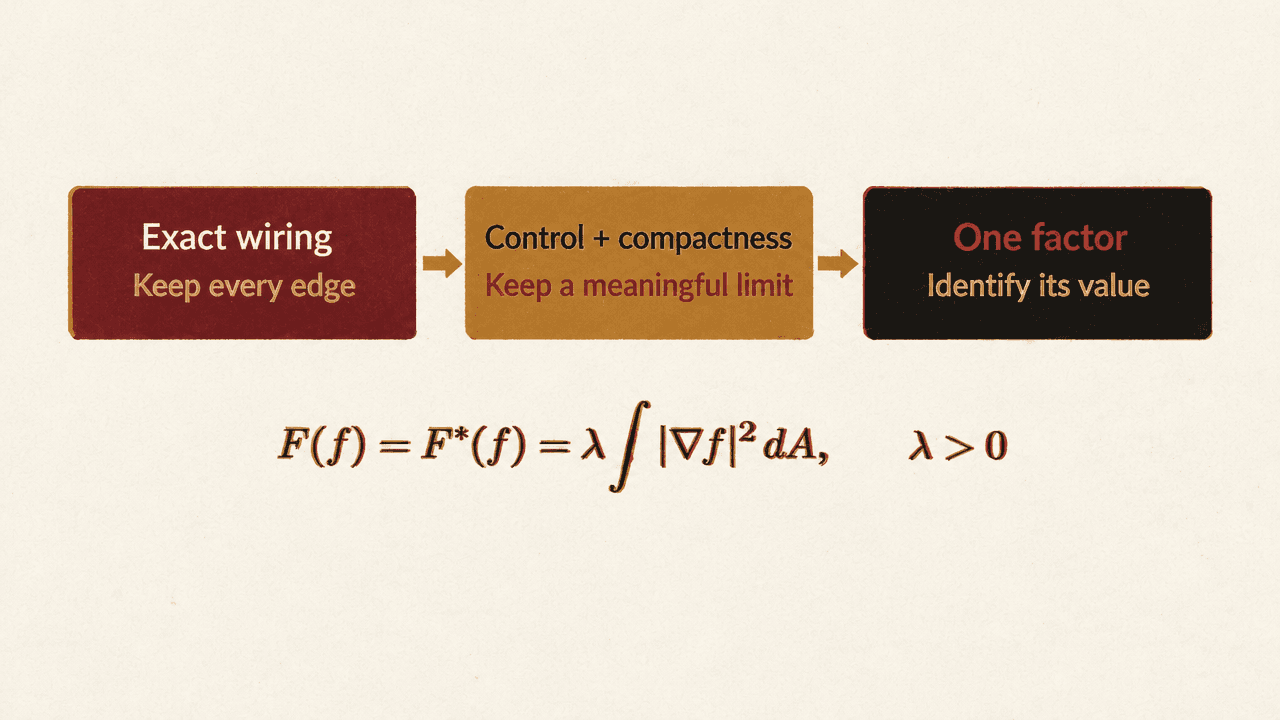
The map’s edge count supplies the clock
For a tree-weighted planar map with (n) edges, the walk must be accelerated by exactly (n) to converge to stationary Liouville Brownian motion on the limiting sphere. The claim is precise about the conventions: there is no additional unknown clock constant. But deriving that factor is only one part of the proof; the argument also has to show that the discrete maps preserve the right energy and that the limiting walk has the right speed measure.
A planar map here is a finite connected graph drawn on a sphere, rooted at one oriented edge. Loops and parallel edges are allowed. To sample a map with a fixed number of edges, choose uniformly from pairs consisting of a rooted map and one of its spanning trees, then forget the tree. A map with more spanning trees is therefore more likely: in the source’s three-edge examples, a triangle has three spanning trees and a path has one. The selected tree determines the map’s weight, but the particle may traverse every edge of the map.
The discrete walk runs on a rate-one Poisson clock. At each attempt, it chooses uniformly among the half-edges incident to its current vertex. Choosing a loop leaves it in place, but still counts as an attempt. Its stationary measure assigns vertex (v) mass (\mu_n(v)=\deg(v)/(2n)), with loops counted twice in the degree. For each oriented non-loop edge, stationary mass times the probability of choosing that half-edge is (1/(2n)); the reverse flow is equal.
The continuum target is the unit-area Liouville quantum sphere with parameter (\sqrt2). Its quantum area measure (\mu_h) serves as the Brownian motion’s speed measure, while its random metric gives distances. A companion result supplies the limiting metric and area, using a deterministic distance normalization (a_n), fixed from diameter laws. The paper adds motion on that same surface, with energy given by one half of the conformal gradient integral and speed measure given by quantum area.
The factor \(n\) follows from exact edge accounting
Give every vertex a value (f(v)). The network energy sums ((f(v)-f(w))^2) over all unoriented edges. Parallel edges count separately; loops contribute zero. In the source’s example, two parallel edges contribute one each, two other edges contribute four and one, and a loop contributes zero, for total energy seven.
That edge-by-edge accounting explains the clock. The generator (L_n) gives the instantaneous expected change in (f): at each vertex it averages endpoint differences over incident half-edges. Speeding time up by (n) changes the generator to (nL_n). In the negative stationary average of (f) times this accelerated generator, the stationary weight (\deg(v)/(2n)) cancels the degree in the generator’s denominator, while the acceleration cancels (n). Each unoriented ordinary edge then contributes one half of the squared difference between its endpoint values. Summed over edges, the result is exactly half the network energy.
This is an exact identity for every map under the stated conventions—not an asymptotic estimate. It also explains why no extra holding-time correction is needed: attempts, including those that select loops, are part of the clock.
Preserving distances is not enough
The energy identity alone does not establish convergence. A graph can keep all its distances while changing its energy: removing one of the example’s parallel edges leaves distances unchanged but lowers the energy from seven to six. The proof therefore has to preserve wiring, not merely the map’s large-scale shape.
The argument uses two contour coordinates to recover that wiring, then relies on non-degeneration and compactness estimates to obtain a meaningful limit. Locality and symmetry reduce the limiting energy to a shared positive factor (\lambda), for both the graph and its dual, whose vertices represent faces. The proof needs matching bounds: a lower bound that rules out approximations with energy that is too cheap, and recovery sequences that attain the proposed energy. This is a variational convergence claim, not a guarantee about arbitrary discretizations.
An annulus test identifies the remaining factor. The source presents it as a schematic ring: hold the inner boundary at zero potential and the outer boundary at one, then compare the discrete condenser energy with the continuum minimum. This gives (\lambda\leq 1). For the reverse bound, construct a dual field with period exactly one at each finite stage. Its pairing with the original current has absolute value one; Cauchy–Schwarz then yields (\lambda\geq 1). Together, the bounds force (\lambda=1). The exact period construction and compactness proof are not supplied in the explainer; the diagram does not assume that discrete faces form a regular mesh.
Tree cuts connect energy to motion
Even with the limiting energy identified, the proof must control how area sets the walk’s speed. It does so with a Green-function estimate. Start with vertex values bounded by one and having stationary mean zero. The graph Laplacian turns this source into a potential; in the equation, the source is weighted by stationary mass.
The estimate bounds the largest potential value by a power of the source’s average absolute size, multiplied by a random factor. The exponent (\rho) lies strictly between zero and one half. The multiplier has uniformly bounded expectation across map sizes; it is not a single deterministic bound that holds for every map.
Spanning trees make the estimate tractable. An exact formula expresses potential contributions through tree cuts, whose sizes are one plus distances in the complementary dual tree. Contour estimates control the resulting average. Combined with energy convergence, this Green-function control bounds time-integrated responses and short-time movement, bridging the exact clock calculation and convergence of the path law.
The limit retains the environment and the walk
For each fixed finite horizon, the theorem gives convergence in distribution, through all positive integer map sizes, of the map, its rescaled metric and area measure, and the conditional law of the walk given the map and its selected tree. The limit is the sphere, its metric and area measure, and the conditional law of stationary Liouville Brownian motion given the surface.
The result also preserves the joint behavior of finitely many conditionally independent stationary walkers in the same environment. It is therefore more specific than saying that a random walk becomes Brownian: the tree-weighted ensemble, stationary half-edge dynamics, continuum normalization, and acceleration by exactly (n) converge together.