A Quadratic Bound Guarantees Surjectivity of the Foulkes–Howe Map
An OpenAI preprint proves that the canonical Foulkes–Howe map from Symᵇ(Symᵃ V) to Symᵃ(Symᵇ V) is surjective over finite-dimensional complex vector spaces whenever a ≥ 2 and b ≥ a(a − 1). The bound is sufficient, not asserted to be sharp. The proof rules out any nonzero linear functional that vanishes on the map’s image, using a derivative argument whose injectivity depends on a strict degree inequality.
The theorem is about one map, not just two matching spaces
The canonical Foulkes–Howe map, from Symᵇ(Symᵃ V) to Symᵃ(Symᵇ V), is surjective over every finite-dimensional complex vector space V when a ≥ 2 and b ≥ a(a − 1), according to the manuscript discussed here. The bound is sufficient, not claimed to be sharp: smaller values may also work. When a = 3, it guarantees surjectivity for b ≥ 6; when a = 6, for b ≥ 30. For a = 1, the map is the identity.
Both sides have total degree ab, but group the factors differently: the source has b symmetric groups of a vectors each, while the target has a groups of b. The canonical map averages over possible regroupings before multiplying within the new groups. A single regrouping is only one term of that average.
The claim is not merely that the source and target have comparable dimensions or that some embedding between related spaces exists. It is that this particular linear map reaches every vector in its target. The proof turns that question into a test for whether any linear functional can vanish on the entire image.
Surjectivity becomes an annihilator test
The image is spanned by a-fold tensor powers of products P, where each P is a product of b vectors. Repeated vectors and zero vectors are allowed. A linear functional vanishing on the image defines a symmetric multilinear form T with a slots. Its defining condition is T(P, …, P) = 0 for every such product P.
In finite dimensions, the map is onto exactly when every form satisfying this condition is zero. That shifts the burden of proof: rather than construct preimages for all target vectors, show that no nonzero test T can miss the image.
The manuscript’s argument uses a derivative operator to propagate known zeros. For independent coordinate blocks U and Y, define D = Σₖ Yₖ ∂/∂Uₖ. Each application lowers the degree in U by one and raises the degree in Y by one. The key lemma says that if a polynomial has degrees p in U and q in Y, with p > q, then D is injective on that polynomial: if its derivative is zero, the polynomial itself must be zero. Other independent variables may be present.
A norm identity makes the derivative reversible
The injectivity claim follows from a positive inner product on polynomials. Distinct monomials are orthogonal, and a monomial with exponent list α has squared length ∏ₖ αₖ!. Under this inner product, differentiation is adjoint to multiplication. The adjoint of D is therefore the reverse operator E, which moves degree from Y back to U.
A direct calculation gives (ED − DE)h = (p − q)h for a polynomial h of the stated degrees. Taking the inner product yields ‖Dh‖² − ‖Eh‖² = (p − q)‖h‖². If Dh = 0, the left side is nonpositive. But if p > q and h is nonzero, the right side is positive. So h must be zero.
The strict inequality is essential. When p = q = 1, the nonzero polynomial U₁Y₂ − U₂Y₁ has derivative zero. The proof can therefore work backward from a zero only while the source degree remains strictly greater than the destination degree.
The quadratic bound pays for one shared destination
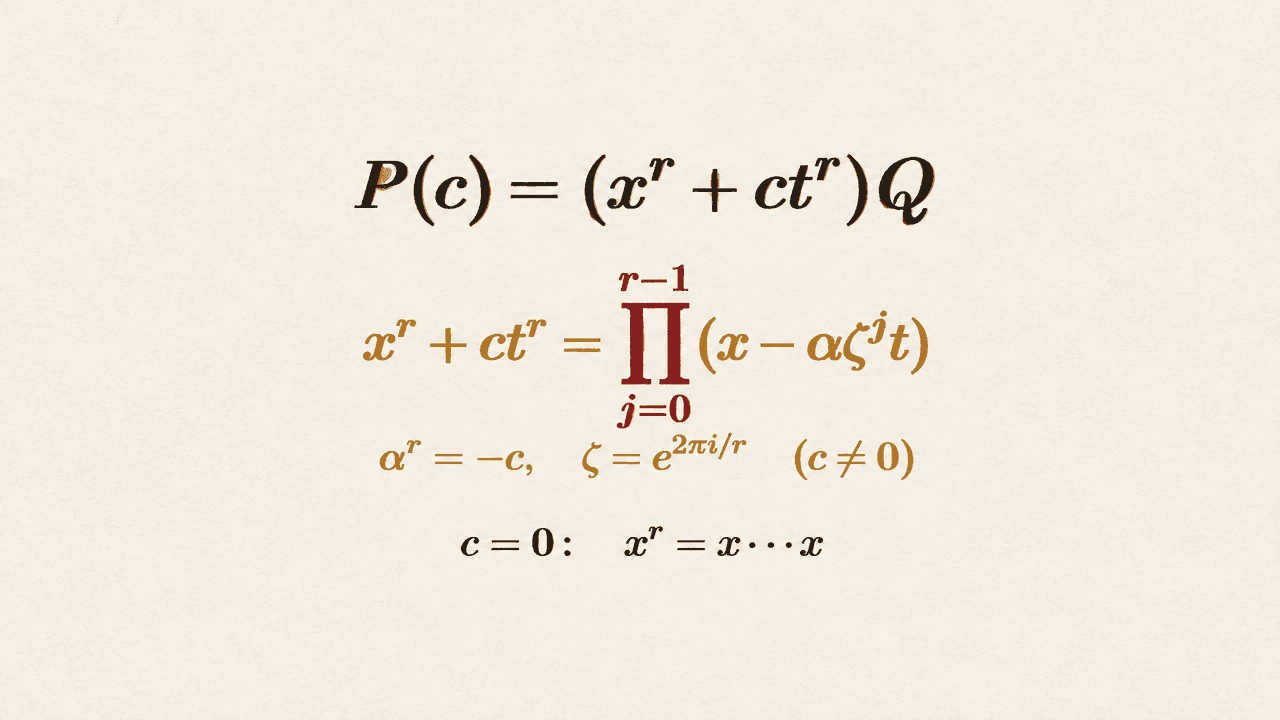
Set r = a − 1 and m = b − r. The bound b ≥ a(a − 1) ensures m ≥ r². Choose a product Q of m vectors. Over the complex numbers, xʳ + ctʳ factors into r linear factors for every scalar c. Thus P(c) = (xʳ + ctʳ)Q is a product of b vectors, so T(P(c), …, P(c)) = 0. Extracting the coefficient of c gives a zero involving r copies of xʳQ and one copy of tʳQ.
The next step frees the factors in that last slot. Replace it with tᵇ, then differentiate toward the factors of Q one at a time. The derivative lemma lets the proof infer that the expression before each differentiation was already zero: the degree in t is strictly greater than the degree in the destination variable. Induction on the number of slots then lets the r copies of Q vary independently, although they still share the factor xʳ.
That shared factor is where the quadratic budget is spent. Begin with independently chosen pure powers of degree b in the remaining r slots, and insert r copies of x into each slot by differentiation. There are r slots and r derivatives per slot: r² derivatives in all, every one feeding the same destination x. Its degree accumulates across the operations. Before any step, that degree is at most r² − 1, while the source degree is at least b − r + 1, hence at least r² + 1. The strict gap keeps every derivative injective. Since the final expression is zero, the original expression must be zero too.
For a = 3 and b = 6, r = 2. The displayed bookkeeping gives source degrees 6, 5, 6, 5 and shared-destination degrees 0, 1, 2, 3. This illustrates the general inequalities; it is not a substitute for them. Finally, pure powers span a symmetric power by polarization. Multilinearity then forces T to vanish on every input, and the annihilator test gives surjectivity.
The bound is universal, but not asserted to be sharp
The degree comparisons do not depend on the dimension of V, which is why the stated bound applies in every finite dimension over the complex numbers. The manuscript also states that the surjection splits equivariantly, yielding an embedding in the opposite direction. The existence of an embedding is distinct from surjectivity of the specified canonical map.
The result is a sufficient quadratic threshold, not a claim of sharpness. The explainer proves the derivative lemma and presents the full induction as a roadmap, with technical steps omitted. It therefore explains the argument’s mechanism without supplying every detail needed to reconstruct the induction. The source visual identifies the manuscript as the OpenAI preprint Quadratic Stabilization of the Canonical Foulkes–Howe Map and states that formal reproduction was not run; that is a statement about the explainer’s reproduction status, not a claim that the theorem itself was unaudited.†