A Trace Theorem Proves the Characteristic-Zero Idempotent Conjecture for Torsion-Free Groups
An OpenAI manuscript dated September 24, 2026, proves that the Hattori–Stallings trace of an idempotent over a complex group ring vanishes on every conjugacy class of infinite-order elements. The result does not eliminate contributions from finite-order classes, but for torsion-free groups it leaves only the identity class; the authors use that trace constraint to conclude that, over a commutative characteristic-zero domain, every scalar group-ring idempotent is zero or one. The argument does not settle the corresponding questions in positive characteristic or for idempotent matrices.
The trace theorem rules out infinite-order classes, not finite-order ones
An idempotent satisfies e² = e: applying the operation twice changes nothing. In a group ring, elements are finite sums of group elements with numerical coefficients, and multiplication combines the group operation with multiplication of coefficients. The question is whether such a ring can contain an idempotent other than zero or one.
The September 24, 2026 OpenAI manuscript approaches that question through the Hattori–Stallings trace. A finitely generated projective module can be represented by an idempotent matrix over the group ring. Rather than reduce the diagonal entries to a single number, the trace adds their coefficients class by class: elements related by conjugation, g ~ h⁻¹gh, contribute to the same slot. The manuscript’s theorem says that for a complex group ring, every slot associated with an infinite-order element vanishes, for every discrete group.†
Slots for finite-order classes may remain. This is a statement about the sum of coefficients within a conjugacy class—not about every individual coefficient vanishing. The result also extends to the algebraic K₀ group by subtracting projective classes.
Finite-order classes matter. In the two-element group, let s² = 1 with s ≠ 1. Then e = (1 + s)/2 is idempotent: squaring gives (1 + 2s + s²)/4 = (1 + s)/2. Its trace has coefficient 1/2 at the identity and 1/2 at s. This example checks the calculation; it is not a proof of the general theorem.
Torsion-freeness turns the trace into a scalar endpoint
In a torsion-free group, the identity is the only finite-order element. The theorem therefore leaves only the identity-class slot.
Two maps on the group ring must be kept distinct. The canonical trace τ_G takes the coefficient of the identity; the augmentation ε_G adds all coefficients. For an idempotent matrix e, all nonidentity class sums vanish, so the canonical matrix trace equals the augmentation of the sum of the diagonal entries. Augmentation preserves multiplication: ε(e)² = ε(e²) = ε(e). Applied entrywise, it turns e into an ordinary idempotent complex matrix.
An ordinary idempotent matrix acts as the identity on its image and as zero on its kernel. Its trace is therefore the dimension of its image, an integer. For a one-by-one matrix, the rank can only be zero or one, so the canonical trace of a scalar group-ring idempotent is either 0 or 1.
That numerical conclusion still does not identify the group-ring element. The manuscript supplies a bridge through the group von Neumann algebra: the idempotent is similar to a self-adjoint projection p with the same canonical trace. The trace is faithful on positive operators, so trace zero forces a projection to be zero. If the trace is one, the complementary projection 1 − p has trace zero, so p = 1. Similarity carries either conclusion back to the original idempotent.
The argument is stated for a commutative, unital, characteristic-zero domain R, not just for coefficients already in ℂ. The finitely many coefficients of an idempotent generate a subring R₀; its fraction field embeds in ℂ, and the induced map R₀G → ℂG is injective. Thus the complex-ring conclusion returns to the original element. The whole coefficient domain need not embed in ℂ.
A coefficient identity makes the vanishing exact
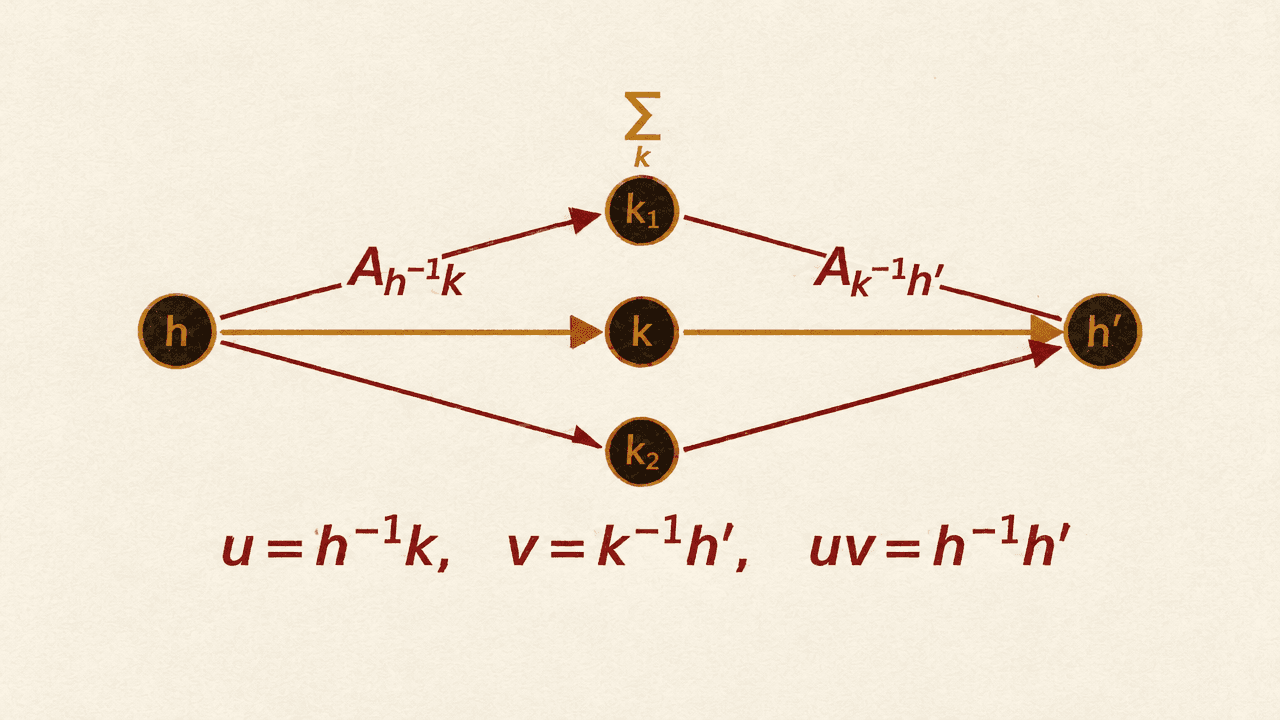
To explain why an infinite-order trace slot vanishes, fix an infinite-order element g and call its Hattori–Stallings trace coefficient λ. Write the finite-support idempotent as e = ∑ₛ Aₛs, where the Aₛ are matrices. Comparing coefficients in e² = e gives ∑ᵤᵥ₌ₜ AᵤAᵥ = Aₜ.
The manuscript interprets this identity through paths: treat A_{h⁻¹k} as the weight of a step from h to k. Summing ordered products of two step weights over intermediate vertices gives the direct-step weight from h to h′. These are matrix weights, not probabilities. Identifying vertices that differ by left multiplication by a power of g closes relevant paths into cycles. Finite support gives the resulting graph a fixed degree bound.
The construction produces cycles in every positive even dimension 2m and an invariant cocycle that measures them. Using a Pfaffian—a signed sum of pairings—the cocycle’s exact value on the cycle is ψₘ(z₂ₘ) = 2⁻ᵐλ.
The geometric argument shows that these measurements vanish in sufficiently high dimension while the graph’s degree bound stays fixed. In outline, it cuts the supporting complex into bounded-diameter pieces; connected supports restrict the possible simplices, and volume choices and near-minimal separators make the final point count arbitrarily small. A chain-homotopy argument preserves the measurement while bounding it by that shrinking count. The explainer describes its diagrams as schematic and omits the equivariance, finite-support bounds and slicing proofs.
Choose one sufficiently large even dimension 2m. The same measurement is both zero and 2⁻ᵐλ. Since that factor is nonzero, λ = 0: the deduction is exact at a fixed dimension, not merely a limit in which the detector becomes small.
The construction first takes place in a finitely generated subgroup containing g and every group element in the idempotent’s support. Summing subgroup conjugacy-class coefficients gives the ambient conjugacy-class coefficient, extending the vanishing result to every discrete group.
The scalar conclusion has a defined scope
For a torsion-free group G and a commutative, unital, characteristic-zero domain R, the manuscript concludes that an idempotent element of RG is either 0 or 1. This does not apply to arbitrary idempotent matrices: the diagonal matrix with entries one and zero remains a nontrivial matrix idempotent. The argument also leaves open positive characteristic, rings with zero divisors, the zero-divisor conjecture and every projection in the reduced group C*-algebra.