The ℓ¹-Bass Conjecture Restricts Idempotent Traces to Finite-Order Classes
An OpenAI preprint claims that for an idempotent matrix over the complex ℓ¹ algebra of any discrete group, its Hattori–Stallings trace has only finitely many nonzero conjugacy-class coefficients, all on classes of finite-order elements. The proposed proof uses curvature estimates and a cutoff argument to force coefficients outside a finite set to vanish; the finite-support conclusion applies to the trace, not to the idempotent’s coefficients. The article notes that the global analytic proof was not certified.
The trace can be finite even when the idempotent is not
An infinite sequence can have infinitely many nonzero terms and still have a finite sum. The ℓ¹-Bass conjecture concerns a different kind of finiteness: for an idempotent matrix over the complex ℓ¹ algebra of a discrete group, the manuscript claims that its Hattori–Stallings trace has only finitely many nonzero conjugacy-class coefficients, all supported on classes of finite-order elements.†
The claim is about the trace, not the coefficients of the idempotent itself. Nor does “finite order” mean that a conjugacy class is finite. An element has finite order if some positive power is the identity; its conjugacy class may still have infinitely many members.
In the complex ℓ¹ algebra of a discrete group G, each group element has a complex coefficient, and the sum of the coefficients’ absolute values is finite. Multiplication is convolution: multiply pairs of group elements, then add the contributions that have the same product.
For a finite square matrix over this algebra, the Hattori–Stallings trace is formed by adding the diagonal entries and collecting their coefficients over each conjugacy class. The result assigns one trace coefficient to each class.
The cyclic group with three elements illustrates the claim without proving it. Let a³ = 1 and set p = (1 + a + a²)/3. For each output element, exactly three ordered pairs multiply to it. Each pair contributes 1/9, so convolution gives p*p = p. The group is commutative, so its conjugacy classes are singletons; the trace has three nonzero coefficients, each 1/3, on finite-order elements.
The reduction improves decay, not support
The proof strategy makes no countability, finite-generation, or growth assumption on G. It first reduces the problem to a more manageable representative. The original idempotent is approximated by a finite-support matrix, then the approximation is corrected using a convergent power series. The result is exactly idempotent and has an exponential moment inside a finitely generated subgroup.
This gives stronger decay, not finite support: the corrected idempotent may still have infinitely many nonzero coefficients. It is similar to the original matrix, and the class traces are preserved because the trace of a product over a conjugacy class equals that of the reversed product. On returning from the subgroup to the original group, some conjugacy classes may merge. That merging cannot turn a finite set of surviving classes into an infinite one.
Idempotency makes deleting a label preserve the weight
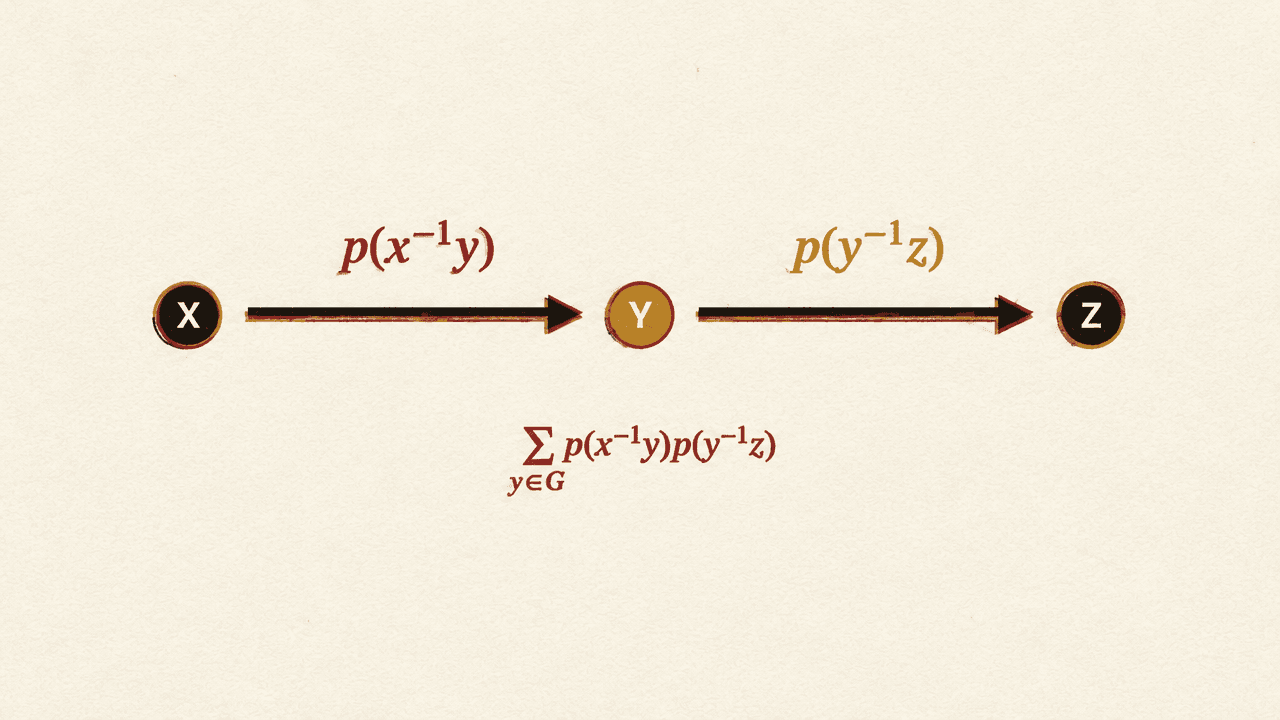
The local identity driving the construction comes directly from idempotency. Fix x and z, insert an intermediate label y, and associate the factors p(x⁻¹y) and p(y⁻¹z). Summing over all y, then setting w = x⁻¹y, gives:
∑_{w∈G} p(w)p(w⁻¹x⁻¹z) = (p*p)(x⁻¹z) = p(x⁻¹z)
Thus summing over the possible intermediate labels recovers the shorter path’s weight. The matrix factors remain in their given order.
The construction assembles such factors into twisted cyclic lists and takes their matrix trace. Their weights may be complex, not probabilities; absolute convergence justifies the sums. Assigning ordered times to the labels places them in a simplex. When an interval shrinks to zero, its label disappears, and the deletion identity makes the boundary weights agree.
That local identity supplies the boundary compatibility needed for the geometric construction; it does not itself force a trace coefficient to vanish. The curvature estimate is the bridge: it bounds the geometric average representing the coefficient, and for the classes the proof aims to exclude, the bound can be made arbitrarily small.
The broader strategy is to express a trace coefficient, up to sign, as a weighted geometric average of curvature terms. The connection is first defined with all time coordinates free to shift together; its exterior derivative descends to the simplex as curvature. In even dimension, a Pfaffian packages the top-degree contribution, and a cyclic Stokes argument identifies its weighted average with the trace coefficient, up to sign.
One cutoff reduces the surviving classes to a finite set
The curvature construction averages point masses associated with timed labels over progressively larger time windows. Smooth spatial summaries track concentration, with derivative control even when input coefficients vanish. Early stages enlarge the spatial radius; later stages keep it fixed. Telescoping concentration differences and a final equality kernel incorporating the closing twist help control the average. Three estimates are needed: sparsity of nearby times, bounds on short-range operators, and terminal singular values decreasing like 1/ν.
For an infinite-order element, and for a finite-order class lying entirely beyond the final cutoff, the construction first supplies a positive normalizer, bounded below by one tenth. This permits the connection to be normalized for those twists. The resulting estimate applies only to these excluded classes, not to every conjugacy class:
|τ_[g](p)| ≤ C_R M_p (Q_R M_p)^n
Here M_p is the finite weighted sum of coefficient sizes, including word length: M_p = ∑_w |p(w)|₁(1 + |w|). The source gives Q_R = C S^(3/2)R^(-1/10), with S = O(1 + log R), so Q_R tends to zero as the spatial parameter R grows. Choose R large enough that Q_R M_p < 1 and then hold it fixed. The factor C_R is fixed once R is chosen. As the even dimension n grows, the bound tends to zero, forcing the trace coefficient to vanish for those excluded classes.
The cutoff argument then turns vanishing into finiteness. The radius is chosen with reference to p, so the cutoff may depend on the idempotent. But that same choice works across all infinite-order elements and all finite-order classes avoiding one fixed word ball. The ball lies in a finitely generated subgroup and is finite. Every surviving class must meet it, so only finitely many classes can survive. There is no universal list of surviving classes for all idempotents.
The finite-support conclusion concerns the trace, and the restriction to finite-order classes is the manuscript’s theorem claim. The cyclic-group example and local identities illustrate parts of the argument, but do not establish the claim for arbitrary groups or idempotents. The source states that the example and local identities were checked separately; the global analytic proof was not certified, and formal reproduction was not run.