A Finite Lattice Cannot Be the Full Congruence Lattice of Any Finite Algebra
An OpenAI preprint claims that some finite lattice cannot be the full congruence lattice of any finite algebra, regardless of the algebra’s operations or signature. The authors reduce the problem, using a theorem of Pálfy and Pudlák, to finding a finite lattice that cannot occur as a full interval of subgroups in any finite group; they then construct such a lattice by combining local restrictions on subgroup intervals with a uniform bound on certain chains.
The obstruction is to a full representation, not an embedded lattice
The manuscript claims that there is a finite, nonempty lattice L that is not isomorphic to the congruence lattice of any finite, nonempty algebra A, whatever finite signature is chosen. The operations may vary; the signature may be empty and may include nullary operations. The claim is that no choice works.†
A congruence is an equivalence relation compatible with every operation: replacing an input by an equivalent one must leave the outputs equivalent. For addition modulo 4, grouping 0 with 2 and 1 with 3 respects addition because the parity of a sum depends only on the parities of its inputs. Grouping 0 with 1 does not: adding 1 to both gives 1 and 2, which are not equivalent under that grouping. For this algebra, exactly three partitions survive: equality, parity, and the universal relation. Ordered by inclusion, they form a three-element chain.
That example explains what congruences are; it is not the manuscript’s counterexample. Nor is it enough to find a lattice resembling the desired one somewhere inside a larger lattice. The representation problem asks for the full congruence lattice, with no additional congruences.
A global equivalence shifts the search to finite groups
The paper uses a theorem of Pálfy and Pudlák to translate the question. The universal claim that every finite lattice is the congruence lattice of some finite algebra is equivalent to the universal claim that every finite lattice is a full subgroup interval of some finite group.
In a subgroup interval [D, X], the elements are the subgroups between D and X; meet is intersection, and join is the subgroup generated by the two subgroups. The equivalence is global: a finite lattice that cannot occur as a full subgroup interval disproves the universal assertion, and therefore the universal finite-algebra assertion. It does not mean that this particular lattice is also an algebra counterexample.
The first step toward the group obstruction is local. The paper calls an interval fenced when each interior element C has two distinct comparable complements U and V, with U < V: both meet C at the bottom D, and both join with C to give the top X. In other words, C ∧ U = C ∧ V = D, while C ∨ U = C ∨ V = X. The source’s six-vertex diagram illustrates this arrangement, not the final obstruction.
Fences impose a sharp restriction on normal subgroups. Suppose R is normal in X, and C = DR lies strictly between D and X. Since R is normal, RU is a subgroup, so it is the join of C and U. The fence identities and subgroup calculation then force (C ∨ U) ∧ V to equal V on one hand and U on the other. That would give U = V, contradicting the fence. Therefore DR = D or DR = X: R lies inside the bottom subgroup, or together with it generates the top. Normality is essential to this argument.
A uniform bound makes a finite test possible
The paper turns fenced vertices into group labels. For a subgroup D ≤ X, it first removes the core of D, the largest normal subgroup of X contained in D. In the resulting quotient, the socle—the subgroup generated by the minimal normal subgroups—is a product of copies of one non-abelian simple group T. The isomorphism type of T becomes the label. In effect, the label records which simple building block remains after the part shared normally with the bottom subgroup is removed.
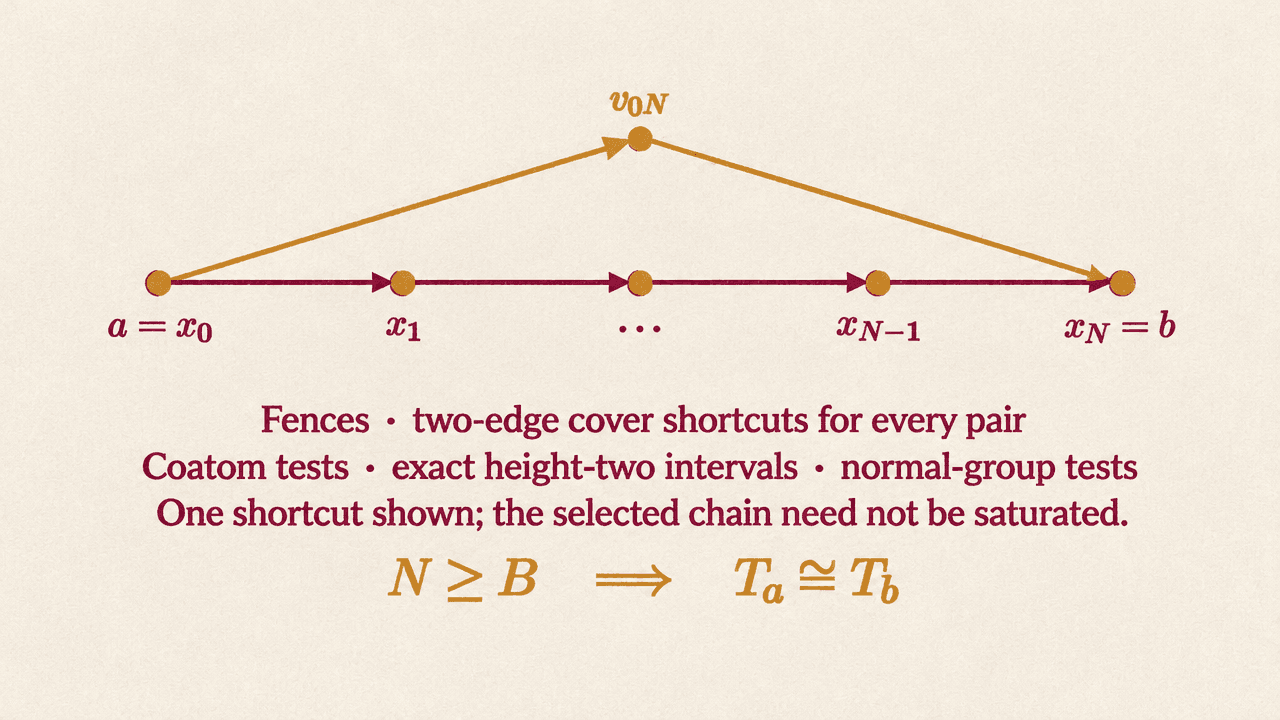
The central rigidity theorem concerns specially tested chains, not arbitrary chains. Their conditions include two-edge shortcuts, fences, and additional interval tests. It asserts an absolute bound B: in every tested chain with at least B edges, the endpoint labels agree. The bound is independent of the size of the representing group, its Lie rank, and its field parameters.
This uniformity is what lets the authors choose a finite test lattice before considering any possible group that might represent it. The proof of the bound is the technical heart of the manuscript, not reproduced in the explainer: classification of finite simple groups narrows the possible steps; field and dimension estimates constrain growth; and representation theory controls restrictions of natural modules along surviving paths. The long chains eventually conflict with their short two-edge shortcuts. The argument establishes the existence of an absolute bound, not a numerical value for B.
The constructed lattice has a Boolean lattice on four elements as its skeleton, where meet is intersection and join is union. A detector configuration and private branches carrying chain tests are added while preserving the Boolean meets and joins. Tests are imposed in both directions, and the construction uses a reversed copy of the Boolean order. In that copy, the faces 123 and 234 are individually proper, but their union is the full four-element set. That difference is reserved for the final contradiction.
Proper faces must extend; the full union cannot
Assume the decorated lattice is a subgroup interval of a finite group, choosing a representation of minimum order in either orientation. The paper’s subgroup dictionary produces homomorphisms extending one fixed action on a non-abelian simple group T. After removing bottom cores, the domains share a simple type R, which need not be T. The detector conditions force the relevant images to contain every inner automorphism of T—that is, every symmetry of T given by conjugation by one of its elements.
For proper Boolean unions, the extensions fit together. The three rank-two faces first force the images of atom cores to contain all inner automorphisms; that constraint passes to every proper face. But a common extension over the full union is forbidden: it would yield a nontrivial subdirect subgroup inside an intersection that must be trivial. Here, “subdirect” means a subgroup whose projection reaches every simple factor. The detector’s intersection condition leaves no room for such a nontrivial subgroup.
The faces 123 and 234 expose the conflict. Each is a proper face, so each has an extension, and their overlap supplies a common normal subgroup whose quotient is isomorphic to T. Conjugation on that quotient gives an extension compatible with both faces. Because 123 and 234 together cover all four elements, this compatibility combines their extensions into one over the full union. But the detector condition forbids any such full-union extension: it would give a nontrivial subdirect subgroup where the intersection is trivial. The assumed group representation therefore cannot exist. The detailed gluing argument is also omitted from the explainer; the description is a roadmap, not a verification of the theorem.
By the Pálfy–Pudlák equivalence, ruling out a finite subgroup-interval representation yields the manuscript’s negative answer for finite algebras: not every finite lattice is the full congruence lattice of a finite algebra. The finiteness restriction matters. The claim does not overturn the general representation theorem when infinite algebras are allowed. The core idea is that a finite order pattern can impose constraints on every hypothetical finite realization, however large.