A Cyclic Polytabloid Proof Establishes Saxl’s Conjecture for Staircase Shapes
An OpenAI preprint claims a proof of Saxl’s conjecture for every staircase-shaped partition: the tensor square of each corresponding symmetric-group representation contains every irreducible representation of that group. The manuscript makes a stronger claim, that every irreducible type already occurs in the orbit of one specifically constructed vector, built from row- and column-based polytabloids. Its proof reduces the claim by induction, using projections onto smaller staircases and a calculation for the intervening bands.
One prescribed vector is claimed to contain every symmetry type
Saxl’s conjecture asks whether a particular representation, tensored with itself, contains every irreducible representation of the same symmetric group. The manuscript described in the source claims a proof for every staircase shape.† Its key strengthening is that it does not need the whole tensor product: the orbit of one specifically constructed vector already contains every type.
For a staircase with m rows, the row lengths are m, m−1, …, 1, for a total of Nₘ = m(m+1)/2 positions. Irreducible representations of the symmetric group on those positions are indexed by partitions of Nₘ. “Contains every type” means that each such irreducible occurs at least once in the tensor square; it does not claim multiplicity one.
The vector is built on the staircase’s positions, with two letter slots at each position. In one layer, each row of length r is filled by the signed sum over all orderings of 1, …, r. In the other, the same construction is applied down each column. Each layer generates a staircase representation. Their tensor is the prescribed vector w. The space W is the span of all vectors obtained by applying the same permutation to both factors of w. The theorem’s stronger claim is that W itself contains every irreducible type.
Induction cuts off a band, but only after projection
To pass from one staircase size to a smaller one, the proof cuts off a band one or two diagonals wide. It divides letters into low and high sets, then discards terms in which a position has one letter from each set. The retained positions have either two high letters or two low letters. The row and column counts force the high positions to form the smaller staircase, so the projected vector factors into a smaller prescribed vector and a vector for the band.
Moving the high positions produces disjoint coordinate sectors. That disjointness matters: it makes the image the full induced representation from the two cyclic spaces, rather than only part of it. The projection is a quotient map; it does not assert that the projected vector remains inside the original pair of Specht factors.
The width-one band is trivial. Width two is the technical case. Its 2m−1 positions form a path, with adjacent pairs alternating between column pairs and row pairs. Each position has two letters, each either 1 or 2. A linear test on the four possible letter pairs can be represented by a 2 × 2 matrix. Pairing the signed band vector with these tests becomes a matrix product: at alternating positions the product uses adjugates, and fixed endpoint letters select its top-left entry, with an overall sign. For a 2 × 2 matrix X, the adjugate is tr(X)I − X.
The band calculation must produce a nonzero pairing
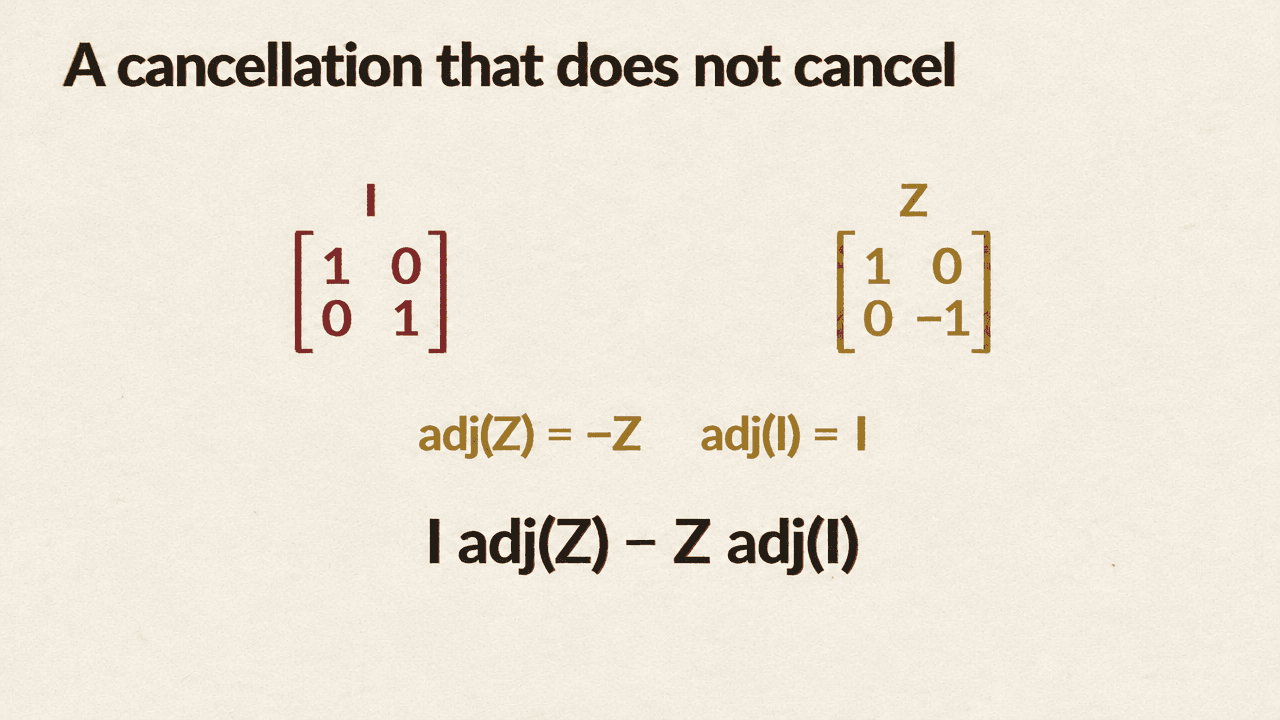
A local example shows why the alternating signs do not automatically cancel. Take the identity matrix I and Z = diag(1, −1). On a two-position segment starting at an odd position, the calculation is I adj(Z) − Z adj(I). Since adj(Z) = −Z and adj(I) = I, the result is −2Z, which is invertible. The two terms reinforce rather than cancel. The manuscript gives corresponding invertible segment matrices for lengths one through four, at either starting parity; those are the lengths needed when the band shape has at most four rows.
| Segment length | Odd start | Even start |
|---|---|---|
| 1 | I | Z |
| 2 | −2Z | 2Z |
| 3 | −6J | −6J |
| 4 | −24I | 24I |
Invertibility alone, however, does not guarantee that the product’s top-left entry is nonzero. For the shape (2, 2, 1), the segment product is 12T, where T swaps the two coordinates. This is invertible but has a zero top-left entry, so the original pairing vanishes. The remedy is to change the test matrices, not the band vector. Conjugating every test matrix by the same change of basis turns T into a matrix with a nonzero top-left entry, giving a nonzero pairing. In general, an invertible matrix has a nonzero eigenvalue, and a suitable basis change makes that eigenvalue appear in the top-left entry. The resulting nonzero equivariant map establishes that the type occurs in the band’s cyclic space.
Four horizontal strips cover the remaining shapes
For an arbitrary target partition, the proof first compares cumulative row totals with those of the staircase. If the target’s totals are all no larger, a dominance argument supplies the constituent. Otherwise, if the first row has at least m boxes, one can remove a horizontal strip of m boxes—at most one per column. If the first row is shorter, failure of dominance forces enough boxes into the first four rows to remove exactly 2m−1 boxes in at most four sweeps. The remainder has the size of the smaller staircase, though it need not itself be a staircase.
The m = 13 example shows why four sweeps can be necessary. A partition with eleven rows of eight boxes and one row of three has 91 boxes; its first twelve rows exceed the staircase total of 90. The band must account for 25 boxes. With only eight columns, each horizontal strip removes at most eight, so three strips cannot suffice. Four remove 8 + 8 + 8 + 1 = 25, leaving 66 boxes. Pieri’s rule turns the strip chain into a suitable band constituent with at most four rows. The choice is constrained: induction needs a constituent that connects the remaining shape to the target, not an arbitrary one.
The induction combines the smaller cyclic space, the needed band types, and the full induced quotient. Complete reducibility for complex representations of finite groups then carries a target constituent in the quotient back to W. Starting from the one-box case gives the stated claim for every positive staircase size.
The dominance argument, sector argument, and full induction are part of the manuscript. Exact construction checks verified the displayed examples, but did not certify the general theorem. The upstream formalization’s scope is stated separately, and Lean was not rerun for this explainer.