One Irreducible Tensor Square Covers Every Type of the Symmetric Group
A manuscript on universal tensor squares claims that, for every positive integer \(n\) other than 2, 4 and 9, one irreducible representation of the symmetric group \(S_n\) has a tensor square containing every irreducible representation of \(S_n\). Its construction starts from a staircase-shaped partition and adds boxes symmetrically; the proof combines a companion staircase result, two sufficient tests for coverage, an area bound and finite checks. Perplexity Computer adapted the OpenAI preprint into an animated video, but the explainer does not reproduce several technical parts of the proof.
One irreducible must cover every target
For every positive integer (n) except (2), (4), and (9), the manuscript claims there is a single irreducible representation of the symmetric group whose tensor square contains every irreducible representation of that group. In partition notation, for each eligible (n), one chooses (\lambda) so that (g(\lambda,\lambda,\nu)>0) for every partition (\nu) of (n). The candidate may depend on (n), but not on the target (\nu).
This is a diagonal tensor square: the same permutation acts on both factors, sending (v\otimes w) to ((gv)\otimes(gw)). It is not a matrix multiplied by itself. The distinction matters because the claim concerns which irreducible types occur in this particular group action on (V\otimes V).
A small example illustrates the claim’s meaning. For (n=3), there are three irreducible types: the trivial representation, the sign representation, and a two-dimensional standard representation. The standard representation’s square contains one copy of each, with dimensions (2\cdot2=1+2+1). This example demonstrates coverage in one case, not the general result.
The sign representation imposes a necessary condition on any general candidate. Tensoring an irreducible with sign transposes its partition diagram. For sign to occur in the candidate’s square, the diagram must equal its transpose; the candidate must be self-conjugate. That symmetry makes a candidate eligible, but does not establish that it covers every target.
Two sufficient tests make coverage a joint problem
The proof’s coverage strategy is to show that a target is reached by at least one of two support mechanisms: a band test or a balance test. Neither is presented as a complete characterization of which targets occur. Passing either test is sufficient; failing one does not mean the target is absent.
The band test decomposes the candidate diagram into a smaller triangle, a band, and two attachments. In the 69-box example, those pieces contain 36, 19, 7, and 7 boxes. A coordinate projection connects the decomposition to the actual tensor square. The triangle is handled using a companion staircase result: coverage occurs within the orbit generated from one specified tensor, with alternation along rows in one factor and columns in the other. Alternating pairs in the band, together with the attachments, provide the remaining shapes; induction and branching then recover target constituents.
This is stronger than simply knowing that the whole staircase square covers certain targets. The manuscript relies on the companion result’s cyclic, one-tensor statement. The explainer does not prove that result, nor the technical arguments establishing endpoint clearance and noncancellation in the band construction.
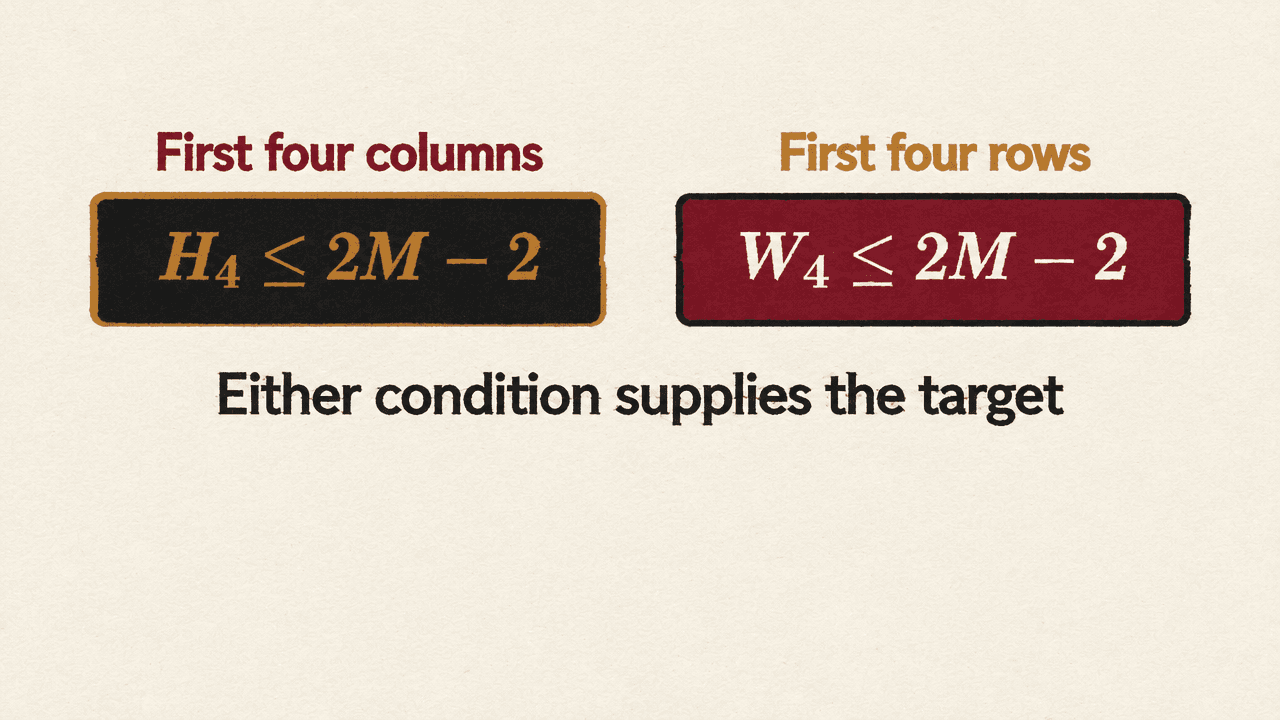
The balance test works in the full square. It supplies a target if its first four columns contain at most (2m-2) boxes, where (m) is the staircase index. Transposition gives the same sufficient test using the first four rows. The proof’s logic is joint: if a target is not supplied by the band test, the balance conditions still need to fail in both orientations before the area argument is needed.
The area bound makes simultaneous failure impossible
For large (m), the key step is to rule out a target that escapes the band tests and both balance orientations. The area lemma does this using bounds on the target’s first (i) columns and first (j) rows.
If the cell at row (j), column (i) is absent, the two strips cover the partition diagram: no box can lie farther down and to the right, because partition rows only get shorter. The strips overlap, so the area is at most (U+V-1), when the first (i) columns contain at most (U) boxes and the first (j) rows at most (V).
If the cell is present, the part outside the strips fits inside a corner rectangle. Counting the overlap once and applying the strip bounds gives an area limit of (\lfloor UV/(ij)\rfloor). Together, the cases yield the larger of these two bounds. The explainer presents this local geometric lemma in detail; the broader support analysis that supplies its inputs is omitted.
For (m\ge22), that omitted analysis bounds the first eight row and column sums by (S=2r+38), where (2r) counts the added boxes. The area lemma then gives (n\le\max(2S,S^2/64)). The construction’s parameter bounds require (n) to exceed both terms. The contradiction means a target cannot fail every applicable band and balance test in both orientations.
A staircase candidate fills the gaps between triangular sizes
The construction starts with a staircase partition of row lengths (m,m-1,\ldots,1), whose size is (N_m=m(m+1)/2). For a degree between staircase sizes, it chooses the largest staircase no bigger than (n) whose size has the same parity as (n). The difference is even; half the extra boxes are added near the top and the transposed half near the left, in prescribed rows and columns. This preserves self-conjugacy.
For (n=69), the selected staircase has 55 boxes. Adding seven boxes on each side gives (55+7+7=69). The candidate is fixed before the target is considered. The 69-box illustration clarifies the matched enlargement, but the argument depends on the prescribed construction, not arbitrary additions.
The staircase result is a companion input, and its proof is not supplied in the explainer. The new construction and support tests use that input to extend coverage to intervening, non-triangular degrees.
Finite checks cover bounded cases without establishing a pattern
The remaining bounded cases are handled separately. Exact capacity calculations settle intermediate parameters, including 19 exceptional capacity pairs. Exact character calculations identify covering squares for all 61 eligible degrees through 64.
The source explains that a nonzero modular residue certifies positivity because multiplicities are nonnegative integers; a zero residue is inconclusive. These checks close specified finite ranges rather than extrapolating a numerical pattern to all (n). It reports that finite reruns passed and that the Lean rebuild was not run.
The claim is therefore stronger than finding many constituents, and different from relying on a higher tensor power: for each eligible (n), one irreducible is chosen whose square contains every irreducible type. The proof assigns distinct roles to the staircase input, matched enlargement, band and balance tests, area contradiction, and finite checks. The area lemma is explained, but the technical support arguments and companion theorem are not reproduced in full.