One Monomial Ideal Matches the Entire Hilbert Function
A September 2026 OpenAI manuscript claims that, for a homogeneous regular sequence of length \(c\) in \(n\) variables, with degrees \(2 \le a_1 \le \cdots \le a_c\) and \(1 \le c \le n\), every ideal containing the sequence has the same Hilbert function as a monomial ideal containing the corresponding pure powers. The same monomial ideal matches the count of surviving classes in every degree. The manuscript gives its construction over the complex numbers, using commuting linear forms over a division algebra; a separate extension establishes the broader characteristic-zero conclusion.
One monomial ideal must account for every degree
A polynomial quotient can be described by counting how many independent expressions survive in each degree. Those counts form its Hilbert function. The Eisenbud–Green–Harris question asks whether, under suitable regularity conditions, equations can be replaced by monomial constraints without changing those counts.
The September 2026 OpenAI manuscript claims that, over every characteristic-zero field, one monomial ideal suffices for the entire Hilbert function in the stated setting.† Let f₁,…,f_c be a homogeneous regular sequence in a polynomial ring S, with degrees 2 ≤ a₁ ≤ … ≤ a_c and 1 ≤ c ≤ n, where n is the number of variables. Regularity means that multiplication by each fᵢ is injective on the quotient by its predecessors: no nonzero class is killed.
For every homogeneous ideal I containing this sequence, the theorem supplies a monomial ideal J containing x₁ᵃ¹,…,x_cᵃᶜ, with dim_F(S/I)_d = dim_F(S/J)_d for every d ≥ 0. The claim is about equal counts, not isomorphic quotient rings. Its force is that the same J works in all degrees.
The example illustrates the count, not the theorem
Take f₁ = x² + y² and f₂ = y³, and add xy: I = (x² + y², y³, xy). In degree zero, 1 survives; in degree one, x and y survive. In degree two, xy = 0 and x² = −y², leaving one independent class, represented by y².
In degree three, y³ = 0, mixed terms vanish because they contain xy, and x³ = x(x²) = −xy² = 0. All higher-degree classes vanish too. The Hilbert function is (1, 2, 1, 0, …).
| Degree | Surviving classes | Dimension |
|---|---|---|
| 0 | 1 | 1 |
| 1 | x, y | 2 |
| 2 | y² | 1 |
| 3 and higher | None | 0 |
The monomial ideal J = (x², xy, y³) leaves 1, x, y, and y², so its counts match. This exact example illustrates the desired correspondence; it does not establish the general result.
Commuting forms provide a basis before quotienting
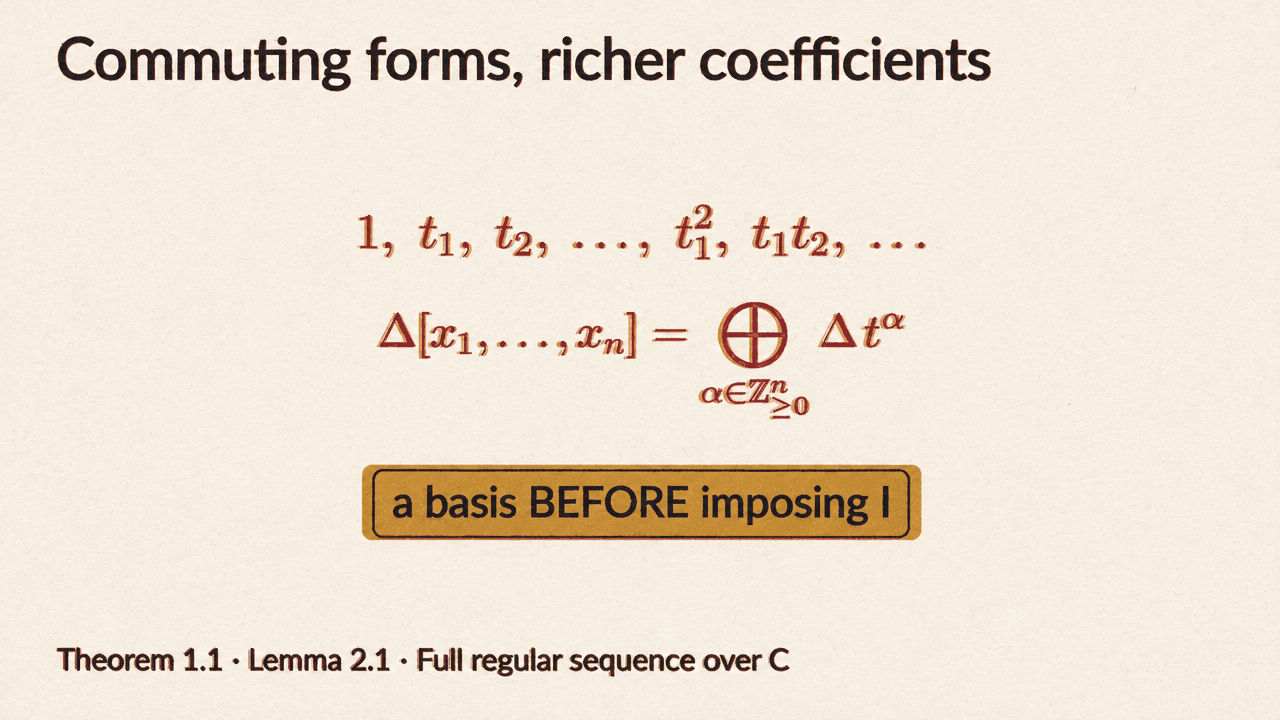
For arbitrary equations, the method does not rely on finding an ordinary change of variables. It enlarges the coefficient system to a finite-dimensional central division algebra Δ. Every nonzero element of Δ is invertible, though coefficients need not commute. The constructed linear forms t₁,…,tₙ, however, commute with one another.
Their ordered products form a basis of the full polynomial algebra over Δ, before imposing I. That order matters: this basis is available for every ideal containing the given equations.
The forms also satisfy triangular power identities. The specified power tᵢᵃⁱ is a nonzero scalar multiple of fᵢ, adjusted by terms involving earlier equations and later forms; every term has the same total degree. In the example, t₁ = x and t₂ = y give t₂³ = f₂ and t₁² = f₁ − t₂². This ordinary-coordinate choice works here, but not necessarily for arbitrary systems. The general construction must supply both the identities and the full ordered basis.
Least exponents produce the monomial model
Assuming the constructed forms, identities, and basis are available, the manuscript’s counting argument proceeds by expanding nonzero homogeneous elements of the extended ideal in the t-basis. Compare exponent lists from the last coordinate backward, select the least exponent in each expansion, and collect the selected exponents in a set E.
Since the forms commute, right multiplication by tⱼ shifts every exponent by one in coordinate j without changing its left coefficient. The least exponent shifts as well. Thus E is upward closed and defines a monomial ideal. This is the proof’s bridge from relations to a monomial model; it depends on the constructed basis and commuting forms.
The triangular identities make the resulting ideal contain the required pure powers. Rearranging a row gives an element of the extended ideal whose least term is tᵢᵃⁱ: correction terms have a positive coordinate later than i, while the pure power does not.
The dimension comparison is a degree-by-degree elimination argument over the division algebra. Independent relations yield distinct pivot positions in the basis, and the remaining positions count quotient classes. In the degree-two example, there are three basis positions and two independent relations, leaving one unselected position and hence one quotient class. This is a sketch of the counting argument, not a substitute for the manuscript’s full proof.
For the direct construction over the complex numbers, extending coefficients preserves degree-by-degree dimensions: the extended quotient is identified with Δ ⊗_C (S/I). The monomial count then gives the same Hilbert function. This direct argument is over the complex numbers; the broader characteristic-zero conclusion comes from a separate extension stated later in the manuscript.
The construction carries the technical burden
The manuscript’s central construction supplies commuting forms with triangular power identities and a full ordered basis. It builds the rows backward from the last equation. At each degree, the construction seeks a sum of powers satisfying row constraints; curves provide matrix formulas for binary power addition, and repeated addition combines summands. Separate linear and quadratic relations preserve earlier identities when the next degree is smaller. A relation space excluding low-degree curves yields a factor condition, while sufficiently many summands are used to obtain high connectivity in a parameter cone. These are dependencies in the construction, not a proof of its geometric steps.
Matrices alone do not provide the needed coefficients: nonzero matrices can multiply to zero. The manuscript uses descent to obtain a central simple algebra and then proves it is division. The stated divisibility condition is that every finite right module has dimension over the center divisible by the algebra’s own dimension. A nonzero proper right ideal would have smaller positive dimension, contrary to that condition. The manuscript invokes Euler characteristics, connectivity of the parameter cone, and integral topological K-theory to establish divisibility; those arguments are not reproduced here.
The direct construction treats full regular sequences over the complex numbers. A later section extends the Hilbert-function conclusion to shorter sequences and characteristic-zero fields. A compression theorem then yields a lex-plus-powers ideal. Stronger Betti-number bounds belong to a companion paper; they are not the contribution claimed here.