One Finite-Dimensional Algebra Has No Bound on Finite Projective Dimensions
An OpenAI preprint constructs a single finite-dimensional complex algebra for which finitely generated modules of finite projective dimension have no common upper bound on their resolution lengths. For every positive integer \(m\), it produces a module with finite projective dimension at least \(2m-2\), showing that the algebra’s little finitistic dimension is infinite. The proof builds a mechanism that keeps selected modules nonzero for a controlled number of steps, then makes them vanish.
Every resolution can finish without a uniform bound
The manuscript constructs one finite-dimensional complex algebra A whose finitely generated modules of finite projective dimension have no common upper bound on their projective dimensions. For every positive integer m, it produces a finite-dimensional A-module N_m such that 2m − 2 ≤ pd_A N_m < ∞.†
The algebra stays fixed as m grows. That is essential: finding longer and longer finite resolutions over different algebras would not establish that a single algebra has infinite little finitistic dimension.
The little finitistic dimension is the supremum of the finite projective dimensions of finitely generated modules over a fixed finite-dimensional algebra. The result makes that supremum infinite, without claiming that every module has a finite resolution. Each N_m has a finite projective resolution; what fails is the existence of one finite ceiling for all their lengths.
A projective resolution builds a module from projective modules in an exact chain. Its projective dimension is the shortest possible length of such a chain; if no finite chain exists, the dimension is infinite. The construction works by creating modules that remain nonzero through a controlled number of algebraic operations and eventually become zero. Non-vanishing supplies the lower bound on resolution length; eventual disappearance supplies finiteness.
A moving projection makes survival last exactly as long as needed
The construction begins with a finitely presented complex algebra R. “Finitely presented” means finitely many generators and relations, not finite-dimensional. It contains central elements z_q with z_q squared equal to 1. From each, define e_q as (1 + z_q)/2. Because z_q squared is 1, e_q squared equals e_q: it acts as a projection, keeping vectors on which z_q acts as +1 and killing those on which z_q acts as −1. Centrality ensures that the part it selects is an R-submodule.
A selection operation H applies e_0, then changes the module’s action using an automorphism alpha that sends z_q to z_(q+1). That change makes the next round read a different sign. After j rounds, the surviving part is selected by the first j projections, e_0 through e_(j−1), rather than by repeated applications of e_0.
So a module with signs +, +, +, − remains nonzero for three rounds and is killed on the fourth. More generally, m−1 plus signs followed by a minus sign yield a module that remains nonzero through round m−1 and vanishes at round m. For m=1, the first sign is negative and the first operation kills the module.
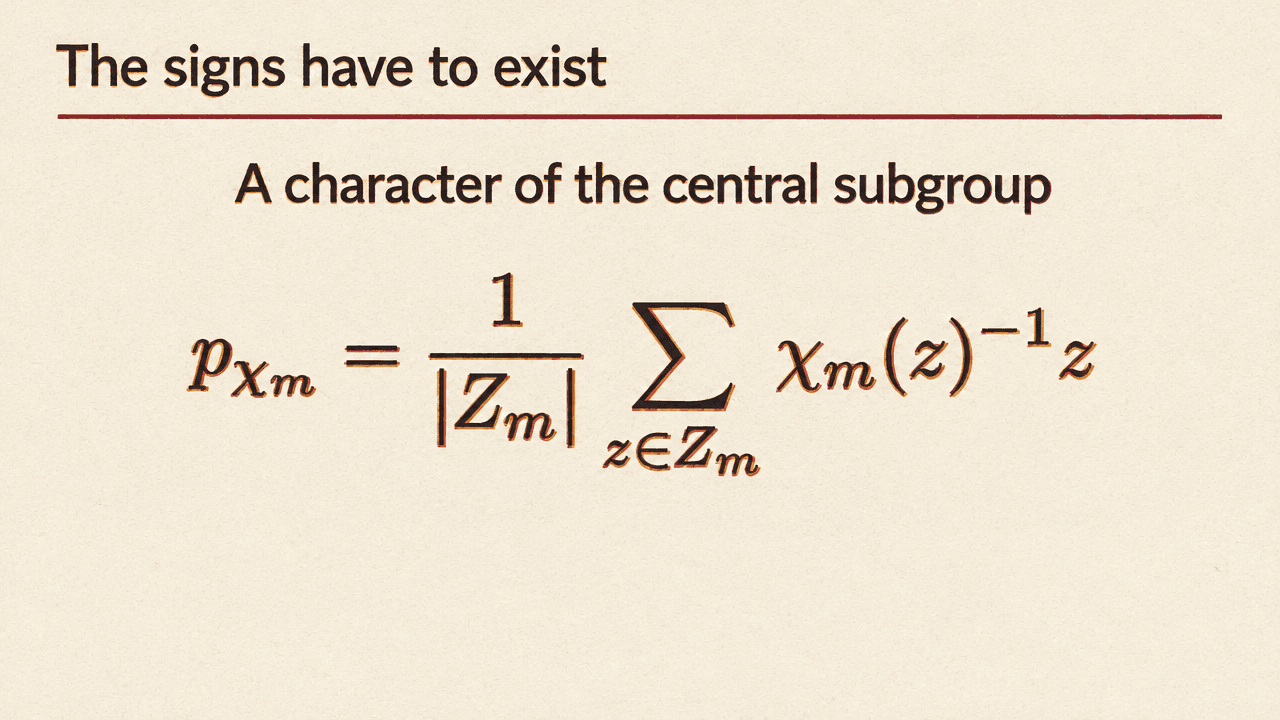
But specifying a sign pattern is not enough: it must come from an actual module. To establish that, the manuscript constructs, for each m, a finite matrix quotient over the ring of polynomials over the two-element field with t^m identified with 1. The image of z_q is the identity matrix plus t^q E_04; multiplying these matrices adds their top-right entries. Since 1, t, …, t^(m−1) form a basis in this coefficient ring, no nonempty subset of the first m central elements multiplies to the identity. The resulting character of their central subgroup defines a projector in the complex regular representation, producing a nonzero finite-dimensional module Y_m. The binary coefficient ring establishes the finite quotient; the modules used in the construction are over the complex numbers.
The selection mechanism has to pass through a uniform homological construction
The local operation on R-modules does not by itself produce the required finite-dimensional algebra or the claimed projective dimensions. The paper’s technical bridge encodes a quadratic presentation of R in an algebra B with three vertices and arrows only from the first to the second and from the second to the third. With no paths of length three, B is finite-dimensional.
For a module Y, the construction forms M(Y), placing Y at each vertex and recording its generator actions along the arrows. A fixed bimodule complex P, after derived tensoring, takes M(Y) to M(H(Y)) together with a copy shifted by three degrees. This is derived tensoring with projective resolutions, not ordinary tensor multiplication. The localization, lifting, and compatibility arguments establish that the same P works for every Y; those technical proofs are omitted here. The shifted copy is part of the stated construction.
The paper then records the differential in a finite directed chain and passes to a product algebra D and an ordinary bimodule X. Let F be derived tensoring with X over D. Starting from N_m = M(Y_m), supported on the B factor, two applications of F return to that factor and implement a selection, with fixed degree shifts. Repetition preserves shifted copies of the successive selections. A shift changes degree, not whether an object is zero. Thus F^(2m−2)N_m is nonzero, while F^(2m)N_m is zero. The construction does not assert which step is its first vanishing step.
Survival gives a lower bound; extinction keeps it finite
The final algebra is the square-zero extension A = D ⋉ X: products involving two entries from X are zero, while mixed products retain the bimodule actions. Regard N_m as an A-module on which X acts by zero. The paper decomposes the derived tensor product of D with N_m over A into pieces indexed by r, with the r-th piece given by F^r N_m, shifted by r. The decomposition groups terms in a bar resolution by how many X-entries they contain; nonzero differentials preserve that count.
If F^r N_m is nonzero, it has nonzero cohomology in some degree q ≤ 0. After the shift, this appears in degree q−r, at most −r. A projective resolution shorter than r cannot reach that degree, so non-vanishing forces projective dimension at least r. Conversely, a separate minimal-resolution argument shows that eventual extinction yields finite projective dimension, using the finite global dimension of D on both sides.
At r = 2m−2, F^r N_m is nonzero; by step 2m, F^(2m)N_m is zero. Together, these give the result: for every m, N_m has finite projective dimension at least 2m−2, all over the same finite-dimensional algebra A. The selection mechanism explains how survival can be prolonged and then stopped; the finite presentation and uniform homological constructions are what carry that mechanism into the theorem.