A Direct-Finiteness Counterexample Emerges in One Odd Characteristic
An OpenAI preprint claims a counterexample to Kaplansky’s direct-finiteness conjecture: in a group algebra over a field of odd characteristic, it constructs elements \(a\) and \(b\) with \(ab=1\) but \(ba\ne1\). The result is specific to a prime defined by the construction and a finitely generated group containing torsion; it does not establish a counterexample for every odd characteristic or for torsion-free groups. The defect also yields an injective update on configurations that is not surjective.
The counterexample is a one-way undo, not a failure of injectivity
Kaplansky’s direct-finiteness conjecture asks whether, in a group algebra, ab = 1 must imply ba = 1. The manuscript claims a counterexample in one specified odd characteristic: two elements a and b satisfy ab = 1, while ba ≠ 1.
That difference produces an update rule that never merges distinct inputs but cannot produce every possible output. The construction combines a triangle-free graph, a finite-group projection with a rank bound, and a compression between modules of unequal sizes.
The scope is narrow. Set m = binom(1200, 600), and let p be the smallest divisor greater than one of (m!)² + 1. A least divisor greater than one is prime. Also, p > m: otherwise p would divide both m! and (m!)² + 1, which is impossible. Thus p is odd. The paper constructs a field K with p⁴ elements and a finitely generated group G containing non-identity elements of finite order. It does not claim the result for every odd prime or for a torsion-free group. These objects are specified by finite formulas and choices, not numerically evaluated.
A group algebra K[G] consists of finite weighted sums of group elements. Its multiplication follows the group law, which need not commute: (Σ aᵤu)(Σ bᵥv) = Σ aᵤbᵥ(uv). That order matters when the algebra’s multiplication is used to define updates on configurations indexed by G.
A triangle-free graph supplies a small dimension bound
The first ingredient is a graph whose vertices are the 600-element subsets of a 1200-element set. Two vertices are joined when their subsets overlap in fewer than 200 elements. The graph has no triangles: three pairwise adjacent subsets would have pairwise intersections of at most 199 elements, so their union would contain at least 1800 − 3·199 = 1203 elements. A triple overlap only increases that lower bound. But the union must fit inside a 1200-element set.
A polynomial produces a fitting matrix for the graph: its diagonal entries are one, and its entries at distinct non-neighbors are zero. The matrix factors through t coordinates, with t/m < 1/100. This gives the construction a small dimension bound to compare with a second rank.
That opposing bound comes from a finite group H. The paper constructs an idempotent e, meaning e² = e. Let w be the order of H, and d the dimension of the image of left multiplication by e. The construction gives d/w > 1/96.
Its local mechanism uses characteristic p. Three commuting translation differences X₁, X₂, X₃ satisfy Xᵢᵖ = 0. A monomial with total degree greater than 3(p − 1) must have some exponent at least p, so it vanishes. A weighted pairing turns a high-degree subspace into a projection with annihilation conditions on opposite sides. The pairing and character-counting arguments are not supplied in the explanation.
Directed zero products turn the rank gap into compression
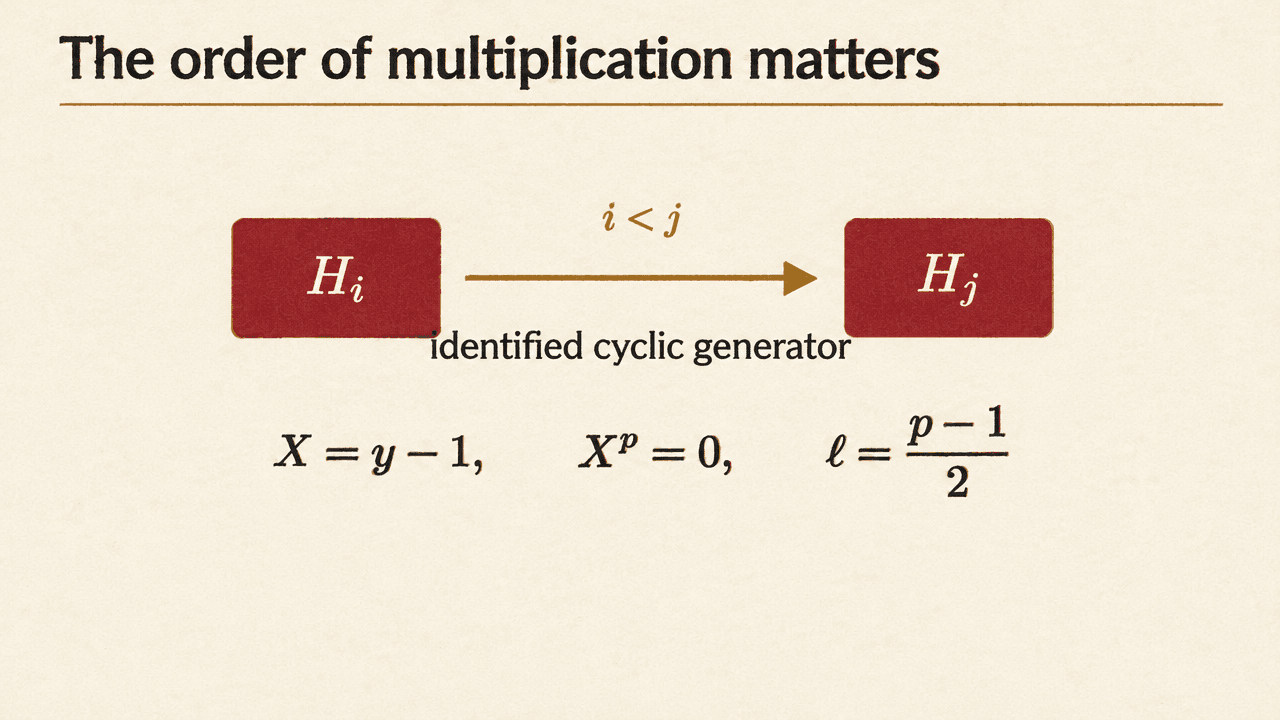
Along an edge from a smaller-indexed vertex i to a larger one j, the construction identifies cyclic subgroups and writes X = y − 1 for their common generator, with ℓ = (p − 1)/2. The local conditions are eᵢXˡ = 0 and Xˡeⱼ = 0.
A coefficient-by-coefficient annihilator calculation gives eᵢ = qXᵖ⁻ˡ. Since p − ℓ = ℓ + 1, their product is eᵢeⱼ = qX(Xˡeⱼ) = 0. No factors are commuted. The reverse product eⱼeᵢ is not claimed to vanish.
The finite groups are attached to graph vertices and glued along the prescribed subgroups. The construction must preserve those groups through gluing, then enlarge the result so that numerical ranks become exact module identities in a nonzero ring S. In the displayed setup, S = fK[G₁]f, with f² = f ≠ 0 central in K[G₁] and serving as the identity of S; the projections are represented there by Pᵢ = feᵢ. The source emphasizes that numerical rank alone does not supply these maps. The structural proofs that establish survival under gluing and produce the exact identities are essential, and are omitted from the explanation.
Combining the graph factorization with the directed zero products yields a matrix that is a diagonal projection plus a strictly lower-triangular error. The error is nilpotent, so a finite geometric-series correction removes it and supplies an exact left inverse. The resulting map goes from a module with md coordinates to one with wt coordinates. Since t/m < 1/100 < 1/96 < d/w, we have wt < md. These are modules over S, not vector spaces over a field. The unequal coordinate counts alone would not establish the result: the exact module maps and the left-inverse identity are what make the compression useful.
The compression produces square matrices A and B with AB = I, while A has a nonzero kernel vector v. Thus BAv = 0, although Iv = v, so BA ≠ I.
Matrices are not scalar elements of a group algebra. To make that final move, the paper uses an injective matrix encoding supplied by a finite Heisenberg group. After padding with an identity, it defines a = 1 − g + Φ(A) and b = 1 − g + Φ(B). Injectivity preserves the nonzero difference ba − 1. The full matrix-unit construction is not given in the explanation; its injectivity is essential to the encoding, rather than a cosmetic detail.
The defect rules out an output, even with infinite support
For a configuration x: G → K, define an update T_c from a finite group-algebra sum c = Σ cᵤu by (T_c x)(g) = Σ cᵤx(gu), summing over the support of c. A configuration may have infinite support, but each update reads only finitely many positions. Applying T_d first and then T_c reads positions guv, with coefficients cᵤdᵥ. Thus T_cT_d = T_cd, in the same order as multiplication in the group algebra.
Since ab = 1, T_aT_b is the identity, so T_b is injective: applying T_a recovers any input from its image. But every output y = T_bx must also satisfy T_ba y = y, because T_baT_b = T_bT_aT_b = T_b.
Now ba − 1 has a nonzero coefficient at some group element h. Let δₕ be the configuration equal to one at h and zero elsewhere. Evaluating T_baδₕ − δₕ at the identity gives that nonzero coefficient. So δₕ fails the necessary condition for being an output of T_b. It has no preimage, even among configurations with infinite support.
The precise result is an injective update that is not surjective, arising from a counterexample at the manuscript’s specified odd prime, over a field of size p⁴ and a finitely generated group containing torsion. The source reports exact checks of the displayed local calculations, while stating that the full construction was not numerically evaluated. The accompanying Lean proof was not reproduced.