A Group-Ring Matrix Has Fuglede–Kadison Determinant Below One
An OpenAI preprint presents a counterexample to the Group-Ring Determinant Conjecture: an integer matrix over a group ring can have an inverse over the rational group ring while its Fuglede–Kadison determinant is strictly between zero and one. The construction turns a one-sided inverse over a field of characteristic two into a projection with trace greater than its factorization dimension, then carries that trace gap into an integer matrix. The resulting operator is invertible, so the failure does not arise from a divergence at zero.
The counterexample turns a one-sided inverse into a determinant below one
For an invertible integer matrix, the absolute determinant is a nonzero integer, so it cannot be smaller than one. The manuscript’s counterexample asks whether a similar lower bound holds when integer entries are replaced by finite sums of elements from a group. It claims that, without restrictions on the group, it does not: an integer matrix over a group ring can have a rational inverse while its Fuglede–Kadison determinant lies strictly between zero and one.†
The determinant here is defined through the operator that the group-ring matrix induces on square-summable functions on the group. Each group element acts by shifting coordinates; a matrix of finite integer combinations of those shifts gives an operator T_A. Its Fuglede–Kadison determinant is obtained by taking the logarithm of the positive operator T_A* T_A, applying the group trace, dividing by two, and exponentiating. The trace is unnormalized: the identity matrix of size n has trace n.
Equivalently, the logarithmic determinant is n/2 times the spectral average of log t for T_A* T_A. The conjectured lower bound amounts to that average being nonnegative. The example is invertible, so its negative value is not caused by spectral mass at zero or a divergent logarithm there.
The construction’s central move is to convert a one-sided inverse over a field of characteristic two into a positive trace gap, and then use that gap to make an integral matrix whose determinant falls below one.
A projection isolates the defect and creates the trace gap
The argument begins with an existence result imported from a companion paper. It supplies a finitely generated group H₂ and elements a, b in a group ring over a finite field K₂ of characteristic two, with ab = 1 but ba ≠ 1. The field need not be the two-element field itself. Expressing its elements in a binary basis turns a and b into matrices X, Y over 𝔽₂[H₂], with XY = I_d and YX ≠ I_d.
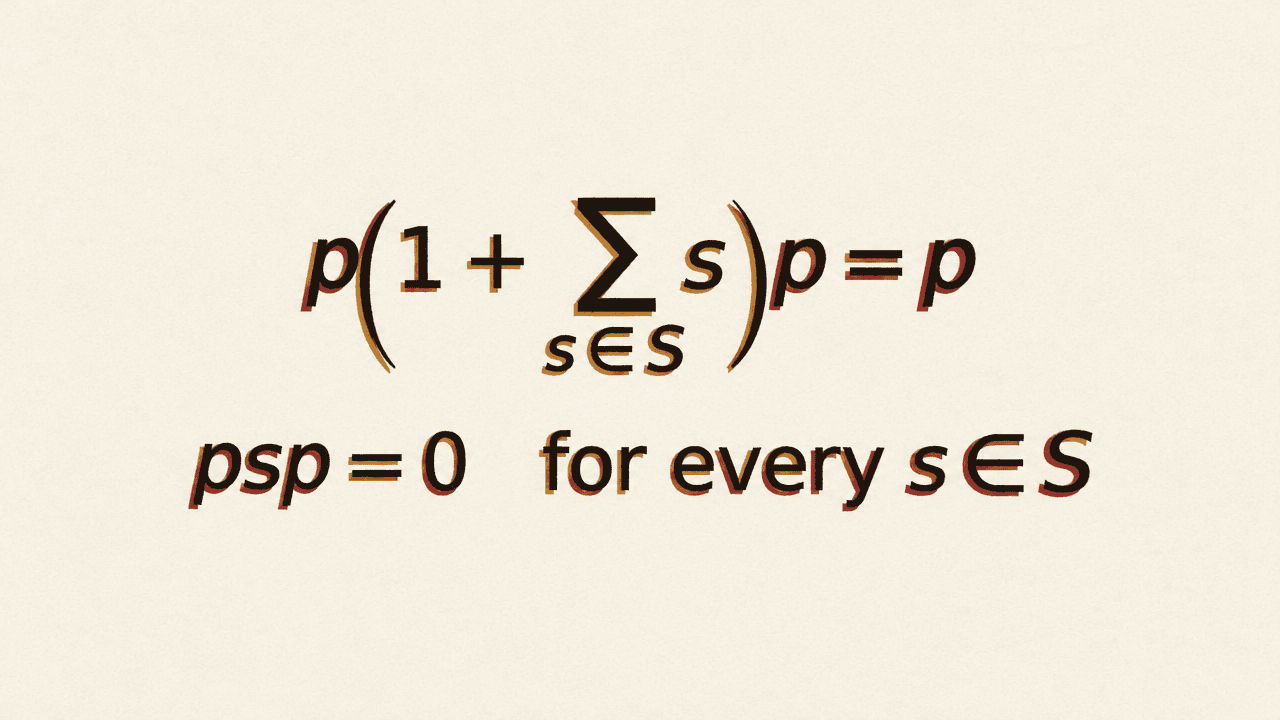
Set C = I_d − YX. Associativity and XY = I_d give three identities: C ≠ 0, C² = C, and XC = CY = 0. The nonzero defect C contains a nonzero group coefficient. Shift that coefficient to the identity element. Because the coefficients are binary, the selected entry can be written as 1 + ∑_{s∈S} s, where S is finite and excludes the identity. The goal is to build a projection p that preserves the identity term but kills every term indexed by S, so that p(1 + ∑_{s∈S} s)p = p.
To do this, the construction enlarges the group: it adds an independent cyclic coordinate of order three at every element of H₂, with H₂ shifting the coordinate labels. For each coordinate h, average its three rotations: p_h = (1 + z_h + z_h²)/3. Since z_h³ = 1, squaring the numerator produces three copies of each rotation, so p_h² = p_h. Inversion swaps the two nonidentity rotations, making p_h self-adjoint. The coordinate averages commute, as do their complements.
Now take p to be the identity-coordinate average p₁, multiplied by 1 − p_s for every s ∈ S. This is an orthogonal projection. Conjugating by an unwanted element s shifts the identity-coordinate average to p_s. Since p already includes 1 − p_s, the product of the original and shifted projections vanishes; hence psp = 0. This remains true if coordinate lists overlap. The unwanted terms disappear when sandwiched between p’s, leaving p.
The identity coefficient—and therefore the trace—of p is θ = τ₁(p) = (1/3)(2/3)^{|S|} > 0. Put the d × d identity and p on the diagonal of a larger projection P. Its trace is d + θ, greater than d.
The trace gap survives the route to integer entries
The trace excess is rational, while the final matrix must have integer group-ring entries. The construction first reduces the projection and its factorization modulo two. Thirds are allowed in the coefficient system before reduction because three is odd. The reduced projection factors through only d columns, even though the rational projection has trace d + θ.
That is not an ordinary rank contradiction: the trace calculation and the factorization are over different coefficient systems. The distinction is what makes the gap useful rather than inconsistent.
To return to integer entries, the manuscript chooses an odd denominator D = 3^{1+|S|} and a power of two q > 1 with q ≡ 1 (mod D). A finite geometric-series correction lifts the factorization from modulo two to modulo q: it corrects the factorization error by a finite sum of powers of a nilpotent error term. Integer lifts of the corrected factors then produce a block matrix A of size 2d + 1. Its bottom-right block is integral because its numerator is divisible by q. Block shears reduce A to a diagonal form and give an explicit inverse over the rational group ring.
The shears preserve the logarithmic determinant by differentiating the traced logarithm along a shear path. Cyclicity of the trace reduces the derivative to terms with zero diagonal blocks, whose trace is zero.
In the resulting diagonal calculation, d coordinate summands expand by q, while the range of P, of trace d + θ, contracts by 1/q. The complementary range has absolute scale one. The trace-weighted logarithmic contributions are:
Since θ > 0 and q > 1, exponentiating gives det_{𝒩(G_D)}(T_A) = q^{−θ}, strictly between zero and one.
The failure is finite, not a divergence at zero
The resulting matrix belongs to an integer group ring and has an inverse over the rational group ring. Its group is finitely generated: generators of the original group, together with one three-cycle, generate the added coordinates by conjugation. The construction does not claim the group is torsion-free; it contains elements of order three.
The rational inverse gives a bounded inverse for the associated operator. Consequently, the spectrum of T_A* T_A stays away from zero, and the spectral average of log t is finite. The manuscript’s value is ∫_{(0,∞)} log t dμ_A(t) = −2θ log q/(2d + 1) < 0. This is a lower-bound failure, not a divergence concealed at zero.