A Group Algebra Has a One-Sided Inverse That Is Not Two-Sided
An OpenAI preprint presents a counterexample to Kaplansky’s direct-finiteness conjecture: over a finite field of characteristic two, it constructs a finitely presented group whose group algebra contains elements \(a\) and \(b\) with \(ab=1\) but \(ba\ne1\). The result also yields an injective but nonsurjective cellular automaton and, by the paper’s stated reasoning, a nonsofic group. The preprint gives a terminating search for the witnesses, but says that search has not been run.
A one-sided inverse exists in a group algebra
The construction gives a finite field K of characteristic two, a finitely presented group G, and elements a,b in K[G] such that ab = 1 but ba ≠ 1. It is a counterexample to Kaplansky’s direct-finiteness conjecture, which asks whether a one-sided inverse in a group algebra must also be a two-sided inverse.
For square matrices over a field, AB = I does imply BA = I: a left inverse makes the associated map injective, and in finite dimension injectivity implies surjectivity. A group algebra K[G], by contrast, can have infinitely many basis elements when G is infinite, even though each of its elements is a finite sum. The result shows that finite support does not suffice to guarantee direct finiteness.
The scope has several qualifications. Characteristic two means 1 + 1 = 0; K need not be the field with two elements. The group contains an element of odd prime order, so this is not a torsion-free example. And although the paper proves that a search specifying the witnesses terminates, it says the search has not been executed: it gives a prescription, not a computed list of witnesses.
Local cancellation leaves a global identity
The algebraic construction begins with finite incidence data: points and designated subsets, arranged so that each point belongs to exactly ℓ + 1 subsets, for an odd prime ℓ. The bipartite incidence graph must have girth at least 12, meaning it has no cycle shorter than 12. Each point v is assigned a vector xᵥ in Kᵐ, with 0 < m < t ≤ mℓ², and the field contains a primitive ℓ-th root of unity.
The vectors are required to satisfy two different summation rules. On each designated subset f, the outer products cancel: the sum of xᵥxᵥᵀ over v in f is zero. Across all points, however, their sum is −Iₘ, which equals Iₘ in characteristic two. The central device is to make every local sum vanish while preserving a nonzero global identity.
A small example illustrates the pairing, not the full construction. In the affine plane over F₄, where ω² = ω + 1, assign x(u,v) = (1 + u + v, u, v)ᵀ. Three selected holes receive the three coordinate vectors, so their outer products sum to I₃. The outer products over the whole plane sum to zero; the remaining points therefore sum to −I₃. This example verifies the identity mechanism, but it does not establish the required regularity or girth.
That distinction matters: the full geometric existence argument must produce lines avoiding the holes while maintaining the specified incidence conditions and large girth. The paper uses random slabs, a local lemma, and incidence-preserving trades to obtain that construction. The toy grid does not do that work.
The reverse product is certified nonzero
The incidence pattern also guides a gluing of finite groups. Local groups isomorphic to (Fℓ², +) are joined through groups isomorphic to (Fℓ, +). The large-girth condition helps ensure the local groups remain embedded: a hypothetical collapse would yield a planar diagram whose degree bounds and long face boundaries conflict with Euler’s formula.
Averaging over the odd-order local groups produces idempotents—elements equal to their own squares. The vector identities then give rectangular factors U and T with UT = Iₘ. That is not yet a counterexample: the factors are rectangular, and a matrix obstruction is not the scalar group-algebra claim.
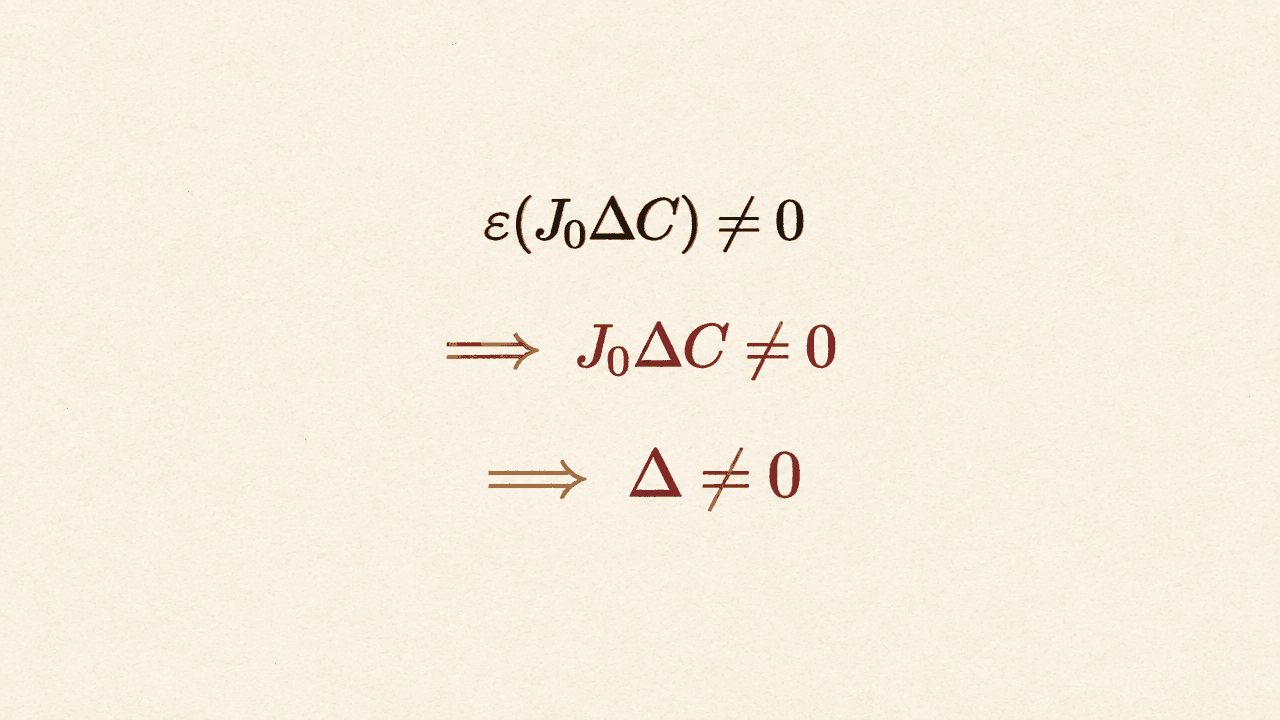
The paper uses character idempotents and a larger group to pack these factors into square matrices A and B with AB = Iₘ. To show that the reverse product fails, it sets Δ = BA − Iₘ and sandwiches Δ between packing maps. This returns the calculation to an embedded subgroup algebra, where a homomorphism specializes the sandwich to XᵀX − Iₜ. The columns of X are the original vectors.
Because m < t, X has a nonzero kernel vector y. Thus (XᵀX − Iₜ)y = −y ≠ 0, certifying that the sandwich, and hence Δ, is nonzero. The specialization is used only after the calculation returns to the subgroup algebra; the paper does not assume a homomorphism from the entire group algebra to K.
A final step turns the matrix defect into scalar elements. The paper embeds the matrix algebra into a corner of a larger group algebra, with identity f, through an injective map Φ. Set a = 1 − f + Φ(A) and b = 1 − f + Φ(B). The complementary term annihilates the corner, and Φ(Iₘ) = f, so ab = 1. But ba − 1 = Φ(Δ) ≠ 0: injectivity preserves the defect.
The same pair gives an injective update that misses a configuration
The inverse pair also yields a cellular automaton: a local update rule applied across configurations x:G→K, which may have infinite support. Each finite group-algebra sum c defines (T₍c₎x)(g) = Σᵤ cᵤx(gu). Composition follows the order of multiplication, T₍c₎ ◦ T₍d₎ = T₍cd₎.
Take T₍b₎. Since ab = 1, T₍a₎ ◦ T₍b₎ is the identity, so T₍b₎ is injective. Its image is exactly the configurations fixed by T₍ba₎: every output is fixed by that update, and if y is fixed, then y = T₍b₎(T₍a₎y).
Because ba − 1 ≠ 0, some coefficient of that difference, at a group element h, is nonzero. Let δₕ be one at h and zero elsewhere. Applying the update defined by ba − 1 to δₕ, then evaluating at the identity, gives that nonzero coefficient. So δₕ is not fixed by T₍ba₎, and is not in the image of T₍b₎. The construction therefore gives an injective, nonsurjective cellular automaton over the finite alphabet K, a counterexample to Gottschalk’s surjectivity conjecture.
The paper also concludes that the constructed group is nonsofic. Its stated reason is that an existing theorem makes group algebras of sofic groups stably finite, which would rule out ab = 1 with ba ≠ 1.
The source also distinguishes the paper’s proof from what was reproduced for the explainer: the toy calculations were checked, but the terminating witness search was not run, and the Lean proof was not reproduced. Those checks do not amount to independent verification of the full construction.