A Torsion-Free Group Algebra Fails Direct Finiteness Over F₂
An October 2026 OpenAI manuscript claims a counterexample to Kaplansky’s conjecture: a finitely presented, torsion-free group whose group algebra over the two-element field is not directly finite. The authors reduce the claim to constructing three finite sums with \(ab=1\), \(ac=0\), and \(c\ne0\), using labeled graphs and parity to control which terms cancel. The construction selects a finite matching outcome, but the manuscript does not print the witness’s edge list.
Three finite sums are enough to break direct finiteness
In a ring, multiplication need not commute. Direct finiteness is the condition that if ab = 1, then ba = 1 as well. Kaplansky’s conjecture predicts this property for every group algebra over every field.
An October 2026 OpenAI manuscript claims a counterexample over the two-element field, F₂. Its group is finitely presented and torsion-free: it has a finite description, but no nonidentity element of finite order. The manuscript’s central claim is that its group algebra over F₂ is not directly finite. The paper gives the construction.
The algebraic target is a trio of finite sums a, b, and c in the group algebra:
ab = 1, ac = 0, and c ≠ 0.
If ba were also 1, associativity would force c = (ba)c = b(ac) = b0 = 0, contradicting c ≠ 0. The construction therefore reduces the problem to producing those three sums.
A group algebra consists of finite formal sums of group elements, with multiplication distributed across the sums and group elements kept in order. Over F₂, two identical terms cancel. The manuscript builds the required sums from labeled graphs, then uses parity to control which terms survive.
Shared labels make products constant along graph components
Take two finite labeled graphs, each with no self-loops. Edge labels have inverses: traversing an edge backwards uses the inverse label. At any vertex, outgoing labels are distinct. The construction maps both graphs into a bouquet of labeled loops and attaches an abstract cone to each graph component. In the resulting group, every closed path in either graph represents the identity.
Choose a root in each graph. For a vertex x in the first root component, let gₓ be the label of a path from the root to x; define hᵧ similarly in the second graph. These labels do not depend on the chosen path, since two paths to the same vertex differ by a closed path. The sums are formed from the gₓ, their inverses, and the inverses of the hᵧ.
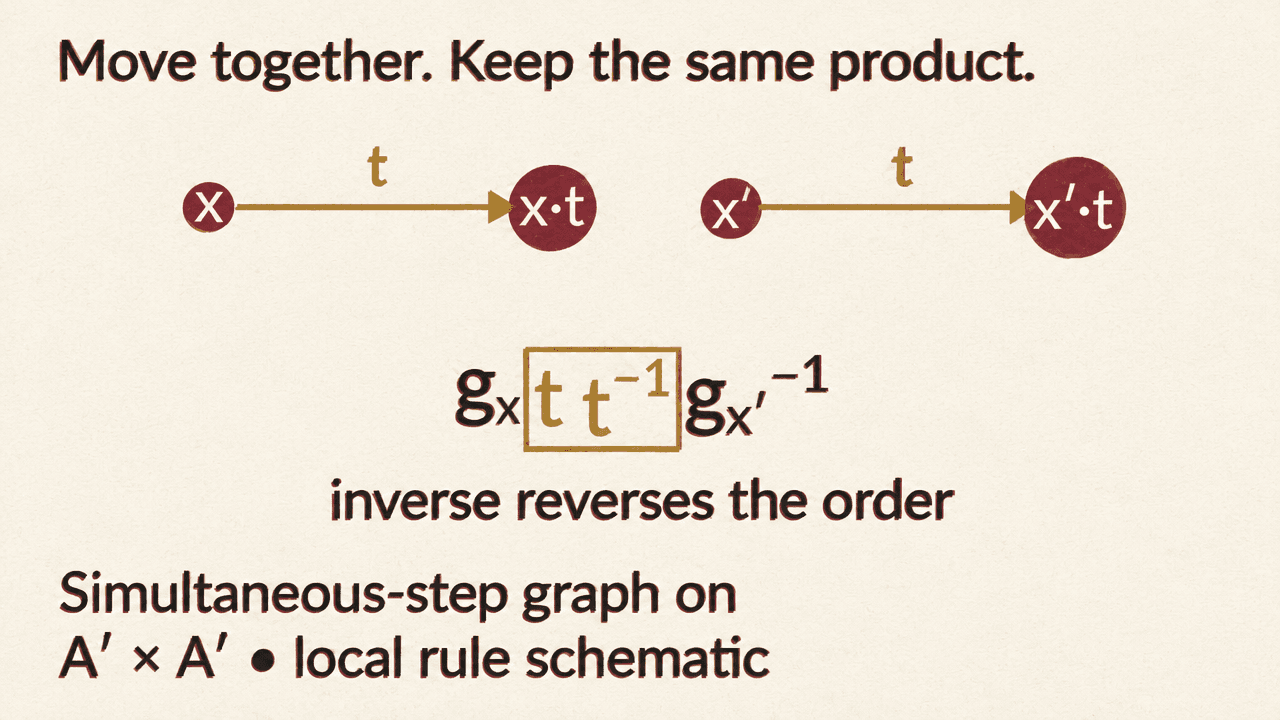
To analyze ab, consider pairs of vertices (x, x′) in the first root component. Join a pair by an edge for each outgoing label t shared by x and x′. Reverse traversal is the same edge; distinct steps with the same endpoints remain distinct edges. The term associated with the pair is gₓgₓ′⁻¹. After both paths take the shared step, their labels acquire t on the right. In the product, the new t and t⁻¹ cancel. The term is therefore unchanged along every edge, and hence throughout each connected component of this simultaneous-step graph.
The degree of a pair is the number of outgoing labels shared by its two vertices. This turns the algebraic question—how many copies of a group element occur in a product—into a parity question about finite graph components.
One even-degree exception leaves the identity
In any finite graph, the sum of vertex degrees is twice the number of edges. So the number of odd-degree vertices is even. In particular, a component in which every vertex has odd degree has even size. Since coefficients are in F₂, equal algebraic terms contributed by such a component cancel in pairs.
The label design makes the root paired with itself the single even-degree exception in the simultaneous-step graph for ab. Its component has an even number of other vertices and therefore odd total size. The term is constant across the component, and at the root paired with itself it is the identity. An odd number of copies leaves one: ab = 1.
For the graph used to analyze ac, every degree is odd, so the components contribute even numbers of each term and cancel. Thus ac = 0. A separate root-protection property ensures that no other vertex in the second root component has identity path label. The identity coefficient in c is consequently one, so c ≠ 0.
The degree pattern comes from a specific finite incidence design. Ordinary outgoing labels are based on lines in the projective plane over the field of size 128. Each line has 129 points, and two different lines intersect in one point: both counts are odd. Seven additional labels come from the points of the Fano plane. The complement of a three-point line has four points, and two different such complements share two points. Ordinary vertices receive either one such complement or no extra labels; only the distinguished root in the first graph receives all seven. The added intersections are even except when that root is paired with itself, where the degree is 129 plus seven, or 136. Label counts are also balanced against their inverses so the steps can be matched by bijections.
Random matchings and topology supply the required roots
The parity calculation does not, by itself, guarantee root protection or torsion-freeness. Those properties depend on the manuscript’s deeper existence argument.
The manuscript chooses random label matchings while requiring that cycles shorter than a growing girth scale be absent. It estimates the likelihood of path systems with too few unmatched positions. The comparisons involve disjoint intervals of equal length whose label words agree, or agree after reversal and inversion. Paired positions must traverse distinct underlying graph edges: repeated traversals of one edge cannot be treated as independent random events.
The constraints keep the estimate valid as the graphs grow. In particular, the allowed unmatched fraction is fixed before the bounds on path counts, total length, and number of comparisons; total length must reach the girth scale. The graph-size threshold can depend on those bounds. Under these conditions, systems with too few unmatched positions become arbitrarily unlikely.
The remaining argument uses bounded component diameter to close paths, then planar separation to extract a bounded system from any reduced spherical arrangement, however large. Cone surgeries remove pairings that traverse the same underlying edge. Excluding the remaining arrangements yields root protection and a finite two-dimensional complex with contractible universal cover. The manuscript invokes standard topological consequences to obtain a finitely presented, torsion-free group.
The construction establishes existence by selecting a finite matching outcome; it does not print the edge list for that witness. The explainer’s diagrams are schematic, and its stated checks cover the displayed combinatorics and cancellations, not a full formal reproduction of the theorem.