A Torsion-Free Group Algebra Contains Zero Divisors Over F₂
An OpenAI manuscript dated September 2026 claims a counterexample to Kaplansky’s Zero Divisor Conjecture, constructing a finitely presented torsion-free group whose group algebra over the two-element field contains nonzero elements with product zero. The construction uses parity in a graph-based argument to force cancellation; separate random and topological arguments are used to keep both elements nonzero and establish that the group is torsion-free.
The counterexample separates cancellation from torsion
An OpenAI manuscript dated September 2026 claims a counterexample to Kaplansky’s Zero Divisor Conjecture: a torsion-free group G and two nonzero elements of F₂[G] whose product is zero.† Here F₂ is the field with two elements. The conjecture says that for a torsion-free group, such zero divisors should not occur over any field.
The construction has to do three things at once: make the product cancel, keep each factor nonzero, and ensure the group has no nonidentity element of finite order. A graph-based parity argument handles the cancellation. Separate existence and topology arguments are needed to keep the factors nonzero and establish torsion-freeness.
In a group algebra, elements are finite formal sums of group elements. Multiplication expands the sums using the group law, preserving the order of factors. If a group element g has finite order m greater than one, then (1 − g)(1 + g + ⋯ + gᵐ⁻¹) = 1 − gᵐ = 0. Both factors are nonzero. Torsion-free means that no nonidentity element returns to the identity after a positive number of powers. The conjecture asserts that removing this familiar finite-order obstruction is enough. The manuscript’s proposed example is designed to show otherwise.
Shared labels make every graph component cancel
The two factors are assembled from paths in two finite, directed, letter-labeled graphs. Reversing an edge inverts its label, and no outgoing letter appears twice at the same vertex. Each graph has a root.
The construction attaches a cone over every connected component to a common graph of generators. This makes every closed path in either graph represent the identity in the resulting group. Consequently, the word read along a path from a root to a vertex is independent of the path chosen. Write these group elements as gₓ for vertices x in the first graph and hᵧ for vertices y in the second.
Take the full component of each root, not a selected subset of vertices, and define α as the sum of all gₓ and β as the sum of all hᵧ⁻¹, with each sum over its respective root component. Expanding their product gives one term gₓhᵧ⁻¹ for every vertex pair (x, y).
Now form a graph whose vertices are those pairs. Join (x, y) to (x′, y′) when both original graphs take a step with the same letter t. Along that simultaneous step, the path labels change from gₓ, hᵧ to gₓt, hᵧt. Since inversion reverses multiplication order, the new term is gₓt(hᵧt)⁻¹ = gₓtt⁻¹hᵧ⁻¹ = gₓhᵧ⁻¹. The term contributed by a pair therefore stays unchanged along every edge, and is constant throughout each connected component of the pair graph.
The vertex types are chosen so every pair shares an odd number of outgoing letters. Keeping full components ensures that every shared letter gives an edge in the pair graph, so every vertex has odd degree. In any finite component, the sum of the degrees is 2|E|, hence even. A sum of odd degrees can be even only if the component has an even number of vertices.
All vertices in that component contribute the same group element to αβ. Over F₂, an even number of identical terms sums to zero. Every component therefore contributes zero, and αβ = 0. The argument does not require distinct components to have distinct labels.
Finite geometry supplies the required odd overlaps
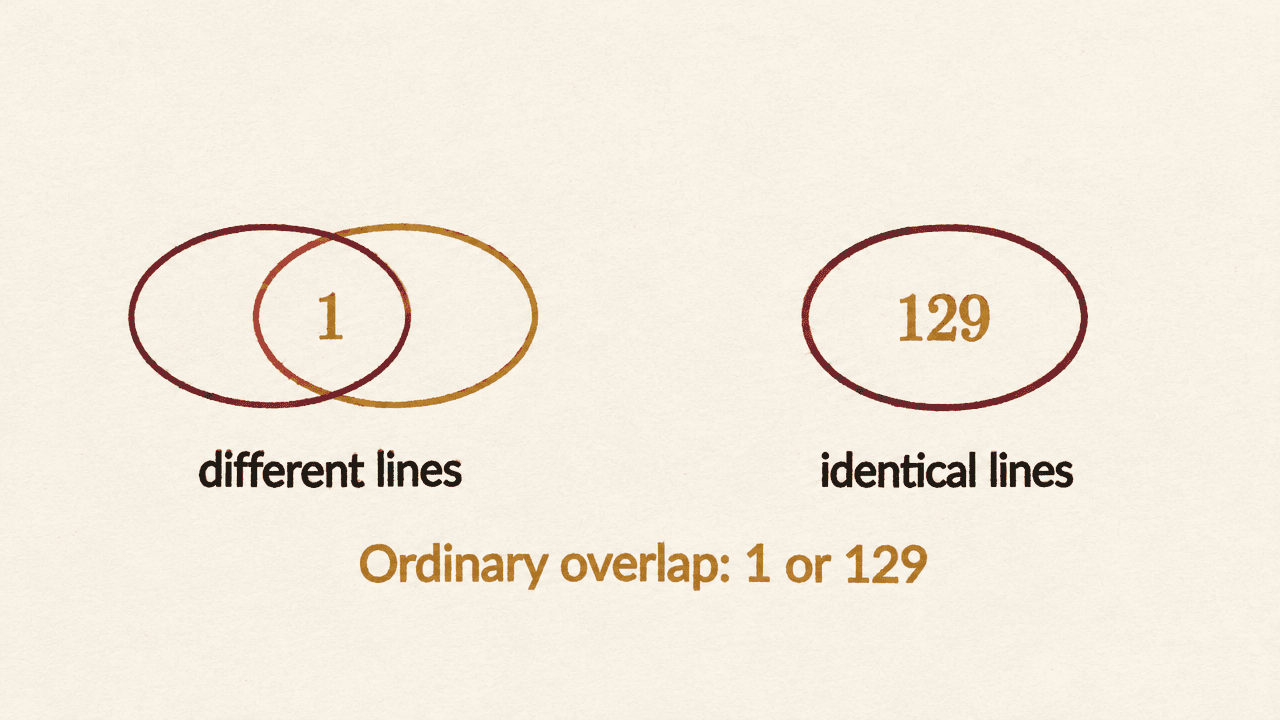
The graph types are built using a finite projective plane over a field of size 128. Its q² + q + 1 = 16,513 points become ordinary letters. Each line contains q + 1 = 129 points, and each vertex receives the letters belonging to a line.
Two different lines share one point; identical lines share 129. Either intersection has odd size. The construction adds three more letters, u, v, and w: a vertex in the first graph receives either none or any pair, while a vertex in the second receives either none or all three. Their extra overlap is therefore zero or two. Adding an even number preserves the odd intersection count.
The prescribed type frequencies also balance each letter with its inverse, allowing the graph edges to be matched. The incidence relationships are schematic; they are not the sampled graphs used in the construction.
Random estimates and topology protect different parts of the construction
Parity alone does not ensure a counterexample. The quotient could collapse a factor to zero or introduce torsion. The manuscript’s random-matching estimates address the first risk by controlling path systems that could undermine separation of the root from other vertices. It chooses random matchings while preserving the prescribed vertex types, conditioned on the absence of short cycles.
For long words, a word-weight estimate bounds the sum of squared weights by an exponentially decreasing quantity. That estimate is used to exclude certain nearly completely paired path systems. Repeated traversals of an edge are tracked through multiplicity stages—that is, the estimates keep track of how often an edge is traversed rather than treating repeated uses as independent random events.
The existence argument fixes its bounds in sequence: first an allowed fraction of unpaired positions, then limits on the number, length, and comparisons of paths, and only afterward a growing graph size. The manuscript argues that suitable finite matchings exist; it does not display a particular matching.
A separate planar-separation argument connects these bounded path estimates to the safeguards the construction needs. Root separation means that the root’s label is not shared by another vertex in its component, so the root can supply the identity coefficient without cancellation from other vertices. An essential sphere is a sphere in the complex that cannot be removed by the relevant cone-picture surgery; the manuscript uses the same path-system estimates to rule out this topological obstruction.
The bridge is that an obstruction could involve an arbitrarily large spherical arrangement. The manuscript shows that any reduced arrangement of this kind contains a forbidden bounded path system. Long paths are split and closed with controlled extra length, and planar separators leave a bounded cluster after discarding only a controlled portion. Cone-picture surgery then turns either a failure of root separation or an essential sphere into one of the forbidden arrangements. Excluding those arrangements gives root separation and removes the obstruction to the topology needed for the construction.
Root separation ensures that only the root contributes the identity in each factor, with coefficient 1. Thus α and β are nonzero, without requiring all other vertex labels to be distinct. Separately, the universal cover of the resulting finite two-dimensional complex is contractible; the manuscript’s finite-dimensional cohomology argument then rules out torsion. This cohomology step is distinct from the random estimates and planar separation: it is the argument that turns the contractible universal cover into torsion-freeness.
The claimed result is a finitely presented torsion-free group with a finite two-dimensional classifying space, together with nonzero α and β in F₂[G] satisfying αβ = 0. A Lean proof is supplied upstream, but a full formal reproduction was not run. Executable checks cover the local algebra and finite-geometry data, not the entire theorem.