A Three-Dimensional Tile Exists Without Any Fully Periodic Tiling
An OpenAI manuscript argues that a finite tile can cover the three-dimensional integer lattice by translations while admitting no fully periodic tiling. It builds the example from an arithmetic array that satisfies specified line constraints but cannot repeat vertically, then encodes those constraints in a tile so that any fully periodic spatial tiling would imply a forbidden period in the array.
The counterexample must exclude every fully periodic tiling
A finite tile can cover the three-dimensional integer lattice by translations without admitting any fully periodic arrangement. That is the claim of the September 2026 OpenAI manuscript, A translational tile with no fully periodic tiling in dimension three†. Here a tiling uses translations only, and “fully periodic” means the translation set repeats under a finite-index subgroup, giving three independent lattice periods.
The distinction matters: it is not enough to exhibit one non-repeating arrangement. The tile must admit an exact tiling and rule out every fully periodic one. The proof establishes those two sides by different routes. An explicit arithmetic array supplies the model for existence; a no-period argument for such arrays supplies the obstruction. The rest of the construction carries that obstruction into a tile in space.
The array constraints allow an example but rule out vertical repetition
The manuscript begins with an infinite array, not a geometric shape. Choose a prime (p>200). The array has (p^2) columns, infinitely many rows, and symbols from 1 through (p-1). Its constraint is imposed along every integer-slope line: the symbols on the line must form a word allowed by a rule based on the first nonzero of two base-(p) digits of an affine expression. If both digits are zero, any nonzero symbol is allowed.
A concrete array shows that these constraints can be met. Define (f(t)), for nonzero (t), by removing all factors of (p) and reducing the result modulo (p); set (f(0)=1). Fill row (m) with (f(m)). For (p=211), for example, (f(211)=1), (f(422)=2), and (f(-211)=210). Along a line, entries have the form (f(dn+e)). Removing the largest common power of (p) from (d) and (e) leaves coefficients not both divisible by (p), which witness that the line’s word satisfies the rule. The zero line is constantly 1 and is allowed. Every column contains both (f(1)=1) and (f(2)=2), so the array’s columns are nonconstant.
The obstruction is that no admissible array with nonconstant columns can have a vertical period. The paper’s affine approximation says that, at positions where (An+Bm+C) is nonzero modulo (p), the array’s symbol equals that affine expression. This gives a way to compare entries after a proposed vertical shift: nonconstant columns force (B\ne0), so the expression changes with the row. If a positive shift (M) were a period, one can choose a row residue where the affine expression is nonzero both before and after the shift; at most two residues are excluded. Periodicity makes the entries equal, so subtracting the affine expressions gives (BM\equiv0\pmod p). Since (p) is prime and (B\ne0), (p\mid M).
That divisibility does not yet rule out a period. The second move is a descent. Take the smallest positive period possible among admissible arrays with nonconstant columns, normalize the affine expression by shifting columns, and retain every (p)th row. The line constraint survives this subsampling: a line in the new array corresponds to a line in the old one. Nonconstant columns require an additional argument, because selecting every (p)th row could in principle make a column constant. The manuscript’s second-digit rule shows that such a failure would force (p-1) distinct nonzero values to equal one fixed symbol. The subsampled array therefore retains nonconstant columns and has period (M/p), contradicting the choice of (M).
A common translation set carries the obstruction into a tile
To turn the array obstruction into a tile, the manuscript encodes the array constraints as a family of tiling equations. Each word position becomes a function whose inputs represent symbol choices. A symbol is active when changing its input can change the output; the equations exclude forbidden combinations of active symbols. Further constraints force activity, and two seed channels ensure that symbols 1 and 2 occur in every extracted column. Importantly, all the equations must be satisfied by one common translation set. Separate solutions would not let a periodic spatial tiling decode into the single array needed for the contradiction.
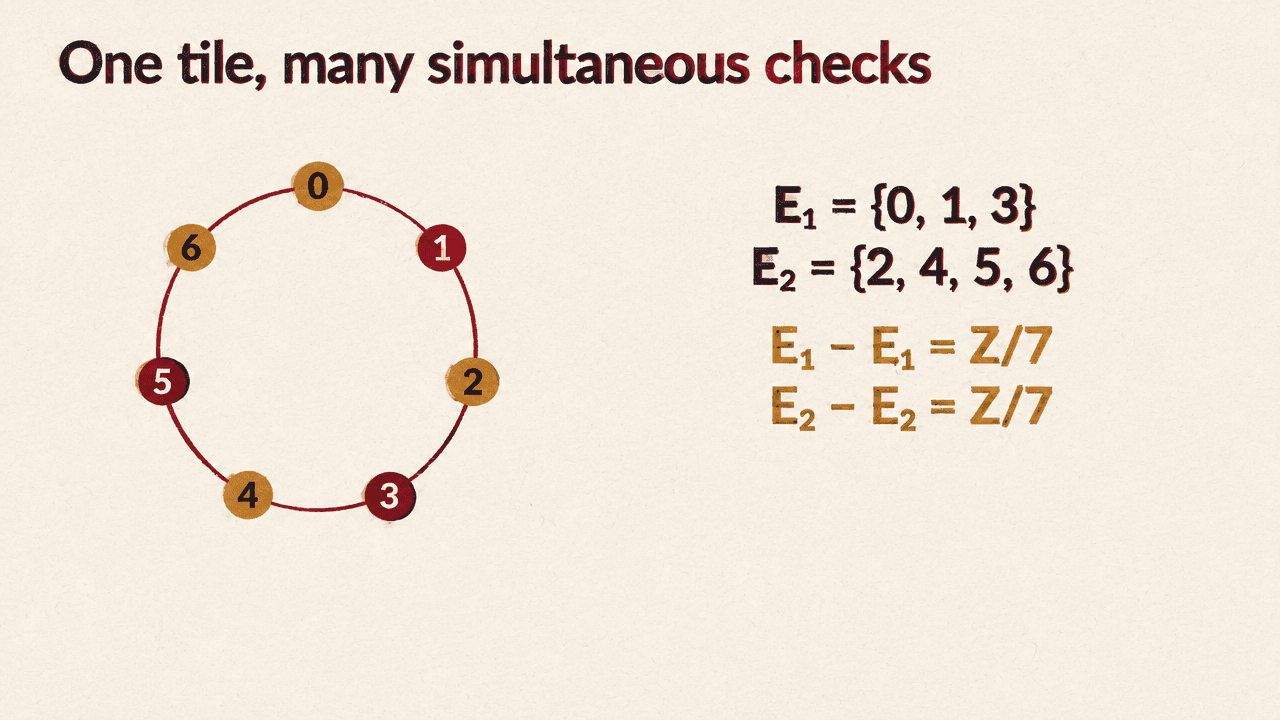
A stacking construction combines the equations into one tile. It uses color classes in a fresh prime cycle, each arranged so every possible difference occurs within that class. Consequently, two translates of the same class intersect, limiting how many contributions of that color an exact tiling can place in a fiber. Since the class sizes together cover the fiber, exact coverage requires one contribution of every color. Projection then yields one translation set satisfying all the original equations. Pairwise coprime cyclic factors keep the finite coordinate cyclic, producing a tile in two integer directions and one finite cyclic direction.
The step from this finite coordinate to an integer coordinate is essential to the claim about Euclidean tilings. Simply thickening lattice points into cubes would not control arbitrary real translation vectors. The construction instead makes two component shapes with a large common part, differing in the position of one marked cube, displaced by (m w), where (w=(0,0,Q)) and (m) is a chosen integer scale.
In a hypothetical fully periodic tiling, the shared portion of the two components constrains how their centers can be displaced: overlap rules out incorrect nearby offsets. A periodic volume argument then forces all component centers onto one translated grid with spacing (m). This rigidity step is what makes the next count possible. Once the centers lie on that grid, each marked cell can be accounted for by grid sites, rather than by arbitrary real translates.
Let (b(a)=1) when grid site (a) uses the moved component, and (b(a)=0) when it uses the unmoved one. At the marked cell for (a), the unmoved component contributes (1-b(a)), while a moved component from (a-w) contributes (b(a-w)). The residue structure excludes other contributions. Exact coverage therefore gives (1-b(a)+b(a-w)=1), forcing (b(a)=b(a-w)). The selected sites are invariant under the quotient kernel, so the tiling descends to the finite cyclic coordinate while retaining full periodicity.
The contradiction now runs backward: a fully periodic spatial tiling would produce a fully periodic common solution to the equations, and that solution would yield a forbidden vertical period in the array. In the forward direction, the explicit array and subsequent constructions supply the tile. The manuscript claims that its tile covers (\mathbb Z^3) by translations, while its unit-cube thickening tiles (\mathbb R^3) up to null sets without a fully periodic tiling, even with arbitrary real shifts. The result rules out full periodicity, not every individual period, and does not assert connectedness. The explainer says its examples were checked but that it did not reproduce the complete formal proof.