Triple Ergodic Averages Converge to a Product of Means
An OpenAI preprint claims that for any three distinct, nonzero integer slopes, averages of three bounded measurable functions along the same orbit of an invertible, probability-preserving mixing system converge almost everywhere to the product of their means. The result holds along every positive integer length, not only along a selected subsequence. Coefficient identities let the authors extend the argument beyond equally spaced slopes, while analytic estimates control oscillation and establish convergence.
Distinct slopes still average to a product of means
The manuscript, Triple ergodic averages with distinct integer slopes, claims that for a mixing system, three bounded measurable functions sampled along three distinct, nonzero integer slopes have a product-of-means limit for almost every starting point. The average runs over every positive integer length, not just a selected subsequence.
This is a long average along one orbit, not a claim that the three readings are independent at each step. Mixing means that two measurable events become asymptotically uncorrelated as the time separating them grows. The transformation must be invertible and preserve a probability measure; invertibility matters because a negative slope runs the orbit backward. No mixing rate or additional standardness condition is assumed. For each fixed choice of slopes and functions, the exceptional set of starting points has measure zero, and it may change when the functions change.
Arbitrary slopes require more than rescaling
The new case is not just the equally spaced case in different notation. Earlier companion work uses four coordinates: x, x plus t, x plus 2t, and x plus 3t, with x serving as a testing coordinate. Dividing the slopes by their greatest common divisor and replacing T by the corresponding power reduces the problem to primitive slopes. But a primitive configuration need not contain a pair whose difference is one.
For example, the slopes 0, 6, 10, and 15 have greatest common divisor one, yet none of their pairwise differences is one. Looking at only two coordinates can fail to recover integer time: requiring x and x plus 6t to be integers still permits t to equal 1/6.
Using all four coordinates resolves this example. Set y₀ = x, y₁ = x + 6t, y₂ = x + 10t, and y₃ = x + 15t. Then −y₀ + y₁ + y₂ − y₃ = t. The x terms cancel, and the coefficient of t is 6 + 10 − 15 = 1. Thus, if all four y values are integers, so is t. For general primitive slopes, Bézout’s identity supplies the needed integer combination.
A second identity cancels quadratic structure. For these slopes, the weights −6, 25, −27, and 8 sum to zero. Their weighted sums against the slopes and against the squared slopes are also zero. Consequently, the weighted sum of the four squared coordinates vanishes identically: the coefficients of x², xt, and t² each cancel. The table gives the slopes and their corresponding weights:
| Coordinate | Slope | Weight |
|---|---|---|
| y₀ | 0 | −6 |
| y₁ | 6 | 25 |
| y₂ | 10 | −27 |
| y₃ | 15 | 8 |
Lagrange interpolation supplies corresponding nonzero weights for any four distinct slopes. These identities are ingredients in the analysis, not the convergence proof by themselves.
The proof controls oscillation before identifying the limit
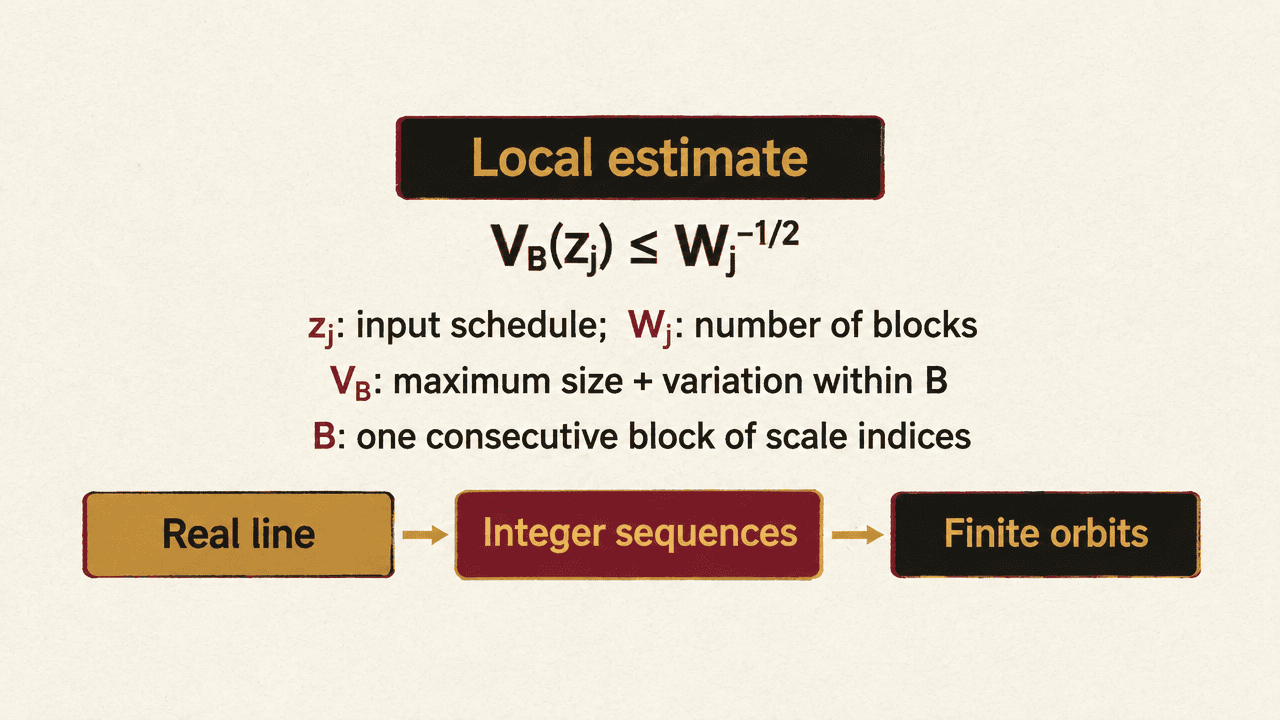
The technical argument extends harmonic analysis from companion results to the new coefficients. It combines quadratic localization, comparisons across short blocks of scales, and a separated-frequency counting estimate. A carefully divisible integer base keeps rational shifts on the required lattice, while the dimension losses must remain polynomial. Together, these estimates yield a local bound uniform over scales and input schedules, with block-wise size and variation controls. The paper transfers that bound from functions on the line to integer sequences and then to finite pieces of orbits, producing an oscillation bound for smooth averages.
To see how oscillation control forces convergence, let Zₖ be a smooth average at scale 2ᵏ. Across w consecutive blocks of scale indices, the integrated sum of the largest within-block changes is bounded by a constant times the square root of w.
Suppose convergence failed on a set of positive measure d, where the tail continues to oscillate by more than twice some fixed positive δ. From any starting index, a later value must then differ from the starting value by more than δ. By monotone convergence, a sufficiently long finite block has integrated maximum change at least δ times d divided by 2. Repeating this over as many blocks as desired gives a lower bound growing linearly in w, contradicting the upper bound proportional to the square root of w. The smooth averages therefore converge almost everywhere. This argument controls persistent oscillation; it does not provide a mixing rate.
Mixing identifies the limit; approximation reaches every length
A separate norm-convergence argument, using a Hilbert-space van der Corput estimate, identifies the limit as the product of the means. That norm limit agrees with the almost-everywhere limit already established.
Smooth averages at powers of two are not yet the original averages at every positive integer length. To bridge the gap, the paper constructs signed smooth profiles close to interval indicators while preserving the required moment conditions. A countable family of profiles establishes convergence on increasingly fine rational grids between consecutive powers of two.
For terms bounded in absolute value by one, averages at lengths N and n differ by at most twice the gap between N and n, divided by n. Finer grids make that gap arbitrarily small, extending convergence to every positive integer length.
The result applies to three distinct, nonzero integer slopes, one invertible probability-preserving mixing transformation, and three bounded measurable functions. Its coefficient identities extend the argument beyond equally spaced clocks, including configurations with a clock running backward.