A C¹ Map Has Zero Entropy Despite Doubling Second Homology
An OpenAI preprint constructs a noninvertible C¹ map of a compact manifold with zero topological entropy but an eigenvalue of 2 in its action on second homology, contradicting the conjectured lower bound linking entropy to homological growth. The authors’ counterexample is specific: it applies in dimension at least five and does not settle the question for diffeomorphisms. Its construction uses delayed signals stored in finitely many registers to control orbit behavior while preserving the homological doubling.
The conjectured bound fails for a noninvertible C¹ map
The manuscript’s counterexample separates two kinds of growth. It constructs a continuously differentiable self-map of a compact smooth manifold without boundary whose topological entropy is zero, even though the map acts on second real homology with an eigenvalue of 2. In the manuscript’s terms, orbit complexity does not have to keep pace with homological growth.†
The distinction is between trajectories and cycles. Topological entropy measures how quickly the number of distinguishable orbit segments can grow: two starting points count as distinguishable if their first n iterates separate by more than a chosen tolerance at some step. Entropy captures the exponential growth rate of the largest such collection as the tolerance shrinks. Homology instead tracks the map’s action on topological cycles. An eigenvalue of 2 means that a nonzero homology class doubles under that induced linear map; it does not say that individual trajectories multiply or separate.
The proposed lower bound connects these measurements, asserting that topological entropy is at least the logarithm of the spectral radius of the induced homology map. The manuscript gives a counterexample in which the topological entropy is zero, while the homological spectral radius is at least 2.
The scope is specific. The manifold is a circle times one 2-sphere times a finite positive number q of additional 2-spheres, so its dimension is 2q+3, at least five. The eigenvalue occurs in second homology, an intermediate degree—not the first or top dimension. The map is noninvertible and only C¹, not infinitely differentiable; it does not settle the corresponding question for diffeomorphisms.
Registers anticipate delays while the orbit dynamics remain controlled
The construction combines a main sphere coordinate, a clock, and finitely many sphere-valued registers. Write the main sphere as the complex plane together with infinity. Its coordinate z usually updates by squaring. The clock runs modulo 100 and advances by at most one per update. The registers hold complex signals that are prepared earlier and read later.
A passage through the clock’s schedule resets the registers, inserts signals during a preparation window, may slow the clock near reading 50, and later reads the registers in narrow windows. These are clock readings, not elapsed times. Each readout window has width less than one clock unit, and the clock advances by exactly one there, so a register is read at most once per passage. Yet the windows collectively ensure a full-strength readout for every clock reading between 76 and 77.
The prediction must cover every possible delay
The clock may be delayed for arbitrarily many updates. Preparation must therefore anticipate every possible delay, not just a finite list. The manuscript uses an infinite series for this prediction, despite having only finitely many registers. Each term predicts a future clock reading and the direction of the repeatedly squared complex coordinate. Its amplitude decreases like L to the power 1−m, while its angular dependence winds increasingly fast.
Choosing L larger than both 2 and a uniform derivative bound for the prediction map makes the relevant derivative estimates sums of convergent geometric series. That is the stated route to continuous first derivatives. A finite truncation would not establish the construction for every possible delay.
The register must stay in its linear region
The readout argument also has to show that the registers really carry the intended signal. The register update includes a saturation map, so it is not enough to arrange cancellation algebraically while assuming the register remains in a linear regime. For a given readout at step j, there are at most five preparation contributions, each with magnitude at most one tenth. The manuscript bounds the register’s candidate value before readout by one half, keeping it inside the unit disk where the saturation map is exactly the identity. Induction then identifies this candidate with the actual register value.
At readout, the gain factors cancel: an input inserted at step i+1 undergoes exactly j−i−1 gains before the readout at j. This establishes the intended signal for that register up to its readout.
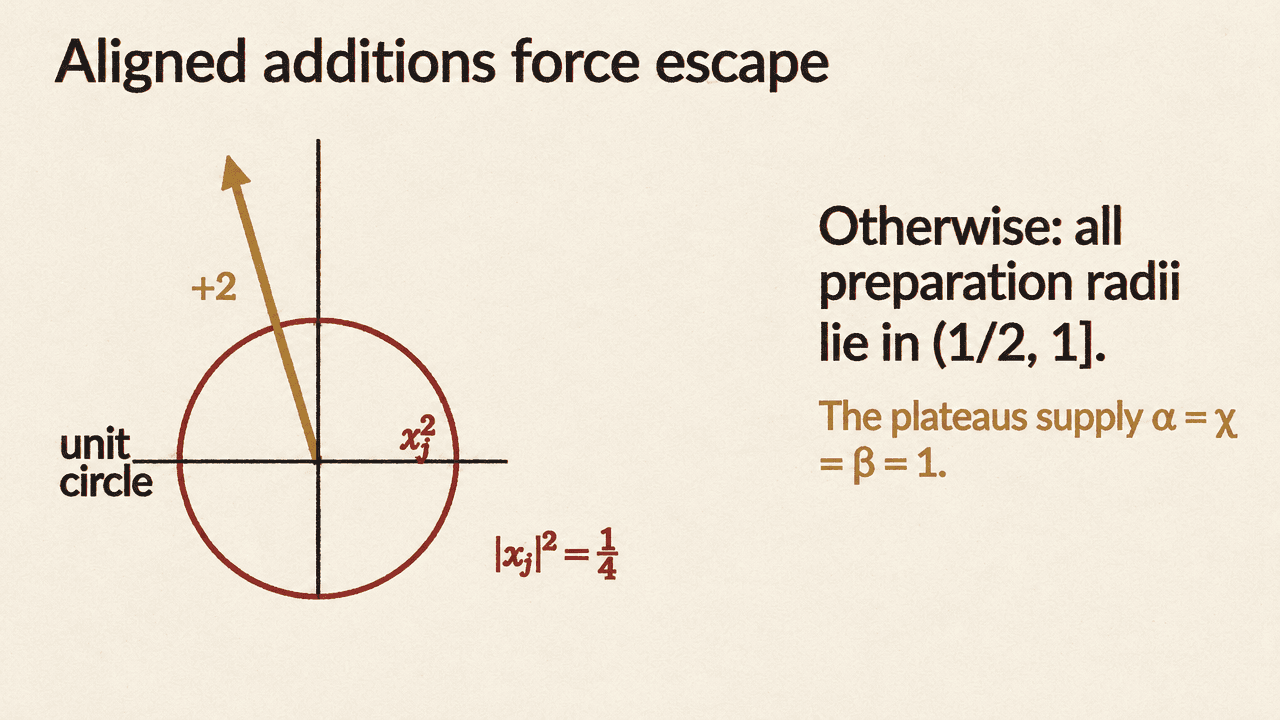
Aligned signals force the main coordinate outward
The stored signals are directed to align with the current square, so the added signal cannot cancel it. If the relevant radii have not already exceeded one, the preparation and readout plateaus provide a contribution of 2; even a squared radius of 1/4 then becomes 1/4+2=9/4. Once the radius exceeds one, subsequent squaring yields a lower bound growing as the initial radius raised to 2^r. The manuscript says this bound persists across later passages, so an orbit whose unwrapped clock is unbounded above has z tending to infinity.
Orbits approach simple invariant sets, limiting their complexity
The construction’s zero-entropy claim depends on accounting for all orbits, including those whose unwrapped clock remains bounded. In that case, the clock approaches 50 and z approaches zero; the registers need not approach zero. On this invariant set, the register angles stay fixed, and after the first image their radii follow a nondecreasing interval map. For an unbounded clock, z approaches infinity, a later reset leaves every register permanently zero, and the remaining clock motion repeats every 100 updates.
The manuscript states that every orbit approaches the union of these two compact invariant sets. Pointwise approach does not provide a common time by which all orbits have arrived near the union. To handle that gap, its entropy-localization argument controls the proportion of exceptional orbit blocks: among r blocks, the number of exceptional ones is bounded by τr+J, for any τ greater than zero and a finite J. It then bounds the number of orbit descriptions by a polynomial in n. Since the logarithm of polynomial growth divided by n tends to zero, the resulting topological entropy is zero.
A homotopy preserves the homology action, not the trajectories
The topology calculation uses a projection onto the main sphere. In that coordinate, the map has the form z ↦ z²+C(t,v), with the correction bounded by 60q. Continuously fading out the correction gives a homotopy to the squaring map, including at infinity. This preserves the induced homology map; it does not make the actual trajectories equivalent to those of squaring.
Squaring on the sphere has degree two: the value 1 has preimages 1 and −1, both with positive local orientation. The induced map on the sphere’s second homology therefore multiplies by 2. Let A denote the map’s action on the manifold’s second homology and P the map induced by projection to the main sphere. The homotopy gives PA=2P, and P is nonzero because the projection has a section. If A−2I were invertible, P(A−2I)=0 would force P=0, a contradiction. Thus 2 is an eigenvalue of A.
The separation rests on two different mechanisms: the orbit dynamics eventually reduce to sets with polynomially many orbit descriptions, while the induced action on a homology class retains the doubling of the sphere map. The manuscript’s all-delay prediction series and register estimates are part of the mathematical proof; the accompanying explainer says it presents the proof structure and checks the displayed local algebra, but does not independently reproduce the full formal development.